WILD FARM by Studio Milani + Arscape
studiomilani.eu + arscape.it
2025 Entries / 2025 Hospitality and Therapeutic / 2025 Landscape and Architecture / Italy / Built in 2021 /

A small and compact rural unit surrounded by woods, olive groves and the distant scent of the sea on the horizon: this is the context in which the renovation and extension of a small farm in the Volterra area is set.
The comparison with our territories—seemingly unchanged over time, yet in fact dynamic and constantly adapting to contemporary uses and habits—demands both great delicacy in the study of the traces handed down through the centuries and strength and clarity in the proposed design intervention.
Starting from the idea that we cannot find true harmony in merely concealing what we no longer are, the widespread and inevitable need today is to pursue formal research and visionary thinking—without renouncing them—while remaining within a realm of aesthetic sustainability that is untouched by passing fashions or the material formalism of technology.


Thus, the existing elements are not a constraint, but an opportunity for creation and the possibility of utopia.
The entire project comes to life from the subtle line between visible and invisible landscape, and from the interpretation of the history and agricultural and construction traditions of these places—through a continuous evocation of elements that are still present yet now vanished, hidden, or transformed in function and spatial location, such as water and submerged limestone rocks.
If the scattered rocks on the hill inspired the architecture, it was the action of water on the surrounding landscape that inspired the park.
The scattered stones become buildings: two new contemporary “stones” in travertine, prismatic in form, emerge beside the old structure and are connected to it through glass and Corten steel inserts. These serve as conduits for light, reflections, and visual focal points that open up toward the landscape, stirring curiosity for what lies beyond the horizon.
A sense of wonder is evoked by a nature that bursts forth in Leonardesque sunsets and horizons, glimpsed between the metaphysical forms of the two stone volumes—structures that capture and direct the wind, the light, and the gaze of those who move around them.
The three main buildings rest on a stone “carpet” that accommodates the swimming pool and takes on more organic forms shaped by the contour lines both upstream and downstream. They appear to float between rustic lawns and local gravel, like small caravels adrift at sea.
From the bow windows set into the travertine extensions, life inside the house is projected outward—creating, on one side, a visual and functional dialogue with the swimming pool, and on the other, an emotional connection with the surrounding field of olive trees and broom, and thus with the calm, productive history of the area.
As mentioned earlier, water played a key role in inspiring and defining the park—evoking its transformative power of erosion and the movement of sediment and seeds.
This agricultural garden facilitates the transition between the various zones of the property along the north–south axis and shapes a sinuous bank of pebbles, aligned with the lines of the aforementioned stone carpet.
The bank of pebbles and grasses expands into a beach-like area beside the pool, scattered with large, rounded rocks. From late winter through to the end of summer, it comes alive with changes in colour and scale along its curves. The variety is not limited to blossoms alone but also includes subtle shifts in the greens and greys of foliage, and in the density or ethereal lightness of the bushes.
In this evocative margin—suggestive of vanishing water and river erosion—clusters of broom and Buddleja shrubs highlight key elements: the visual axis leading to the structure’s largest room, and the Corten steel staircase that bridges the elevation between the house and the olive grove above.
On the opposite slope, the line of vegetation is interrupted by a retaining wall that manages the greatest difference in elevation between the house and the car park. This wall follows the course of two pedestrian paths—one leading to the swimming pool, the other toward the field of grasses and the orchard.
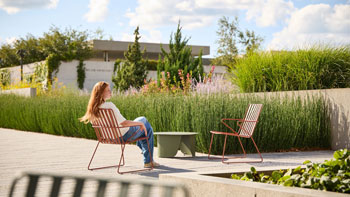
Evoking the presence of the sea, which can be sensed in the air and almost imagined on the horizon, the expanse of seagrasses shifts with the seasons and is visible from the residence’s living room—a natural backdrop stretching toward the coast.
Each plant element interacts with its neighbours in a rhythmic succession of blooms and withering, creating sculptural effects in constant motion.
The overall atmosphere is defined by a chromatic palette typical of the Volterra region, where inert materials range from the grey tones of exposed rock to the warmer hues of travertine and cultivated fields.
• All landscape architecture offices involved in the design of landscape:
Arscape
• All architecture offices involved in the design:
Studio Milani
• Other credits:
Big See architecture award 2024, winner for the category residential
Ulignano, Volterra (Pisa) Italy
61511


LILA 2026 Sponsor