Edinburgh Futures Institute
www.ironsidefarrar.com
2026 Campuses and Corporate / 2026 Landscape and Architecture / United Kingdom / Built in 2024 /

The Edinburgh Futures Institute (EFI) transforms the former Royal Infirmary of Edinburgh into an open, civic university campus where landscape and architecture work together to define a new public realm. Set within a UNESCO World Heritage Site, the project shifts a once enclosed and inward-looking institution into a connected and publicly accessible place. Central to this transformation is the role of landscape in shaping how the university of Edinburgh’s campus and its buildings are experienced, accessed, and understood.
The Category A listed building, reimagined by Bennetts Associates, is transformed through careful fabric restoration ,new pavilions, removal of unsympathetic extensions, and historic features reinstated. The landscape forges new connections between the historic fabric and the surrounding city, using topography, material continuity, and choreographed movement to provide a new circulation framework. In doing so, it creates a setting that is both legible and inviting, supporting the architecture while supporting the reshaping of how it is experienced.


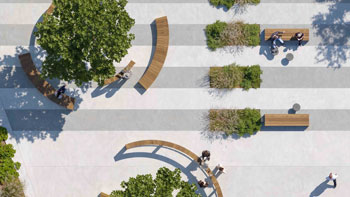
A key move is the creation of a new entrance plaza, which operates as both civic space and architectural roof. This hybrid condition resolves a complex sectional challenge, bridging between Lauriston Place and the building’s primary level while accommodating a large auditorium below. Here, landscape becomes structure and infrastructure: integrating drainage, access, and servicing into a unified surface. The pyramidal-graded paving, framed by lightwells, subtly manages water while meeting the architectural requirements of a flat roof, and giving the space a distinct civic character.
Across the site, landscape acts as connecting element. Former boundaries are opened up, and new routes link the building to Middle Meadow Walk, Bristo Square, and Quartermile. These connections are designed as spatial sequences rather than simple paths – moving through courtyards, lawns, and planted edges that frame views and create moments of pause. The result is a campus that feels continuous with the city.
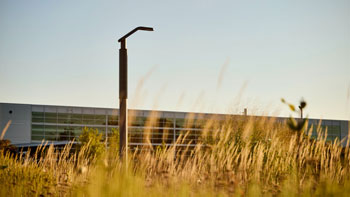
Topography plays a central role. A challenging 9-metre level change, over a short section, is reworked into a coherent and fully accessible landscape. Sloped paths, terraces, and planted embankments are combined to create a continuous terrain that supports movement while shaping the space. Along the northern edge, a sedum-planted embankment transforms a residual boundary into a multifunctional element (managing water, supporting biodiversity, and giving a clear green identity to the site). The northern boundary is part structure, part landscape. A suspended paving surface conceals continuous growing volumes that allow trees to thrive within a hard urban setting, while circulation and services are seamlessly integrated.
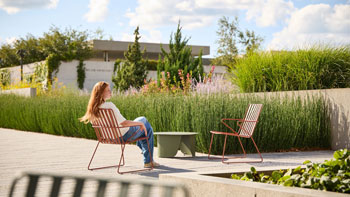
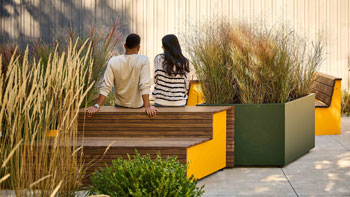
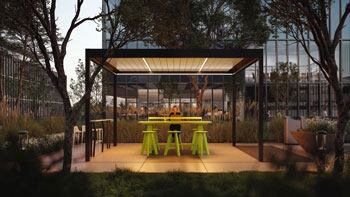
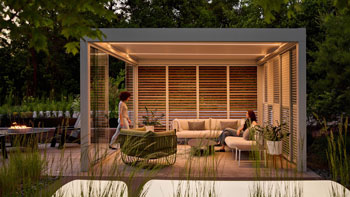
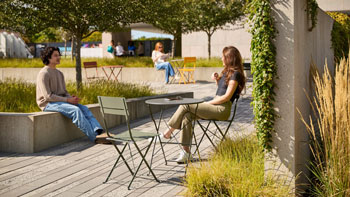
The courtyards reinterpret traditional quad spaces, turning previously inaccessible service yards into active, planted environments. These spaces bring light, greenery, and social life into the building. The historic architecture frames these landscapes, while the landscapes activate the building edges, supporting a range of uses from informal study to events.
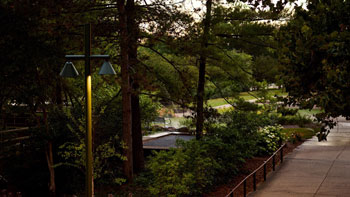
Material choices reinforce the connection between old and new. A restrained palette: stone, resin-bound gravel, and planting draws from the historic context while allowing for contemporary detailing. Environmental performance is embedded throughout. Mature trees (Middle Meadow Walk boundary) are retained and integrated as defining elements of the site, while new planting enhances biodiversity and improves microclimate. Permeable surfaces and vegetated systems manage rainwater naturally, reducing runoff and contributing to long-term resilience. The landscape works as both visible amenity and underlying infrastructure.
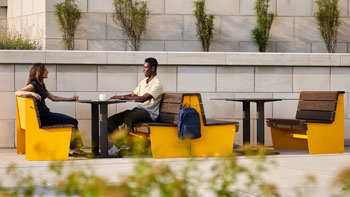
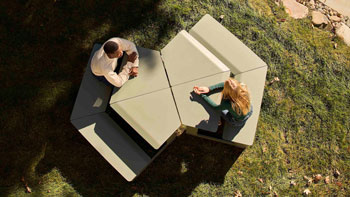
Importantly, the project creates a genuinely public place. The landscape supports everyday university life while also accommodating large-scale events, demonstrating a high degree of flexibility. It enables social interaction, supports wellbeing, and invites people in – students, staff, and the wider city alike.
EFI shows how landscape and architecture can work together to transform a complex historic site. Rather than treating the building as an isolated object, the project uses landscape to unlock its potential, connecting it physically, socially, and environmentally to the city. The result is an open, adaptable, and inclusive campus landscape where the relationship between building and city is central to its success.
Client: University of Edinburgh
Architect: Bennetts Associates
Landscape Architect: Ironside Farrar
Project Manager: Faithful & Gould / AtkinsRéalis
Conservation Architect: Consarc
Structural & Civil Engineer: Will Rudd Davidson
Services Engineer: Atkins
Fire Engineer: Atelier 10
Quantity Surveyor: Thomson Bethune
Enabling Works Contractor: Sir Robert McAlpine
Main Contractor: Balfour Beatty
55.944819395997555, -3.192708360088639
74257


LILA 2026 Sponsor