Field Operations
Special Mention by the LILA 2025 Jury
Hudson River Park’s Gansevoort Peninsula by Field Operations
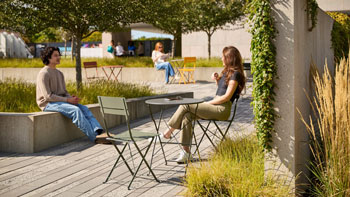
Gansevoort Peninsula exemplifies a sophisticated effort in programmatic stacking—a compositional strategy frequently employed in the design of American public parks in dense cities. The project assembles a complex sequence of functions: viewpoints, ecological zones, rain garden, an outdoor gym, a dog park, promenades, boardwalks, sports field, a beach, art installation, grove, and the obligatory nod to the picturesque. In dialogue with its flamboyant neighbor, Little Island, the Gansevoort Peninsula establishes itself as a rational, programme based group of high-resolution spaces, an urban interface for a long list of activities.
Amidst this surgically orchestrated layering, one particular zone destabilizes the otherwise expected typologies and ambiences. It is by the southern edge, where the Upland Sandy Bluff meets a sequence of descending hardscape platforms—both steps and terraces—that slide into the Hudson River, allowing visitors to engage directly with the water’s edge. This gesture produces a more abstract encounter. As the tide advances and recedes, water interacts with the horizontal planes, generating an ever-shifting dialogue between solidity and liquidity, stability and flux. Suspended above this tidal choreography is David Hammons’ Whitney-commissioned sculpture »Day’s End«, where the presence of the artwork underlines the absence of its artistic and historic references – a demolished warehouse that hosted Gordon Matta-Clark’s artwork of the same name. Its minimal geometry enhances the surrounding emptiness, allowing history, interpretation, and meaning to remain unresolved. In this moment, Gansevoort Peninsula transcends its functional inventory and opens into a space of heightened ambiguity—a site where natural processes, bodily presence, and cultural memory are held in delicate suspension.
Read MorePresidio Tunnel Tops transforms highway infrastructure into a new civic landscape that reconnects the historic Main Post of the Presidio to the San Francisco Bay. The fundamental design challenge was to dissolve a long-standing physical and perceptual barrier created by transportation infrastructure and open the Presidio to broader public access. Following decades of planning and […]
Read MoreComcast NBCUniversal Campus is a vibrant workplace environment designed to attract and retain top talent while supporting evolving ways of working. Through close collaboration across a multidisciplinary team, the project redefines the modern studio lot—drawing inspiration from Southern California’s ecological and cultural landscapes to restore a distinct sense of place and reinvigorate campus identity. The […]
Read MoreWaterfront Park transforms 1.5 miles of elevated viaduct highway into a new public promenade, with bike lanes, event piers, gardens, beaches, and new connections from downtown to Elliott Bay. With the removal of the aging Alaskan Way Viaduct and the reconstruction of the Elliott Bay Seawall, the city was poised to reclaim its waterfront. Set […]
Read MorePresidio Tunnel Tops reimagines a once-elevated highway into a vibrant, ecologically rich 14-acres of public space. Built atop 7 lanes of Presidio Parkway tunnels, the new landscape stitches together historic parklands with the San Francisco Bay and transforms infrastructure into an immersive experience, choreographing movement, topography, and ecology to create an open, accessible pedestrian connection […]
Read MoreAmazon’s second headquarters in Arlington, Virginia composes a highly sustainable campus that has transformed an underutilized urban space into a beloved neighborhood destination. Emphatically integrated within its context, the campus fosters collaboration and innovation for its employees as it enhances quality of life in surrounding communities. With a focus on social engagement and stewardship, Field […]
Read More

LILA 2026 Sponsor