Redevelopment of Bankbeekstraat Gullegem
greenconcepts.be/
2026 Public Projects / Belgium / Built in 2022 /

![The former Sint-Jans School in the centre of Moorsele has been fully depaved and transformed into a new green hotspot in the public realm: Sint-Jans Garden is born. The building that once housed the classrooms has been largely dismantled, leaving behind a pure, stripped-back structure. It now functions both as a piece of public art […]](https://landezine-award.com/wp-content/uploads/2026/04/73558_Hero-image_Sint-Jans-Garden-1-600x450.jpg "Sint-Jans Garden")
The project was originally commissioned under the title ‘Redevelopment of the Bankbeekstraat parking area’, through which the municipality of Wevelgem sought a design team. From the outset, it was clear to us that Bankbeekstraat held far greater potential—one that called for a broader, more integrated vision beyond the mere redesign of a parking facility.
From paved “motorway” to a climate-adaptive, green, and safe village street.
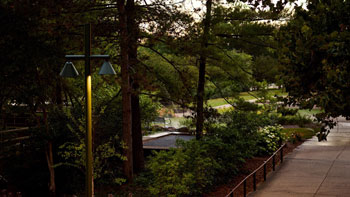
At the start of the assignment, Bankbeekstraat resembled many streets across Flanders: excessively wide and almost entirely paved. At its center, near the main entrance of the cemetery, lay a large parking area used predominantly during All Saints’ Day. For Greenconcepts, it was evident that the intervention should extend beyond the parking area to encompass the entire street. The ambition was to depave and transform the space into a climate-adaptive green street—one that accommodates parking while fostering tranquility, reflection, and spatial quality.
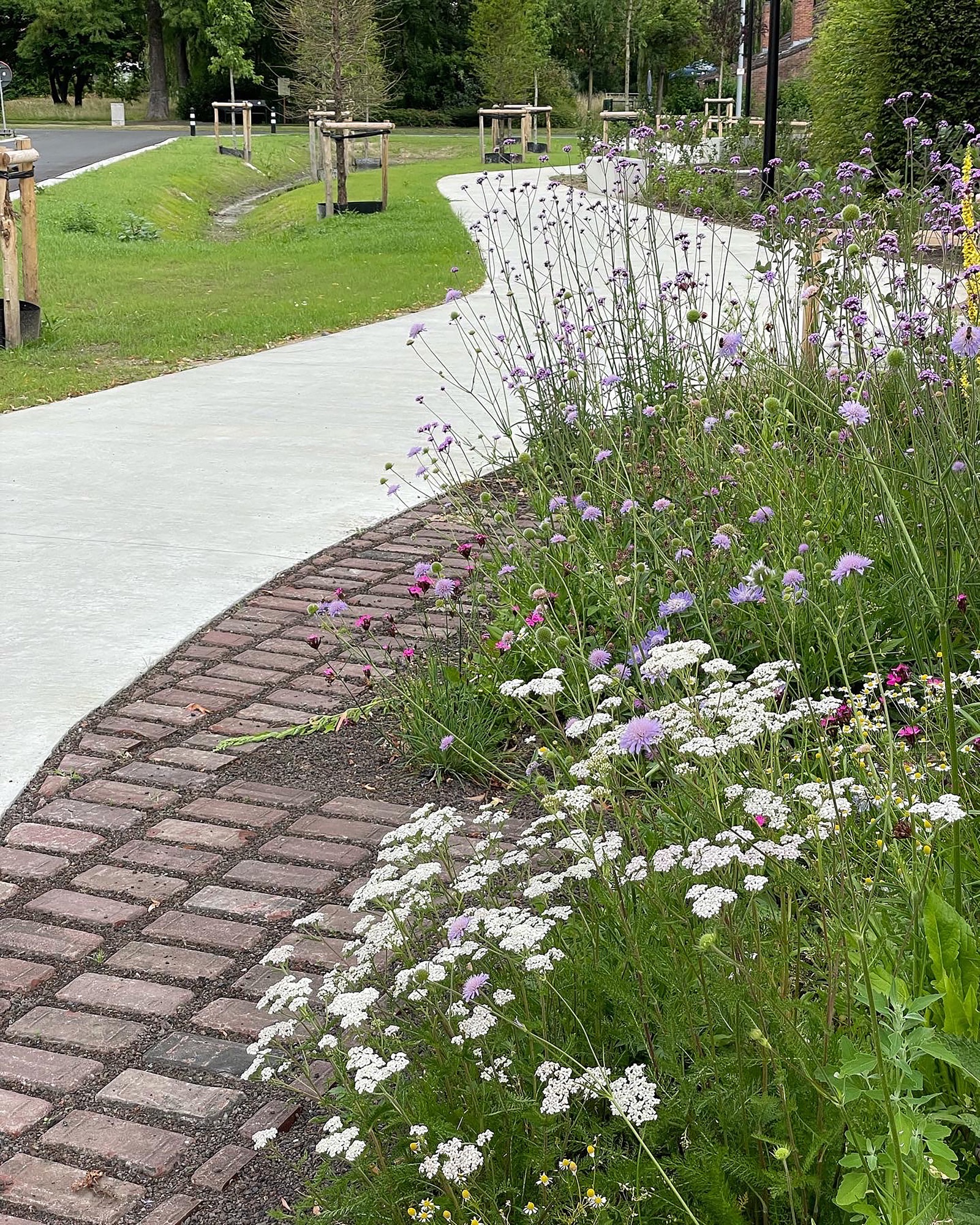
The street was significantly narrowed and reconfigured as a one-way street. By designating it simultaneously as a bicycle street, priority and safety for cyclists were enhanced. Pedestrians are guided along a gently winding path in brushed concrete, embedded within greenery and fully separated from vehicular traffic. This transformation has made the street considerably safer than ever before.
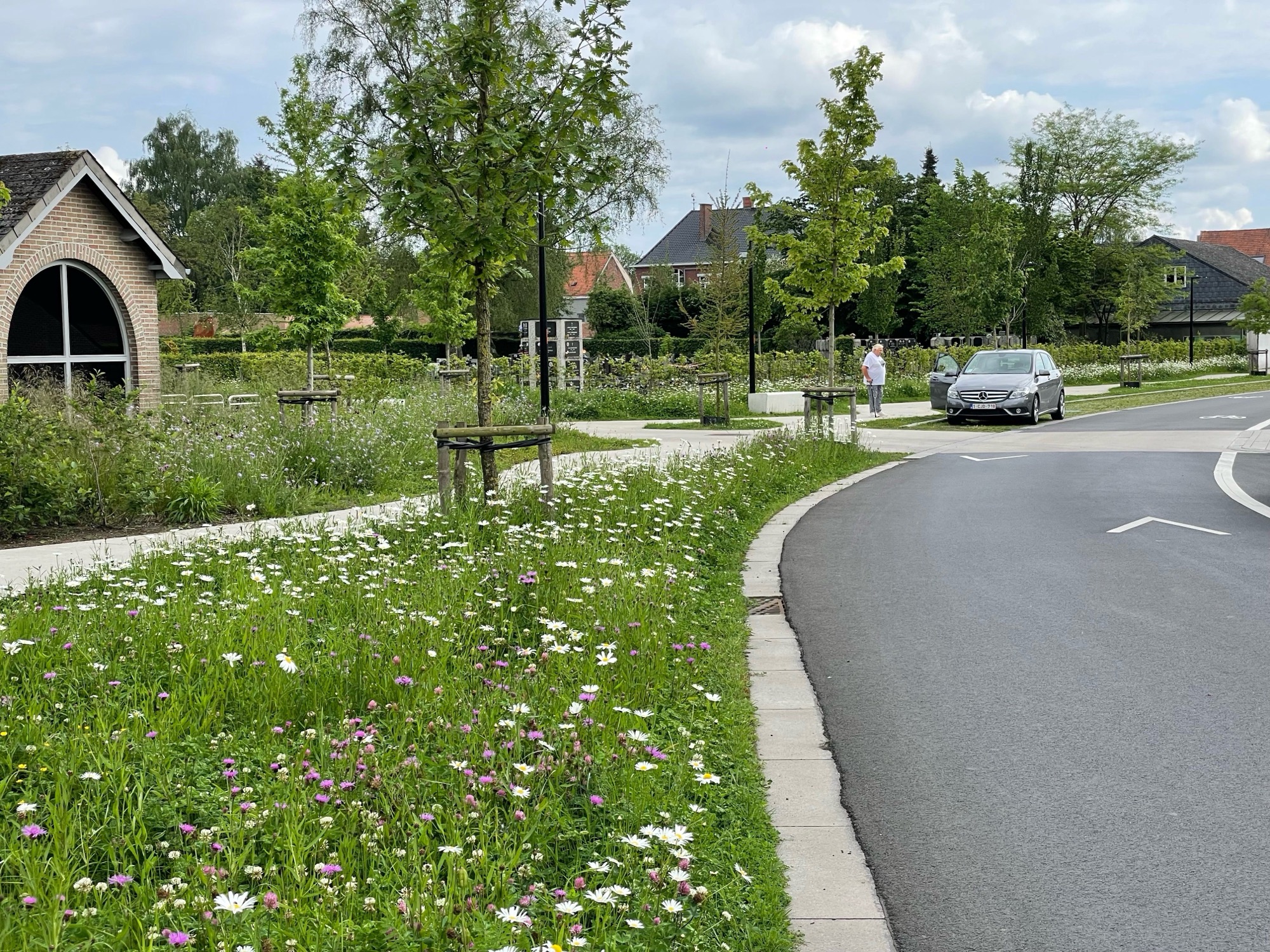
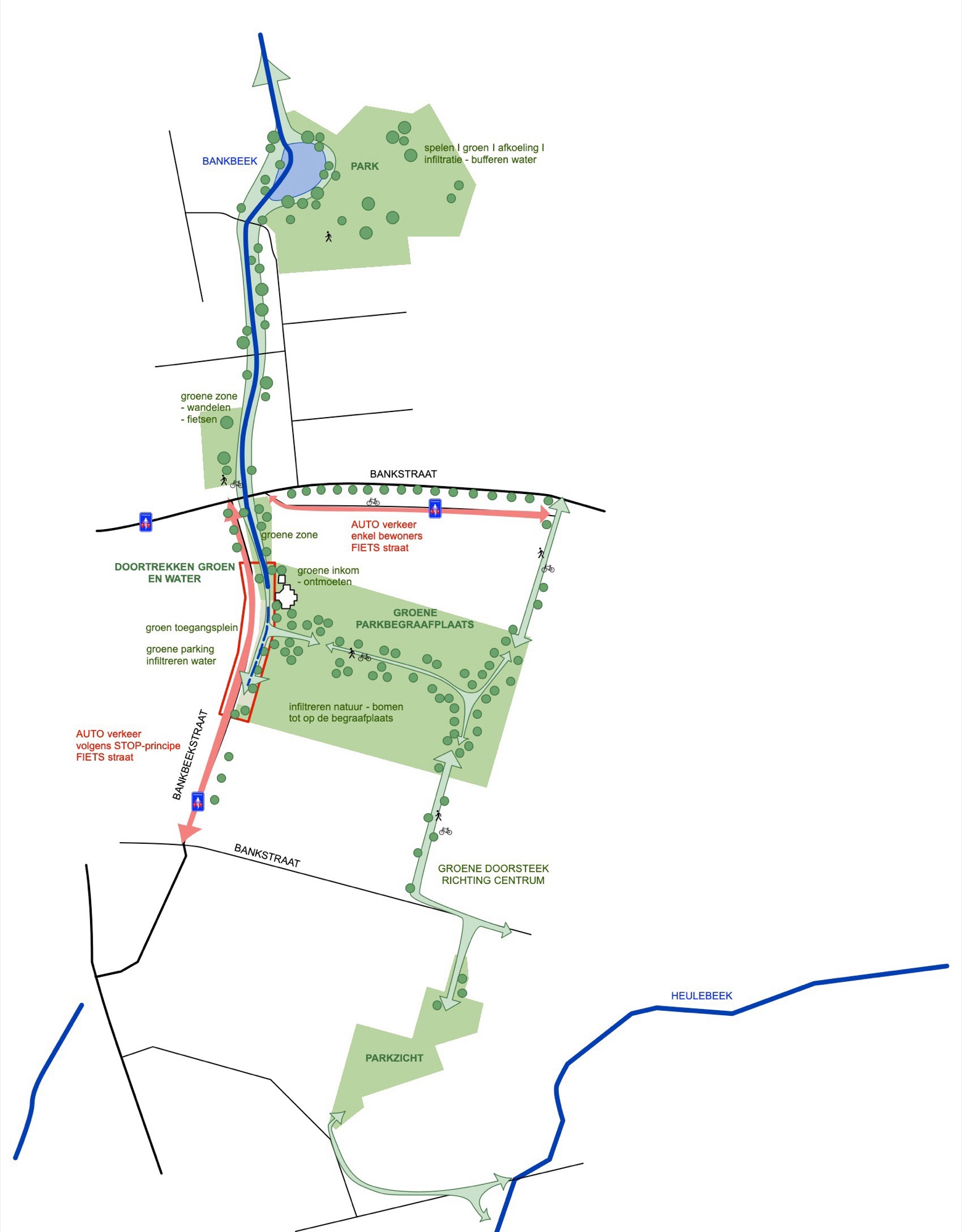
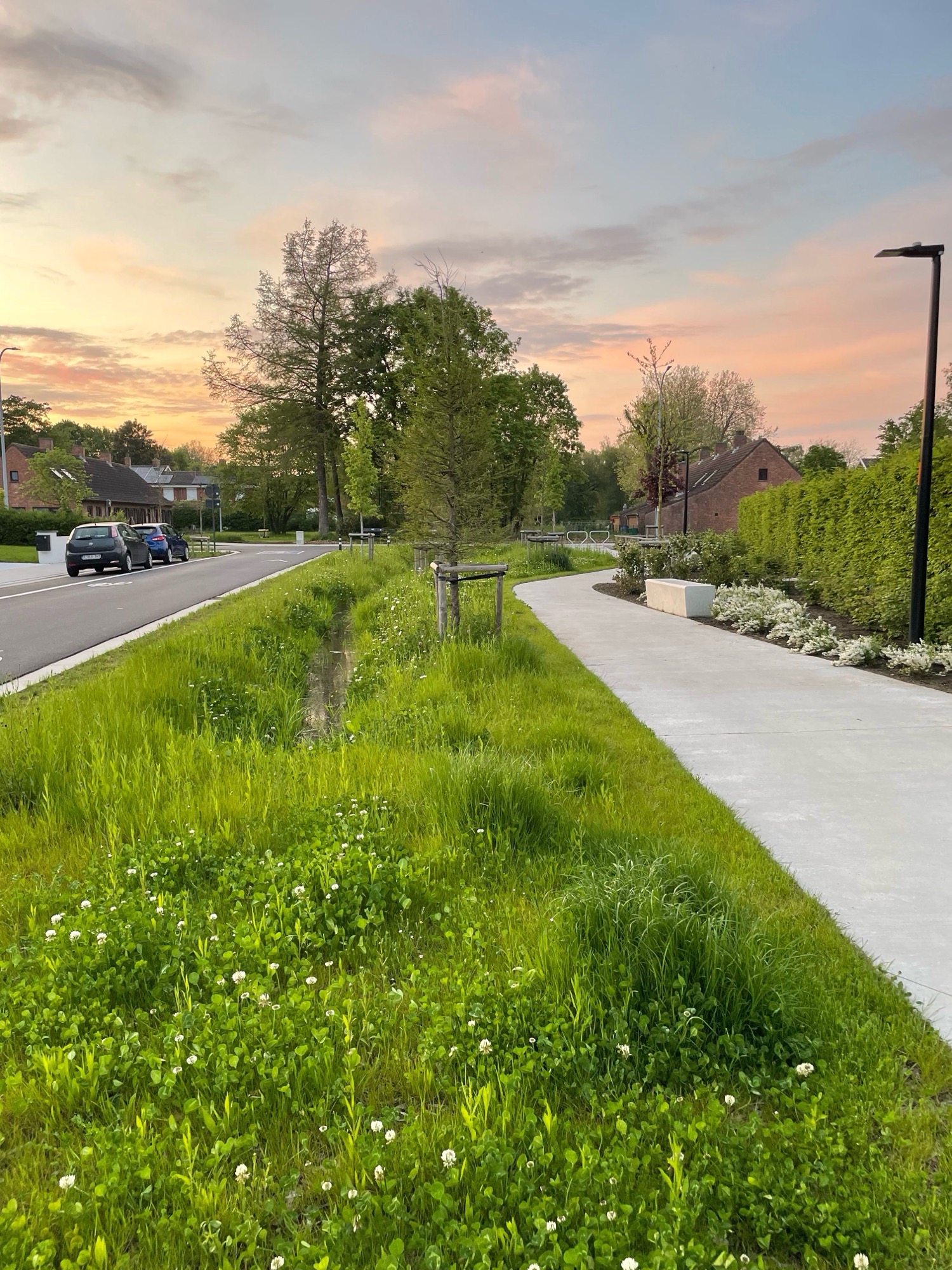
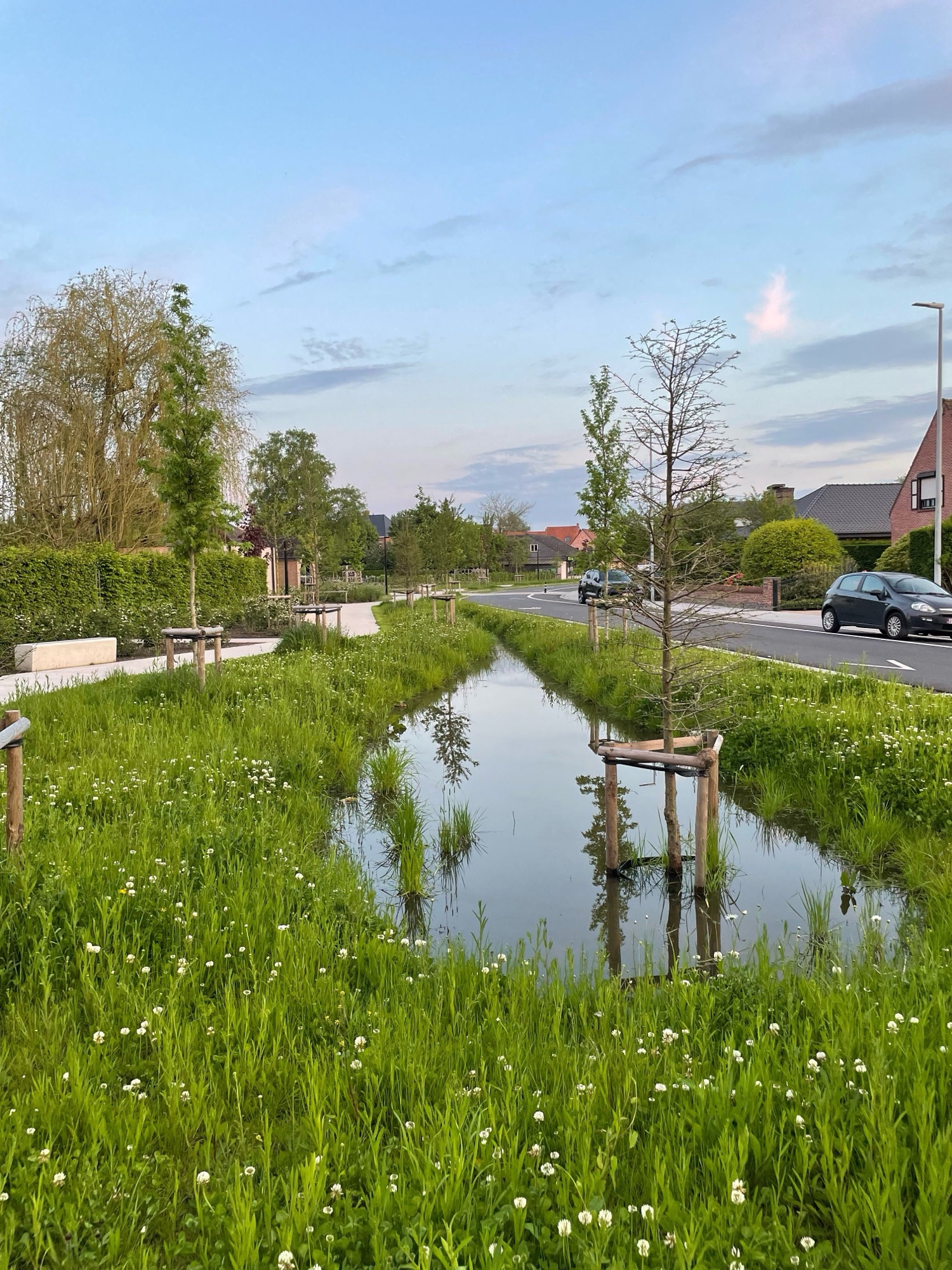
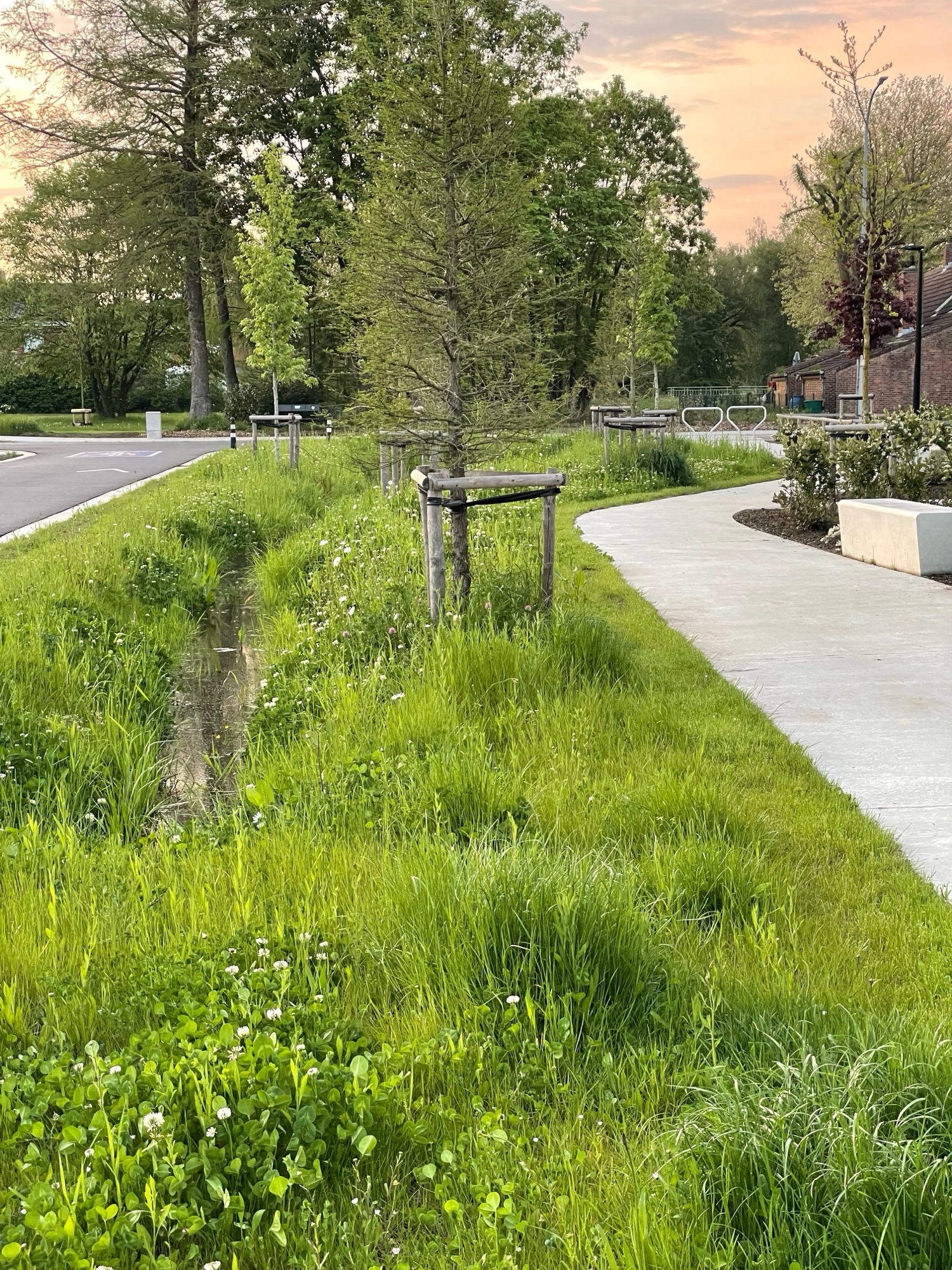
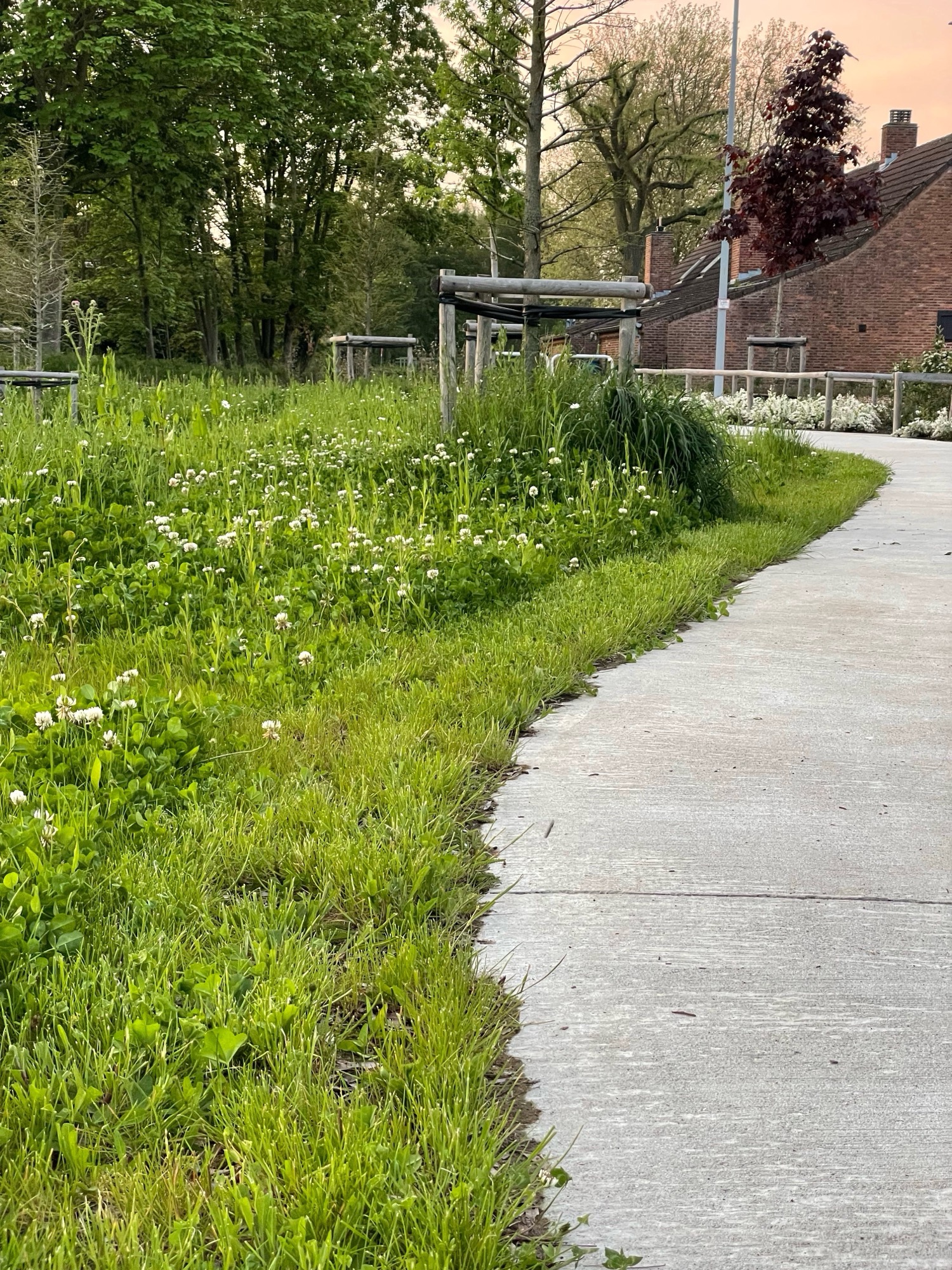
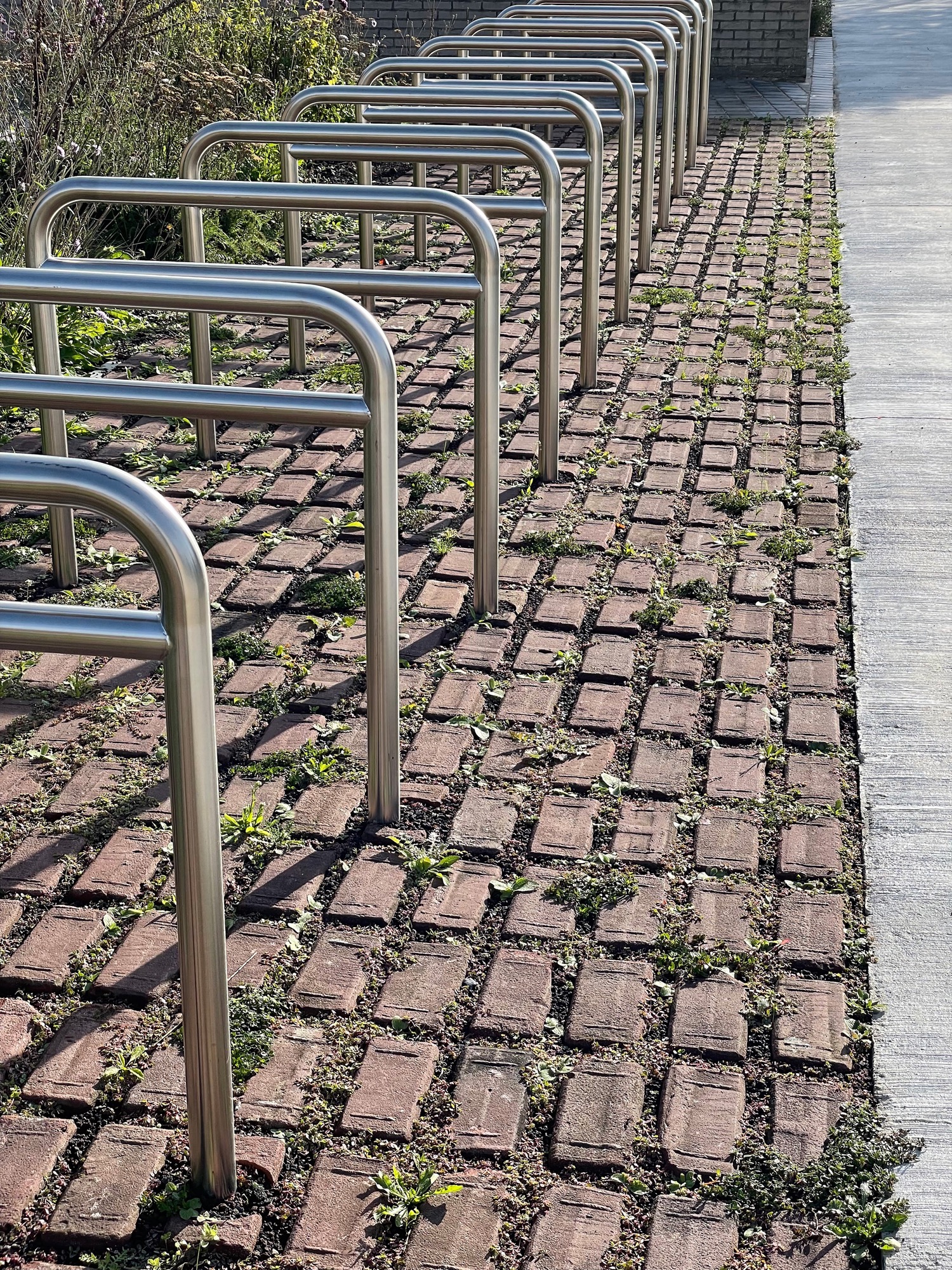
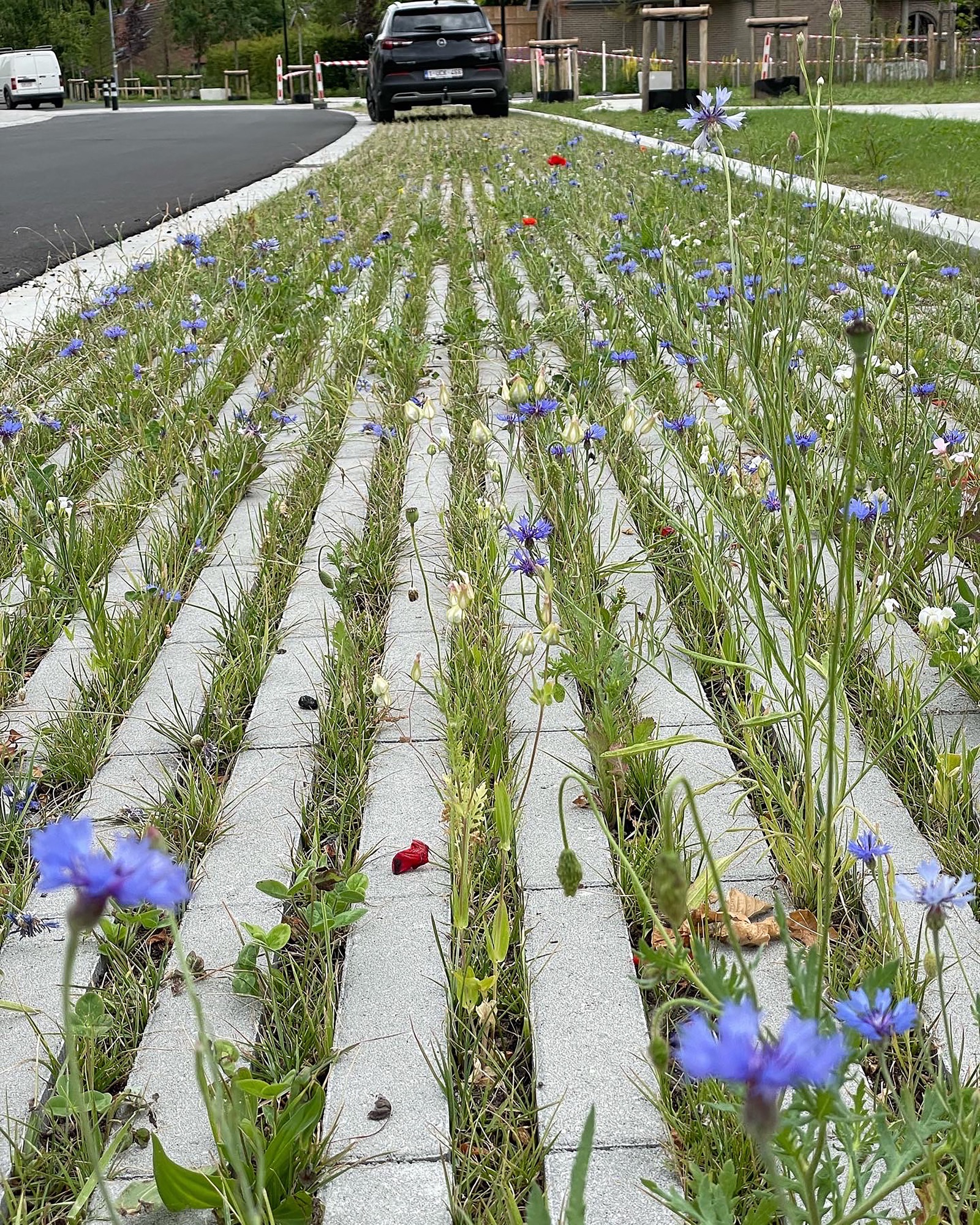
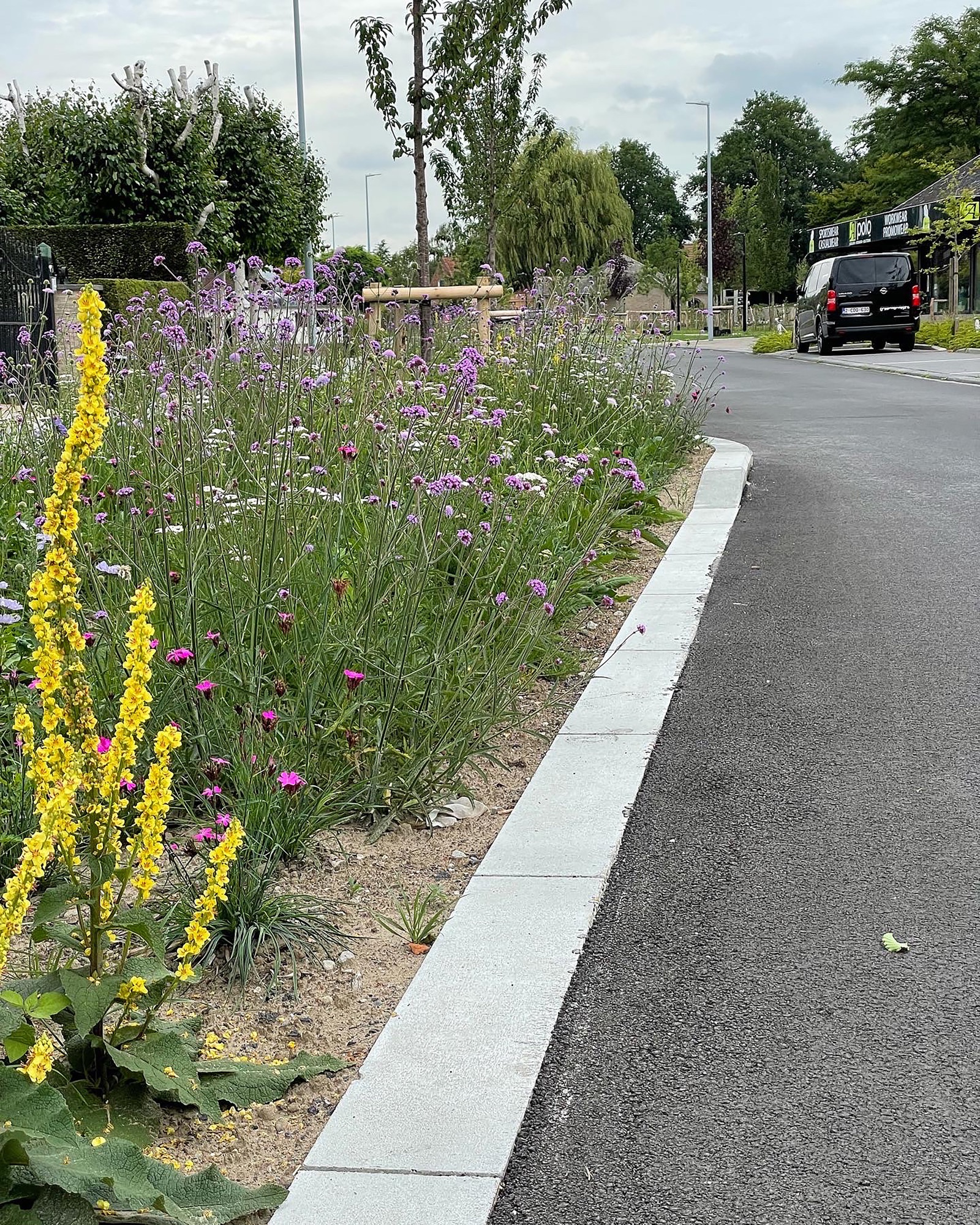
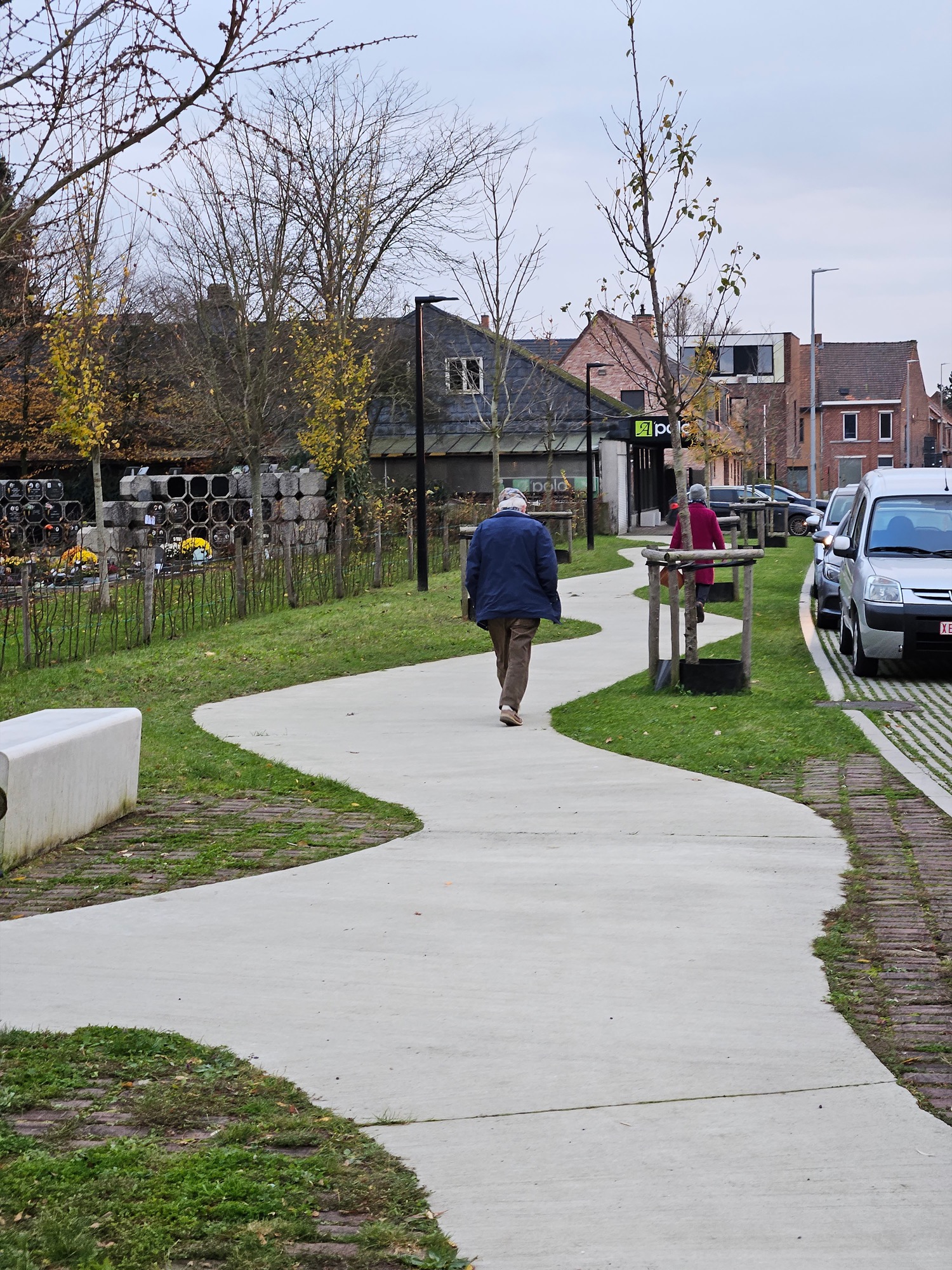
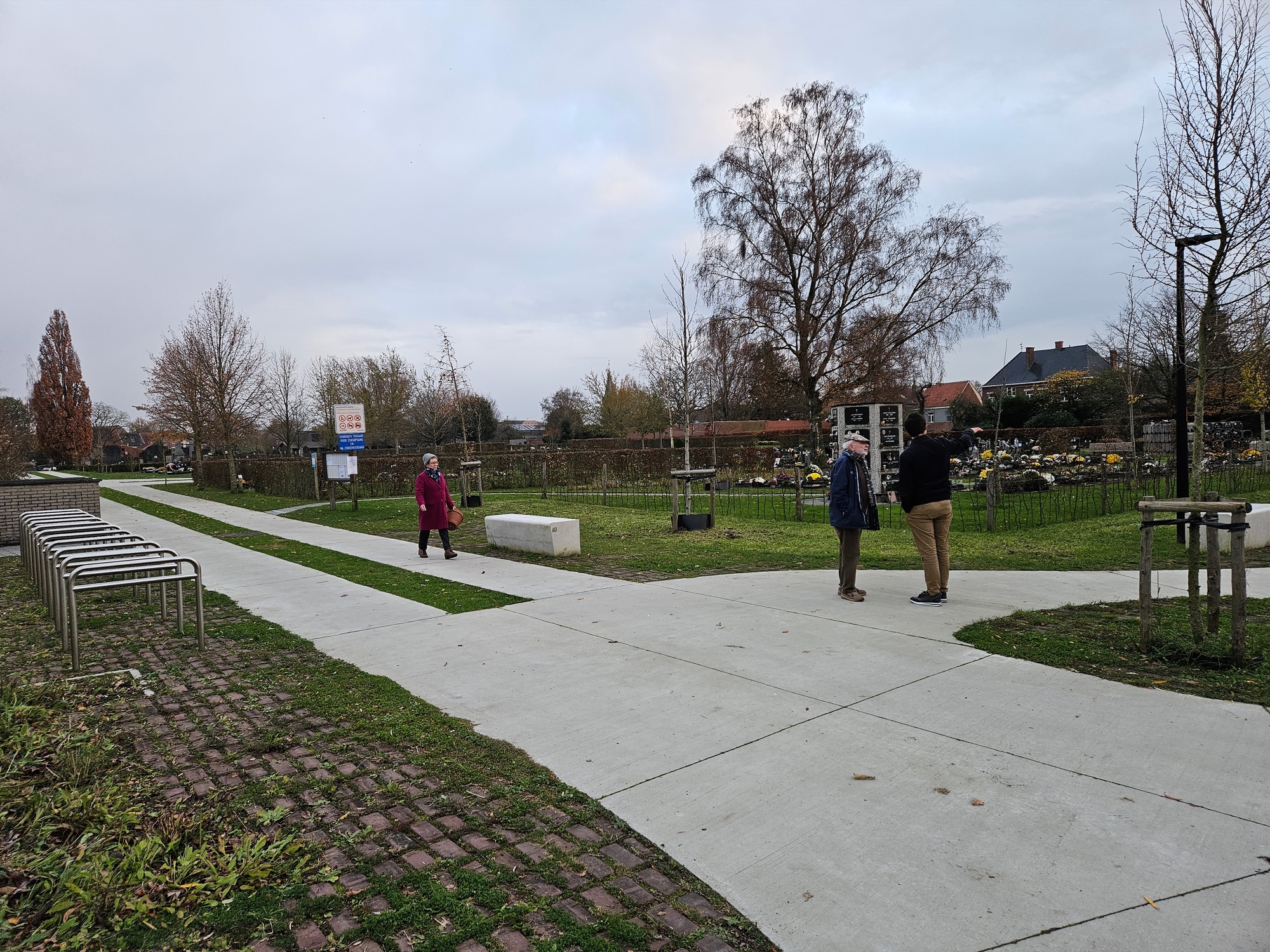
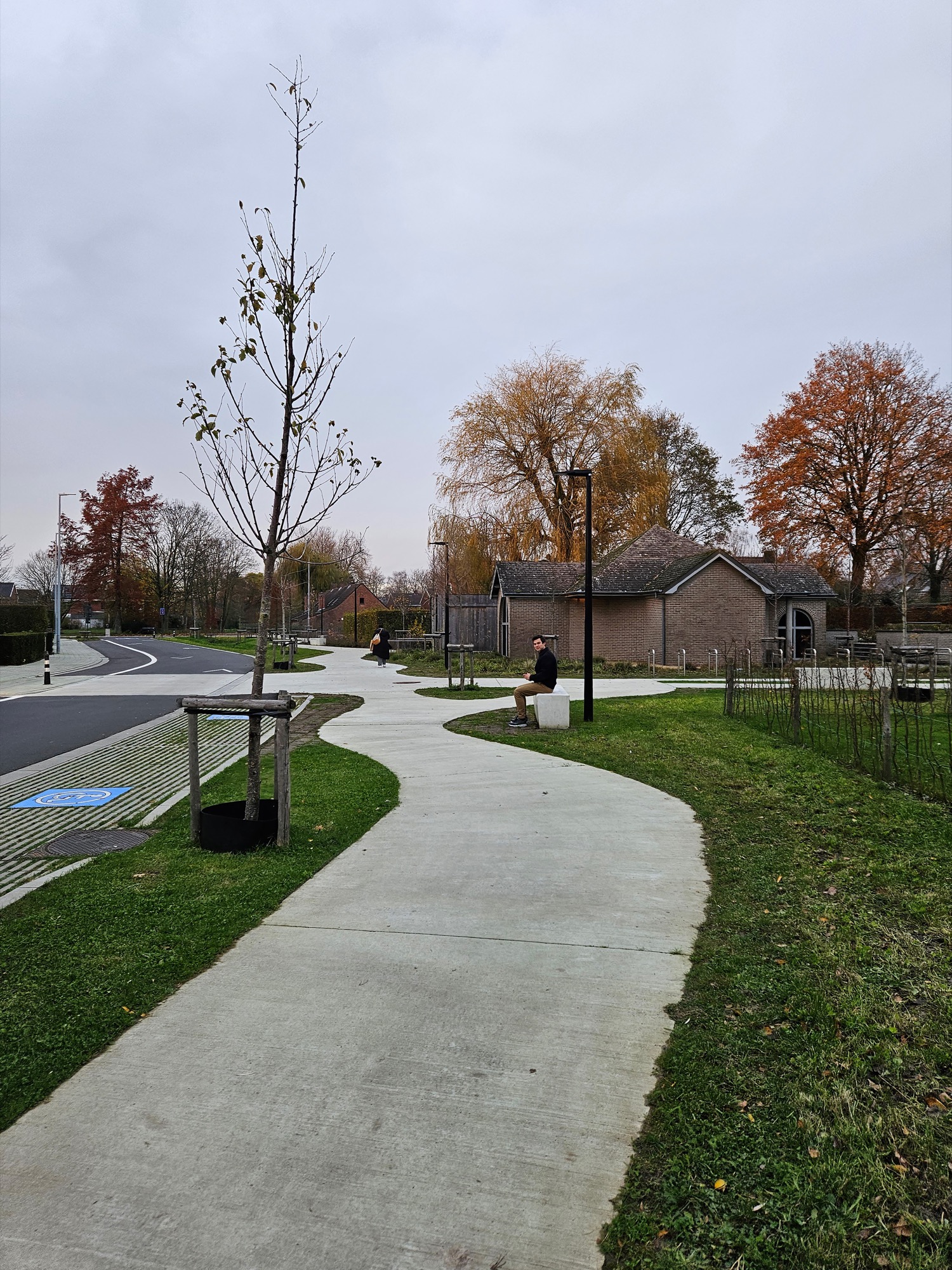
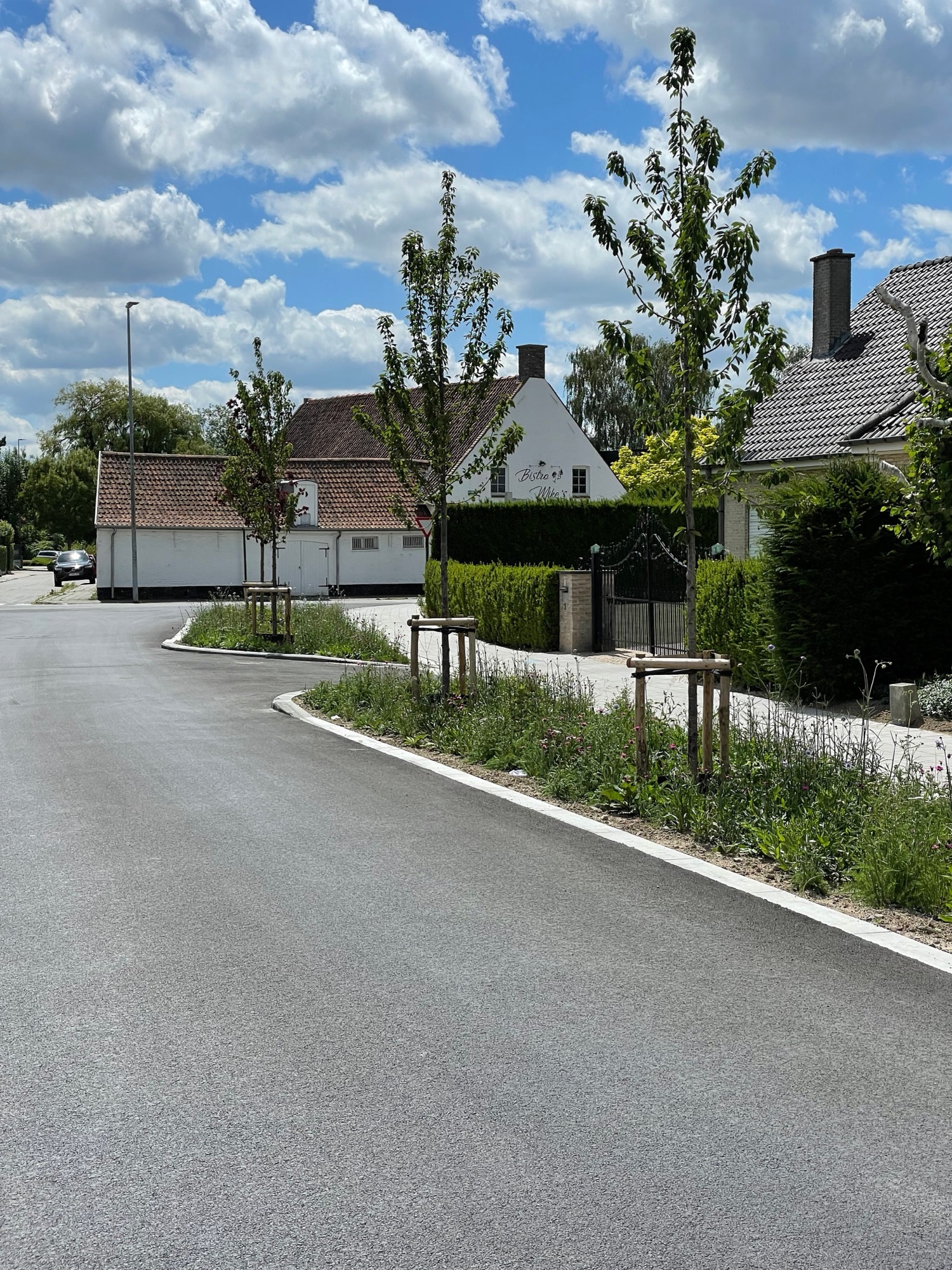
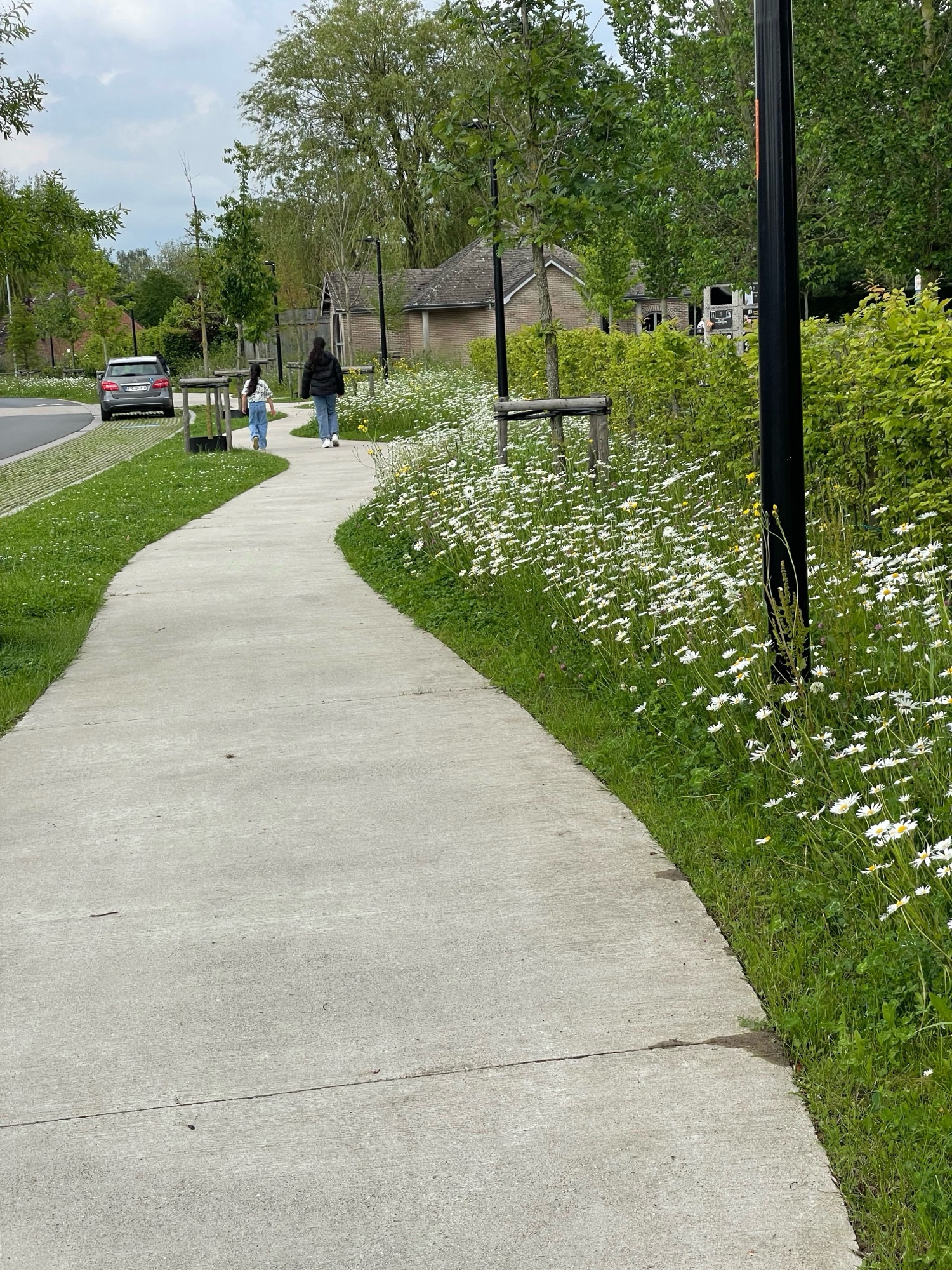
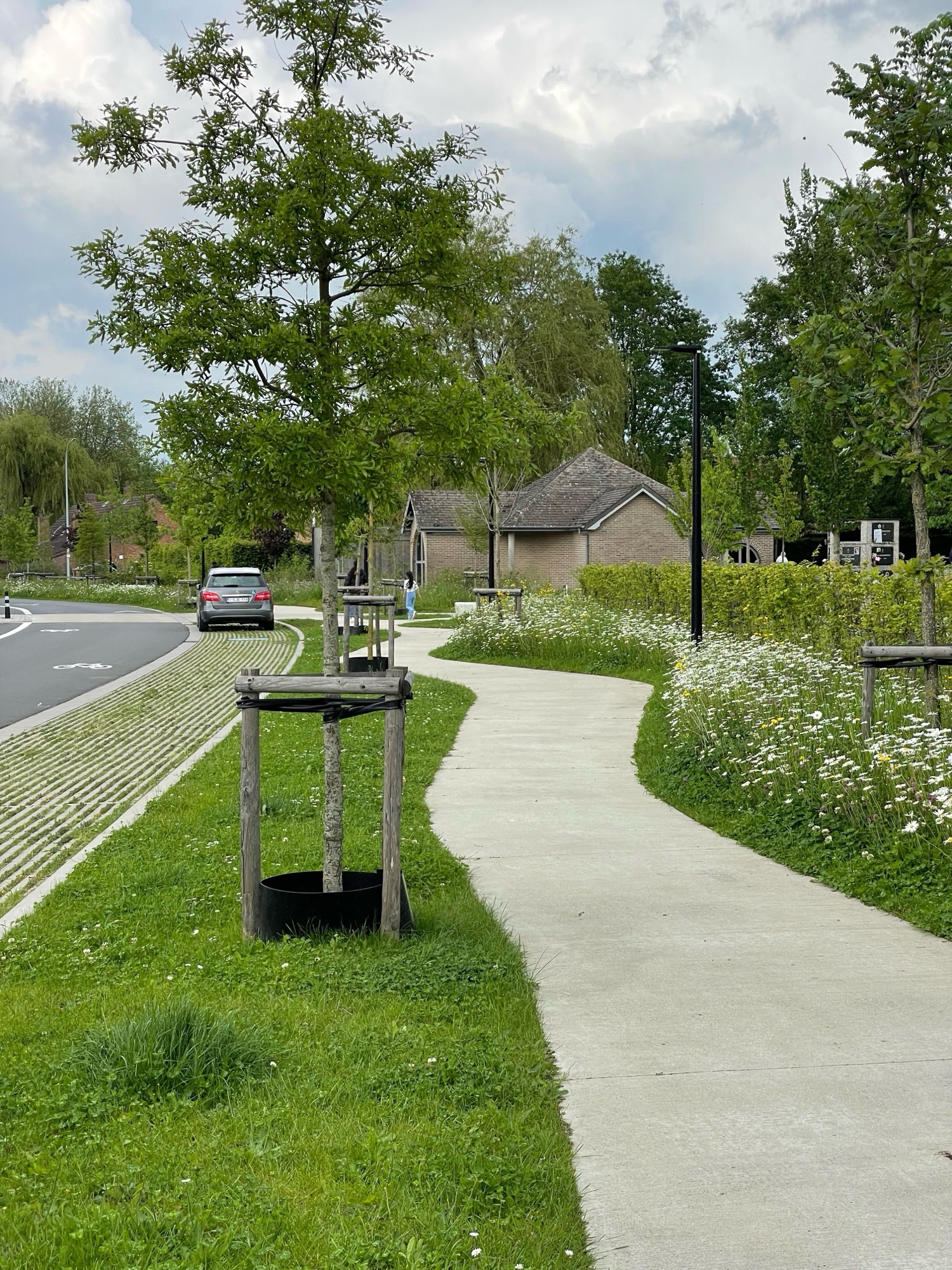
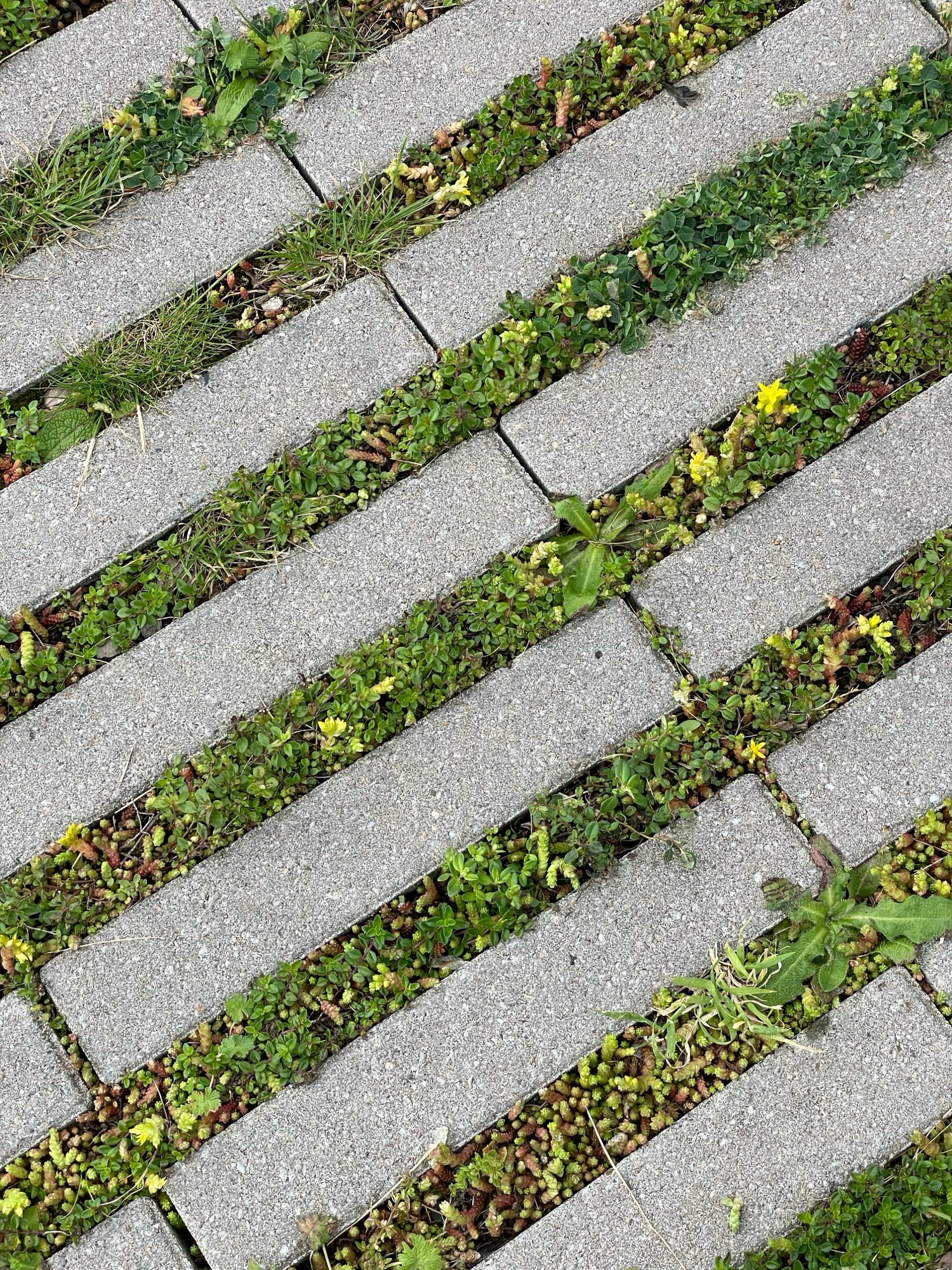
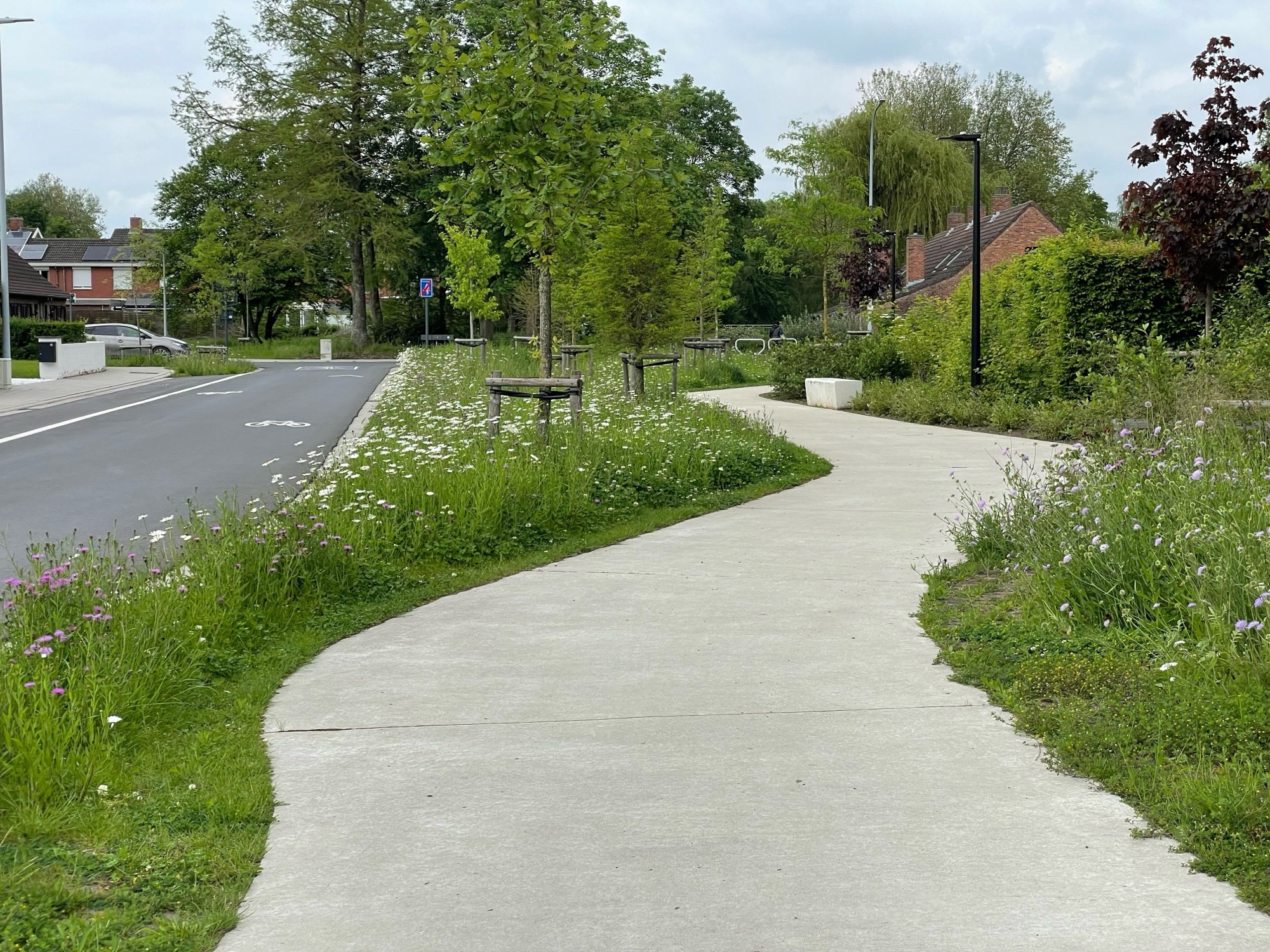
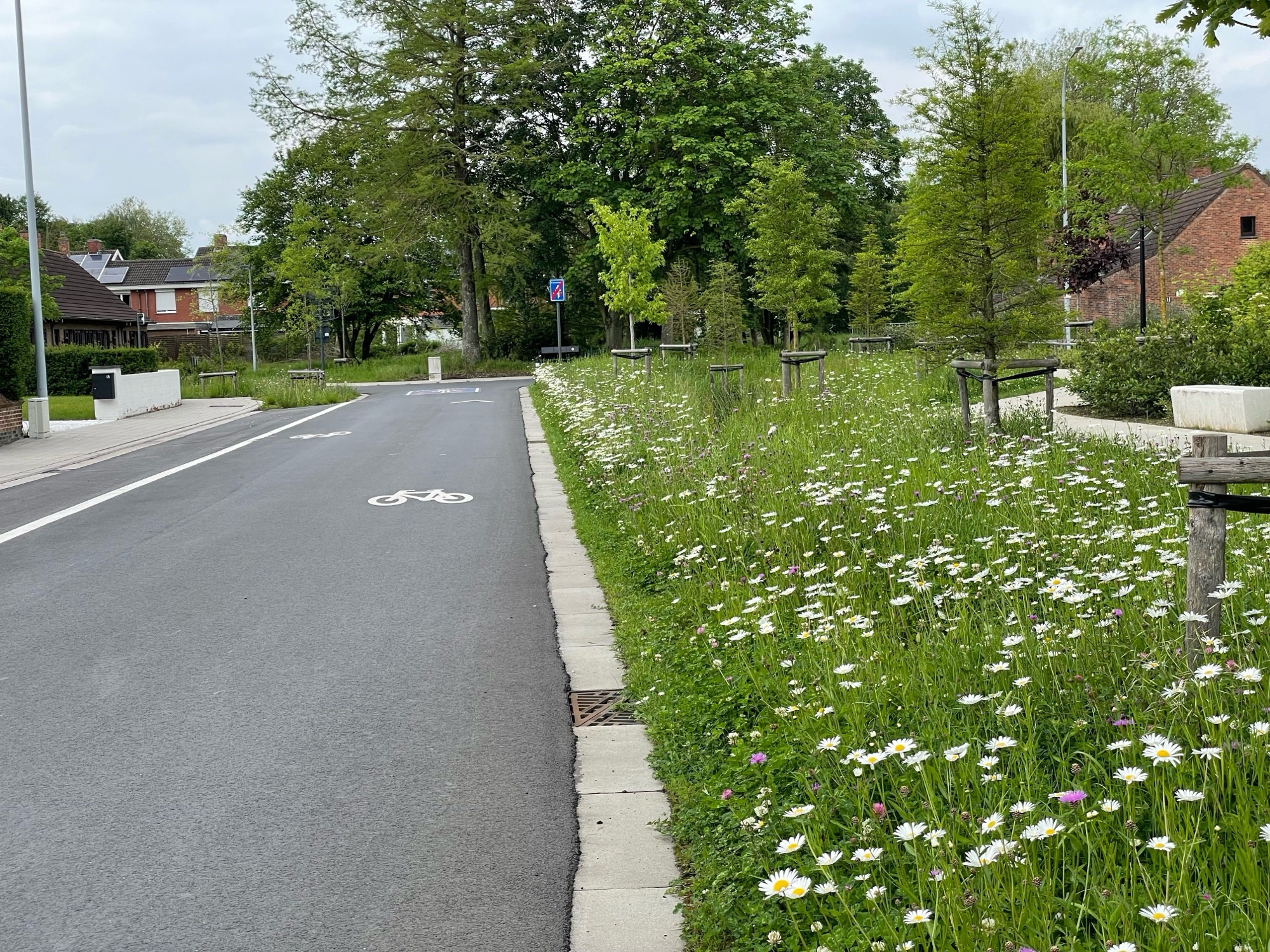
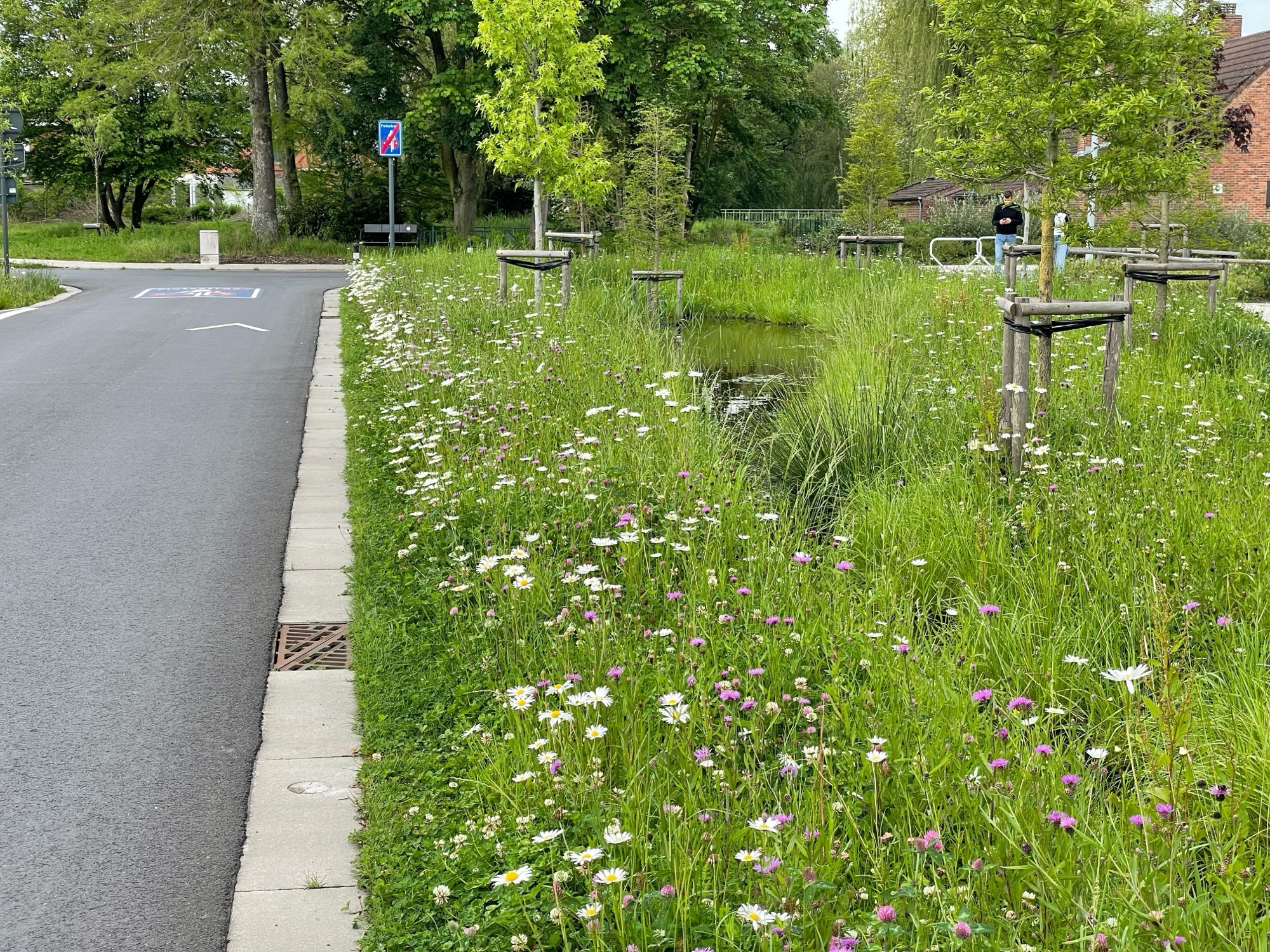
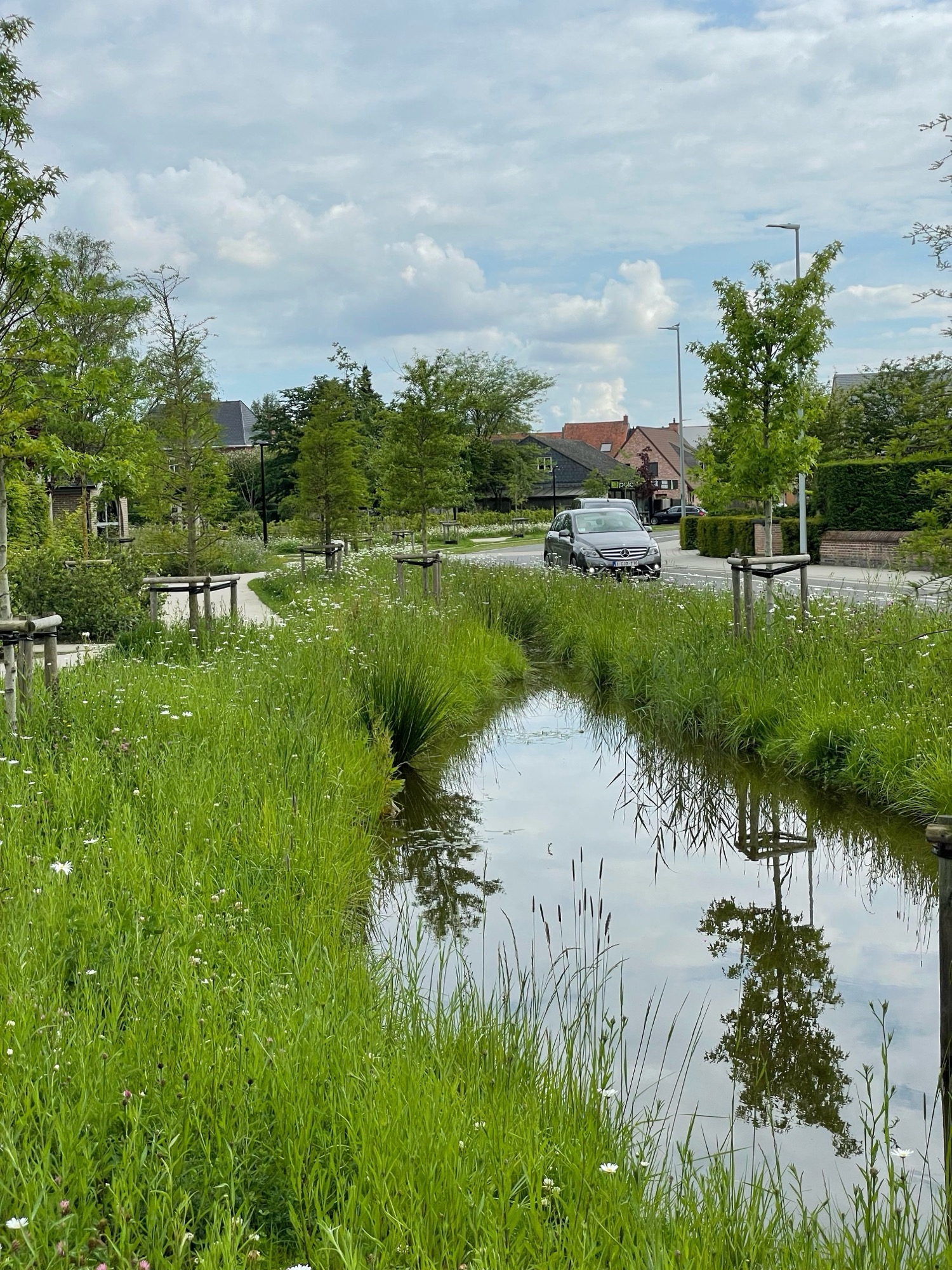
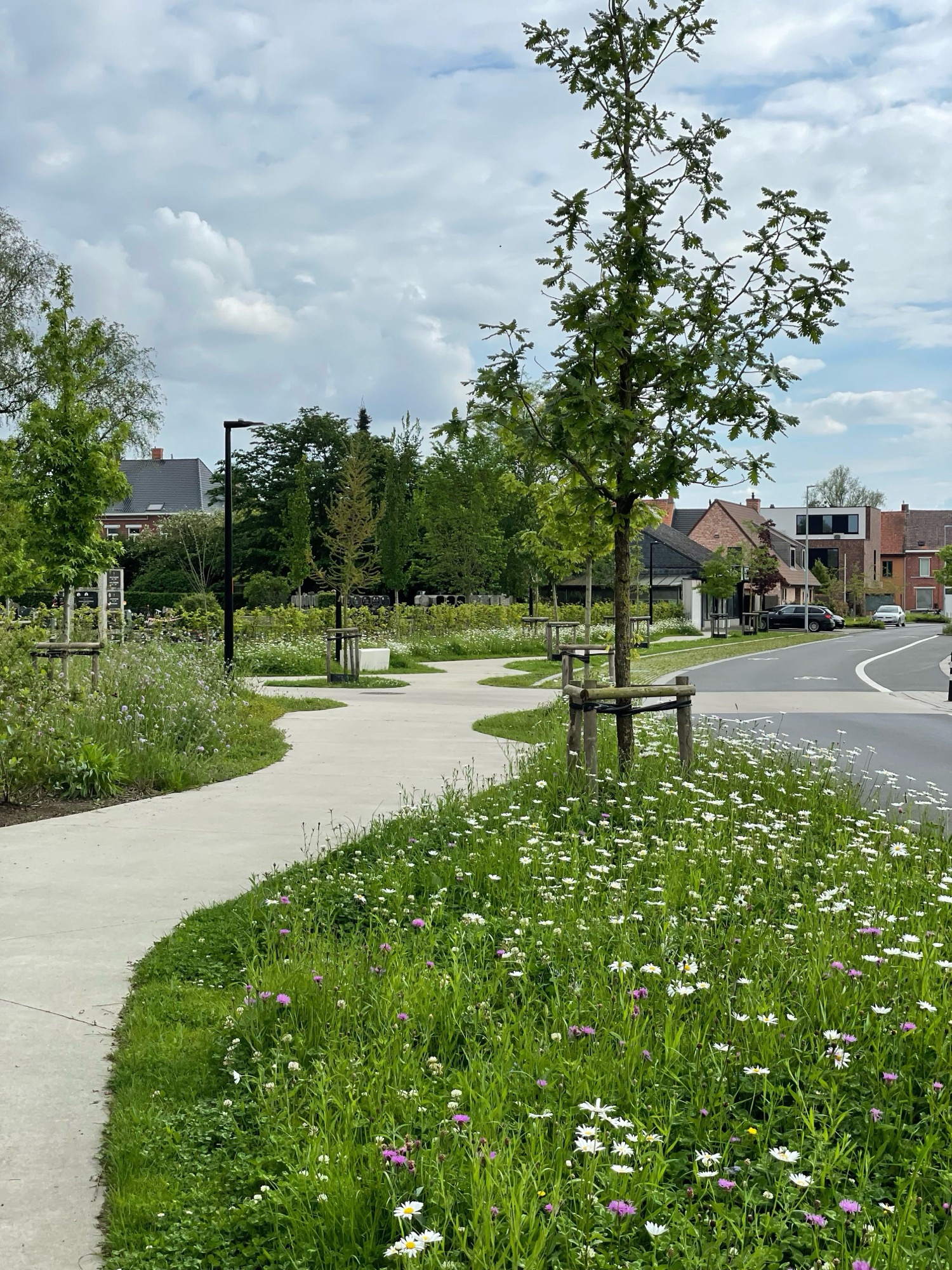
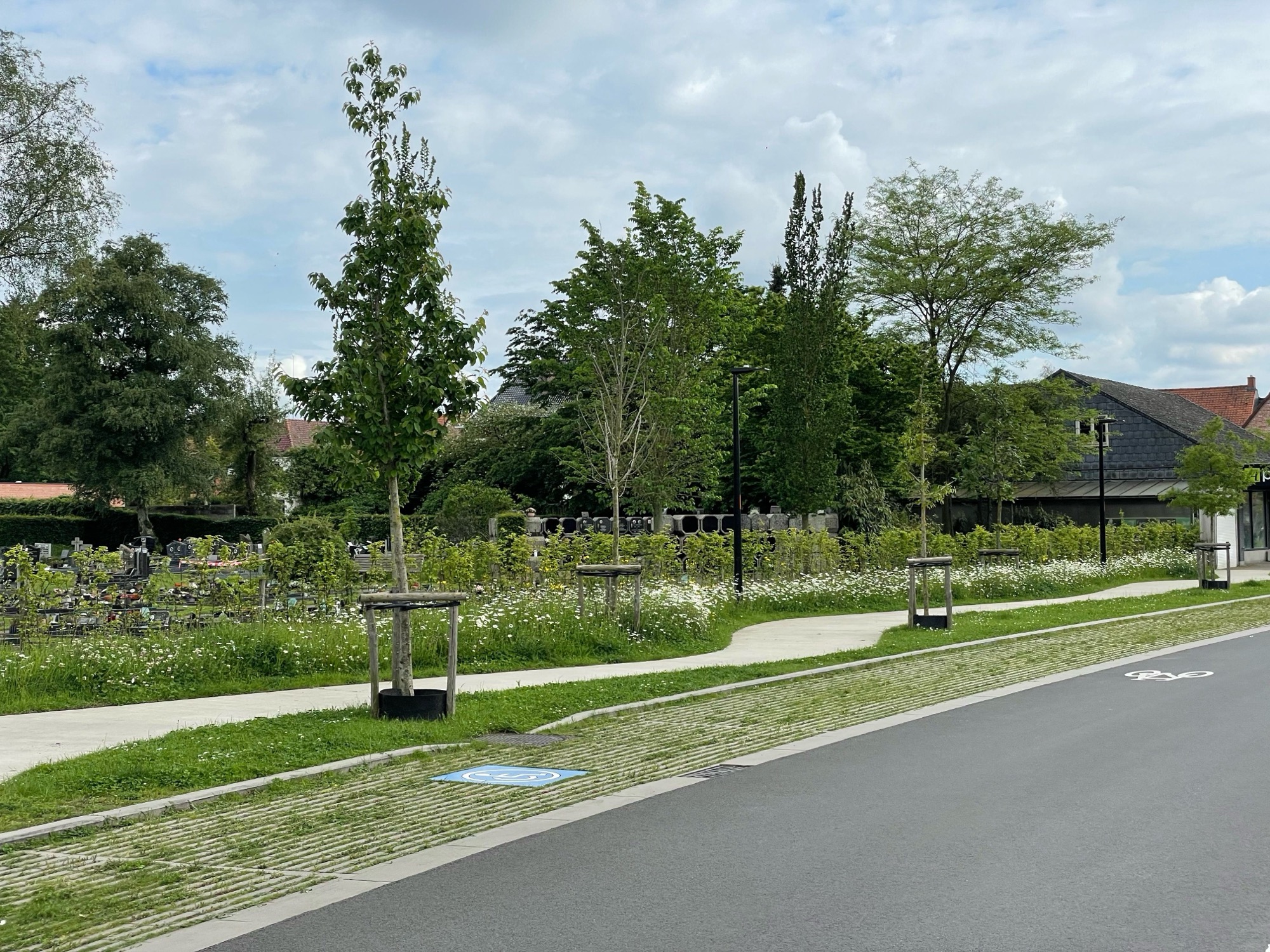
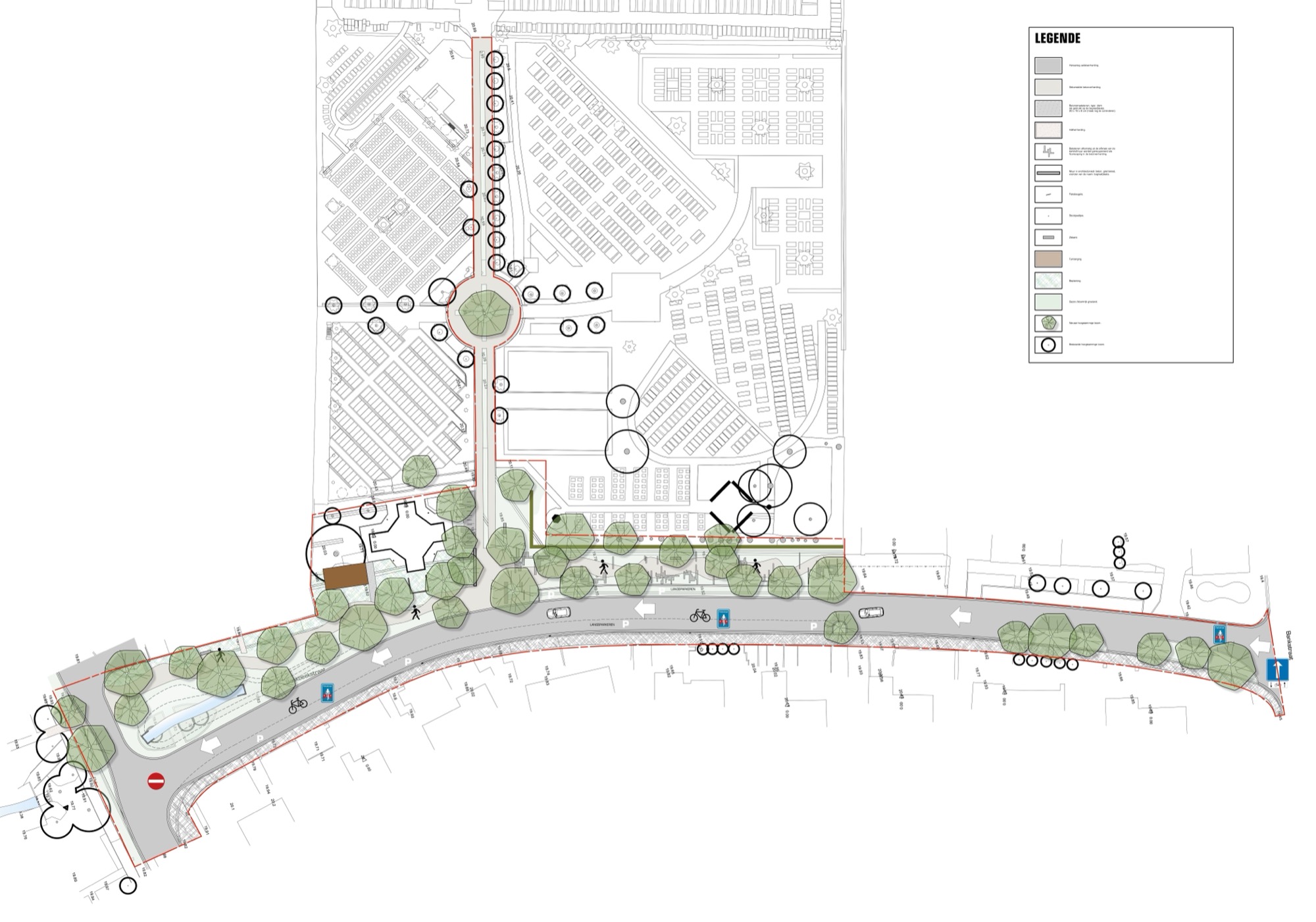
The street’s width was nearly halved. Parallel parking spaces adjacent to the cemetery were redesigned as a green parking area, using concrete grass pavers arranged in a linear pattern and sown with a biodiverse lawn mix. This allows greenery to extend seamlessly up to the roadway. The introduction of numerous new trees visually connects with the existing trees of the cemetery, as if they extend outward into the public realm. As a result, the cemetery’s main entrance now functions as a prominent green gateway—an expressive focal point within Bankbeekstraat.
Strategically integrated green zones within the paving contribute to traffic calming, prioritizing the safety of vulnerable road users. These zones are designed as rain gardens, where surface water from the street and footpaths is directed via lowered curbs and allowed to infiltrate gradually among the planting. The vegetation consists of a balanced mix of native perennial species, arranged as a dynamic planting scheme. This approach encourages natural succession and self-seeding, ensuring that the green character—and thus the street’s appearance—evolves over time. Seasonal variation is intentionally emphasized: flowering bulbs provide early spring color, followed by a succession of spring and summer perennials. A diverse selection of tree species further enhances biodiversity, offering variation in canopy structure, leaf form, blossom, and autumn color.
A swale (wadi) was introduced to collect runoff from street inlets. Together with the rain gardens, it significantly improves on-site water infiltration and retention, thereby reducing pressure on the sewer system. The wadi also establishes a subtle connection to the culverted Bankbeek beneath the street—unfortunately not feasible to daylight due to technical constraints.
Circularity
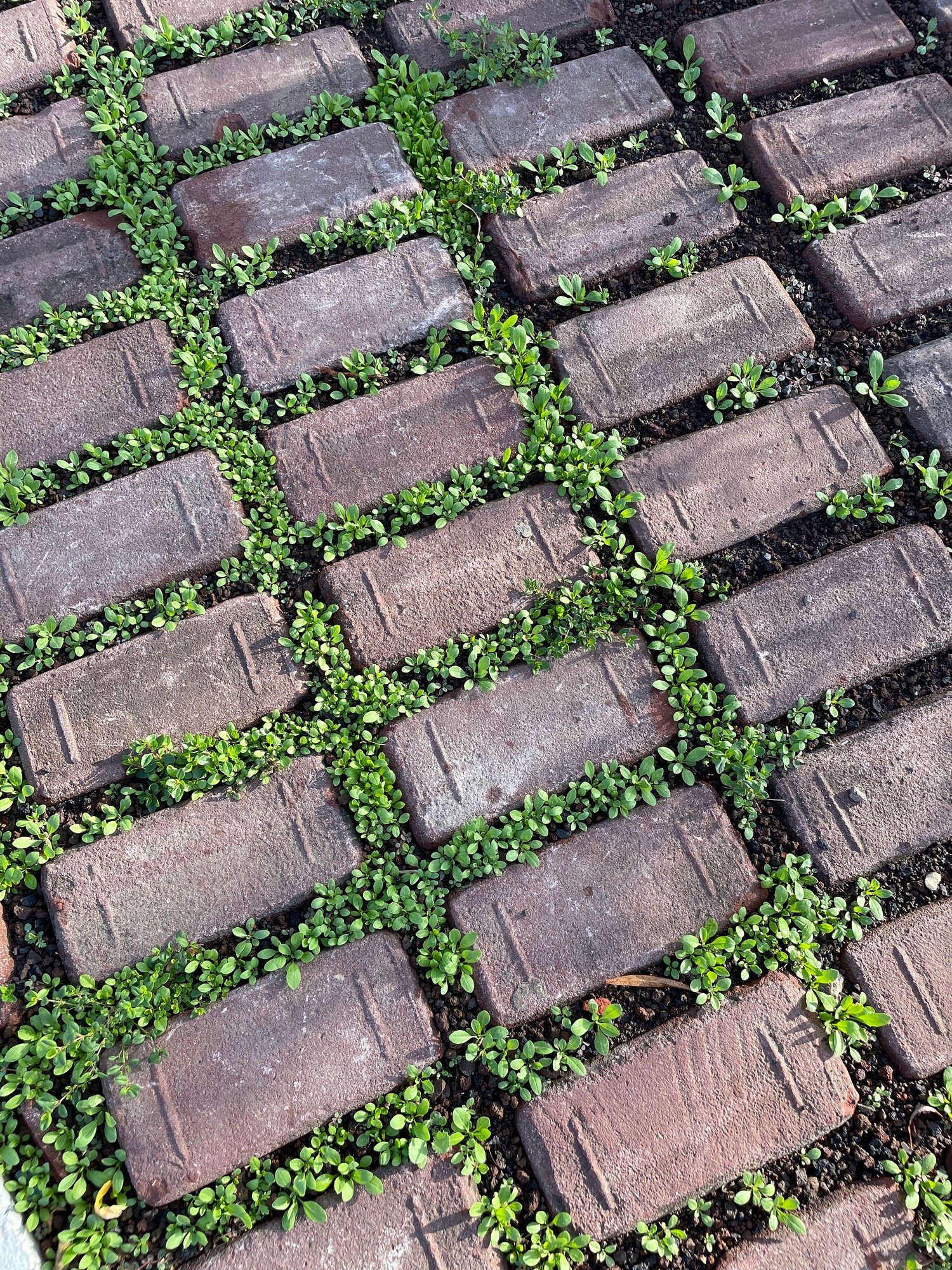
The project actively embraces circular design principles. A portion of the reclaimed clay pavers was reused and reinstalled in a patchwork pattern with open, green joints, sown with a biodiverse seed mix. This approach not only reduces material waste but also contributes to the ecological value of the public space.
A missing link within the blue-green network
The redesigned, green Bankbeekstraat connects to the extensive public green spaces of the Kwadries – Westakker – Kwameers district and indirectly to the nearby provincial domain Bergelen. As such, the street forms a crucial missing link within the municipality’s blue-green network of slow mobility and ecological corridors in Gullegem. Together, these connections establish a valuable recreational and nature-educational network.
Design: Greenconcepts bv
Client: Municipality of Wevelgem
50.8459557280364, 3.2007069311713816
73558


LILA 2026 Sponsor