Sandyford Central
bslarch.com
2026 Landscape and Architecture / 2026 Residential Parks / Ireland / Built in 2024 /

![An ‘Interim’ Scheme During the covid-era lockdowns, Dublin City Council sought to help food businesses by creating street build-outs for outdoor dining. These were done with speed and economy but once the popularity was clear – particularly along Capel Street – they sought to provide an upgraded version. The aim was an ‘Interim’ scheme with […]](https://landezine-award.com/wp-content/uploads/2026/05/Hero-Image-3-600x338.jpg "Capel Street")
![From the early stages of the competition-winning scheme, landscape and gardens were key to the site strategy of the building proposal. The project was aiming to replace a large office headquarters in what was formerly an intact city core of Georgian houses, divided up into narrow plots. The massing strategy sought to respond to this […]](https://landezine-award.com/wp-content/uploads/2025/05/00-BSLA_MG_0396-600x400.jpg "ESB Headquarters by Bernard Seymour Landscape Architects (BSLA)")
![When a Silicon Valley IT company decided to establish a new Dublin HQ, BSLA were engaged to propose landscape solutions for the project. Constructed a decade before, the empty office building had narrow terraces throughout the floors, but the clear potential lay with the 900m2 open roof area on the 7th floor, next to the […]](https://landezine-award.com/wp-content/uploads/2017/05/1.-Main-Project-Photo-600x388.jpg "Kings Building Roof Garden")
![Located in the heart of Dublin city centre, the Irish Life Centre is comprised of three public courtyards and one private courtyard that were established alongside the development of the building campus in 1980 by Irish architects Robinson, Keefe, Devane. BSLA were engaged as lead designers to increase the profile and permeability of the urban […]](https://landezine-award.com/wp-content/uploads/2017/05/01-Plaza-from-Street-MAIN-600x338.jpg "Irish Life Centre")
This project occupies a pivotal position within the evolving fabric of Sandyford Industrial Estate, where it establishes a new pedestrian route through a fragmented and partially realised urban quarter. The landscape is conceived not simply as residual open space, but as a connective civic armature that anticipates future links between adjacent sites as they develop. It contributes to the long term permeability and coherence of the wider district with positive engagement between building and landscape while offering an experiential landscape in its own right.
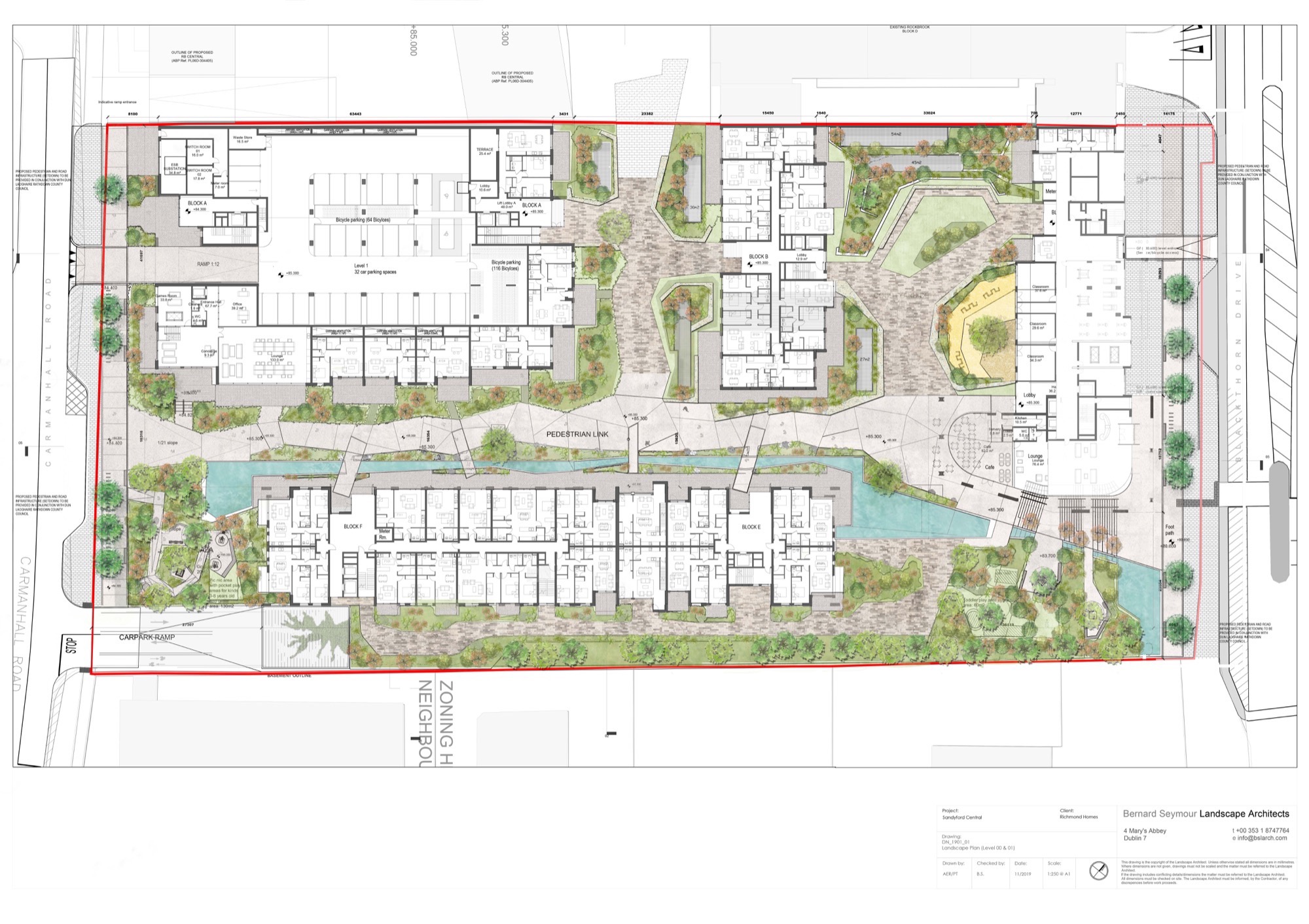
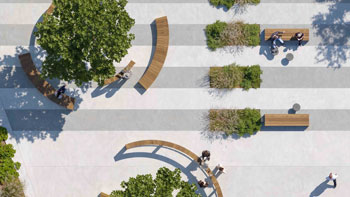
The design reconciles two primary conditions: movement and occupation. It must function as a clear and legible route through the site, while also providing a richly inhabitable landscape at podium level. A shallow rill acts as the central organising device, structuring movement, framing entrances, and establishing a continuous spatial language across the scheme. Its presence guides users intuitively through the space, while also mediating between the scale of the individual and the larger architectural context. Along its length, sequences of planting and water create rhythm and variation, offering moments of pause, encounter, and play.
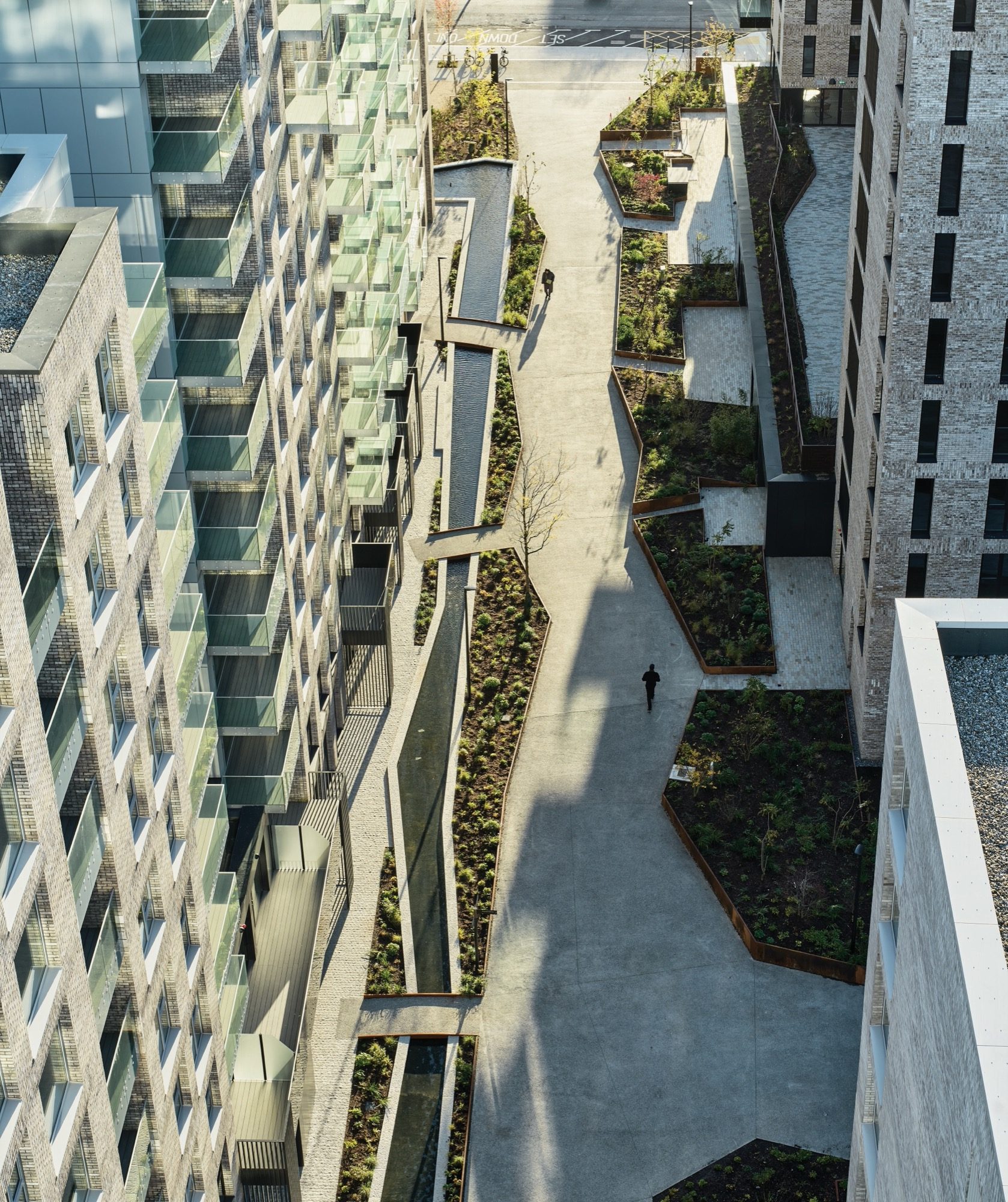
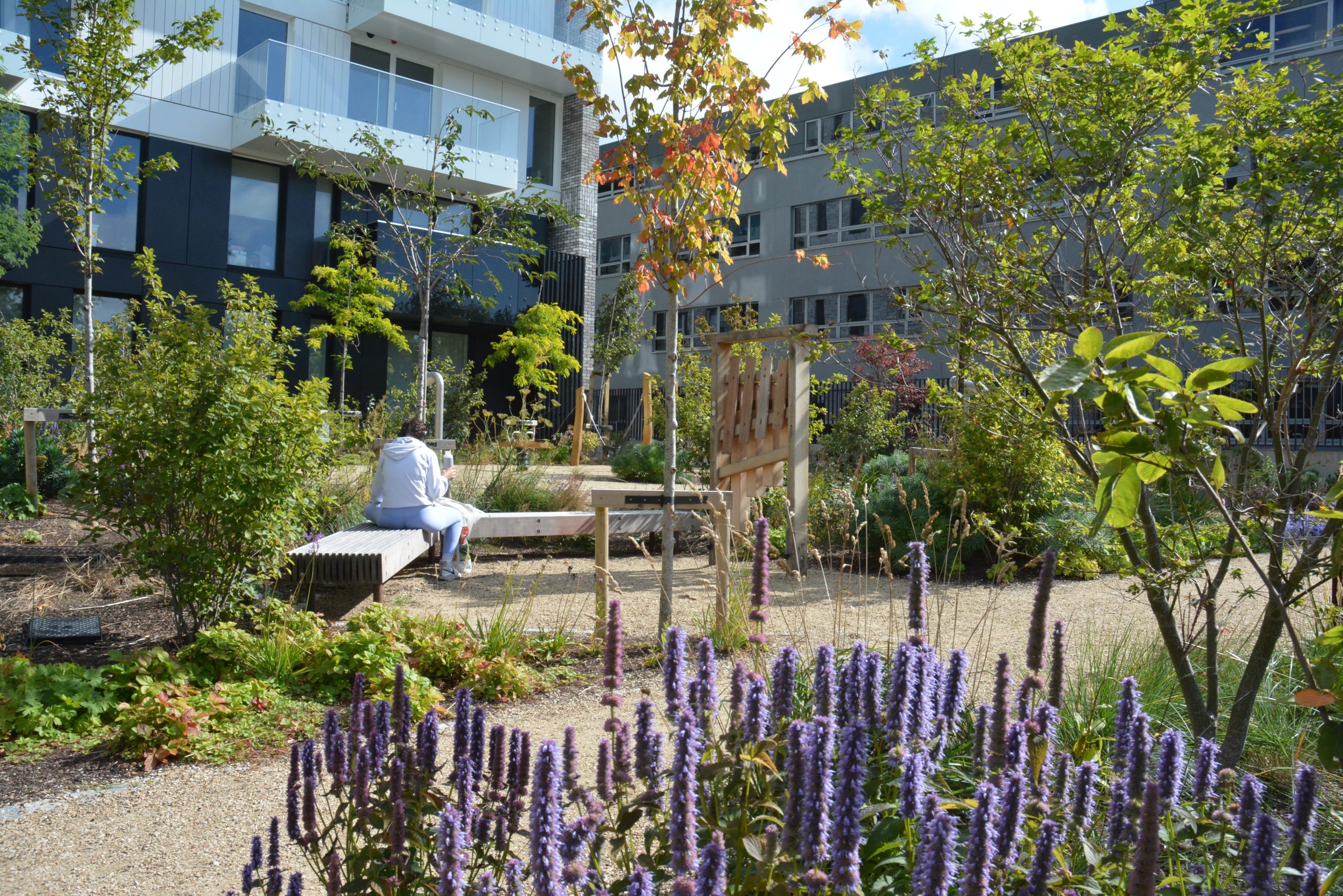
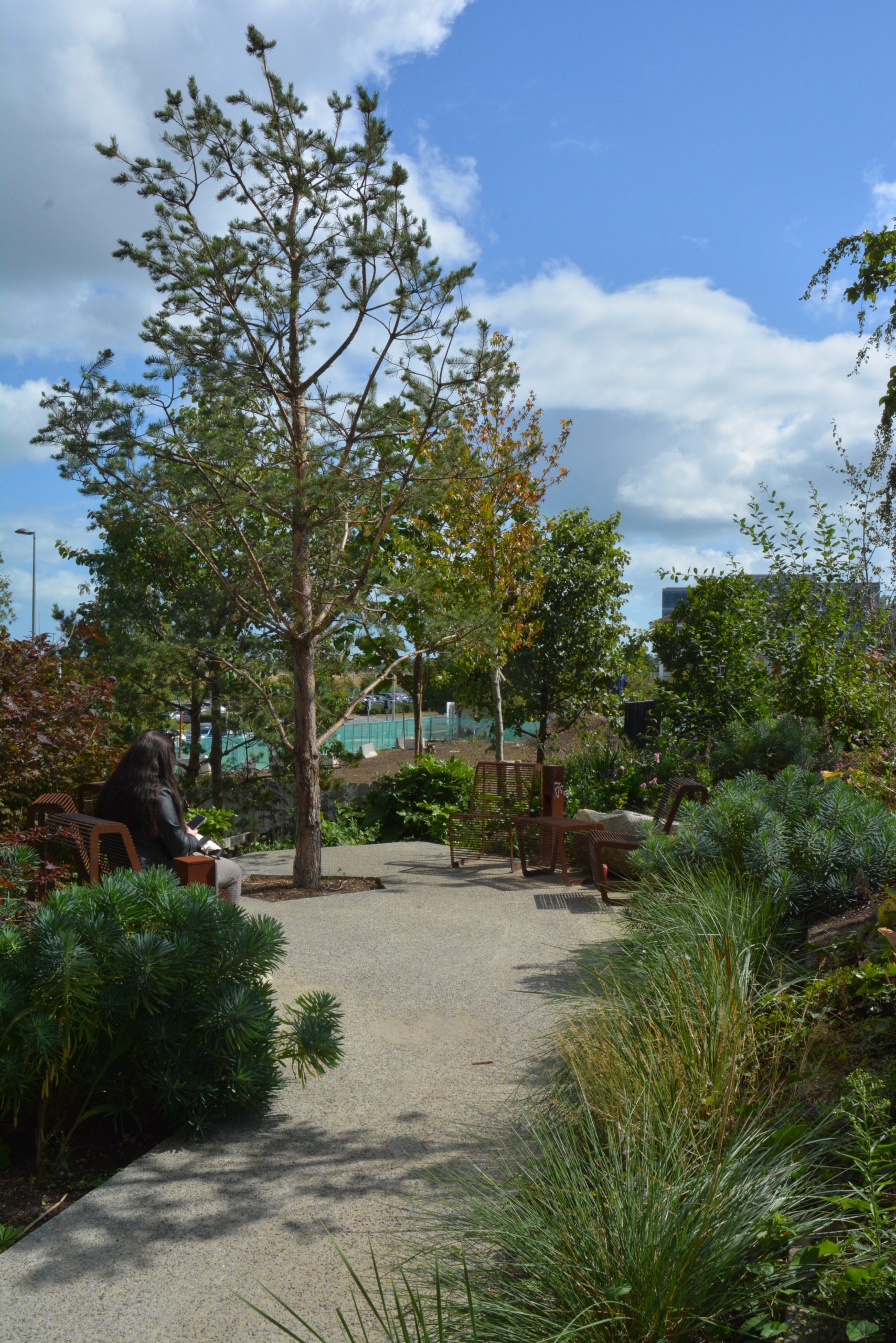
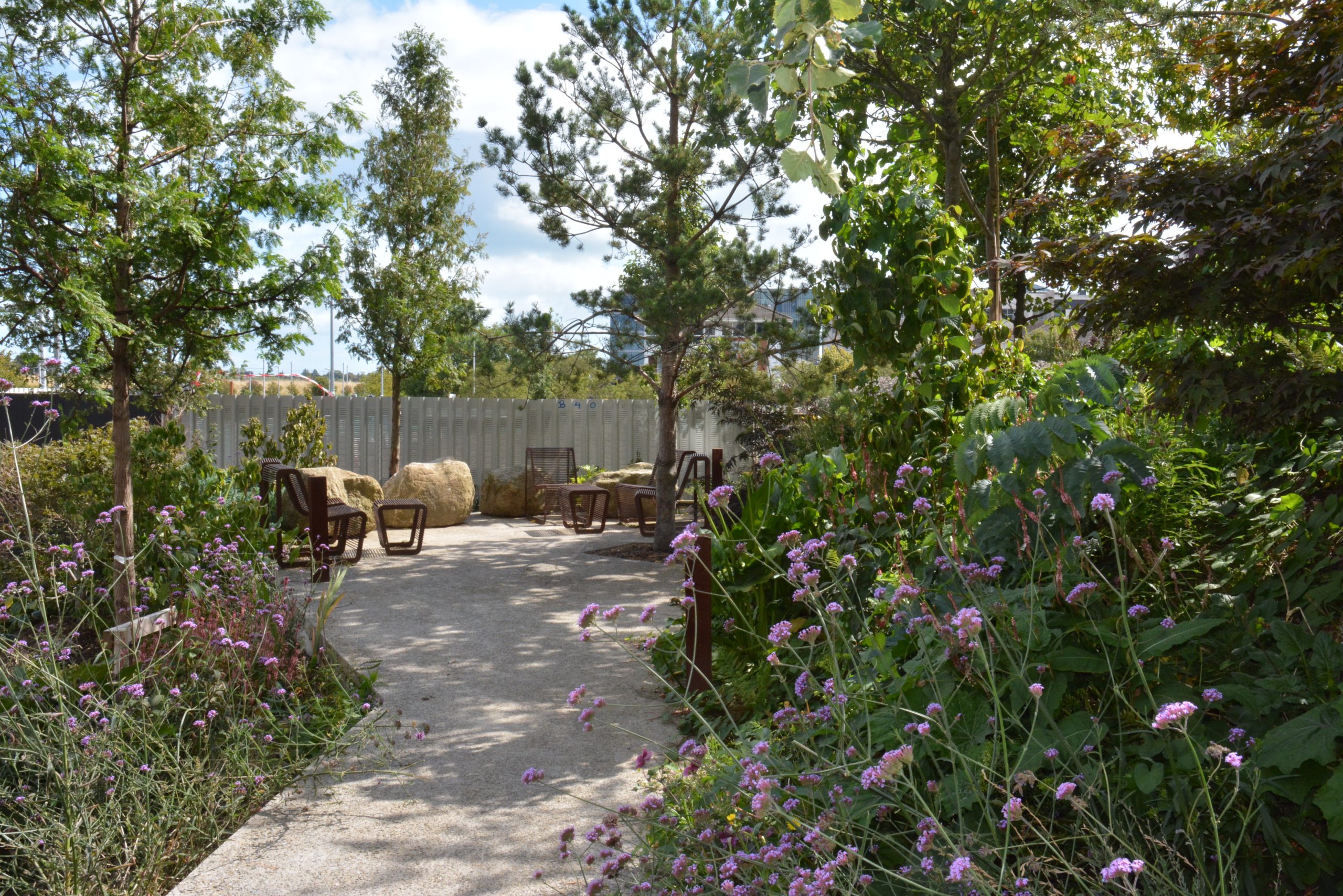
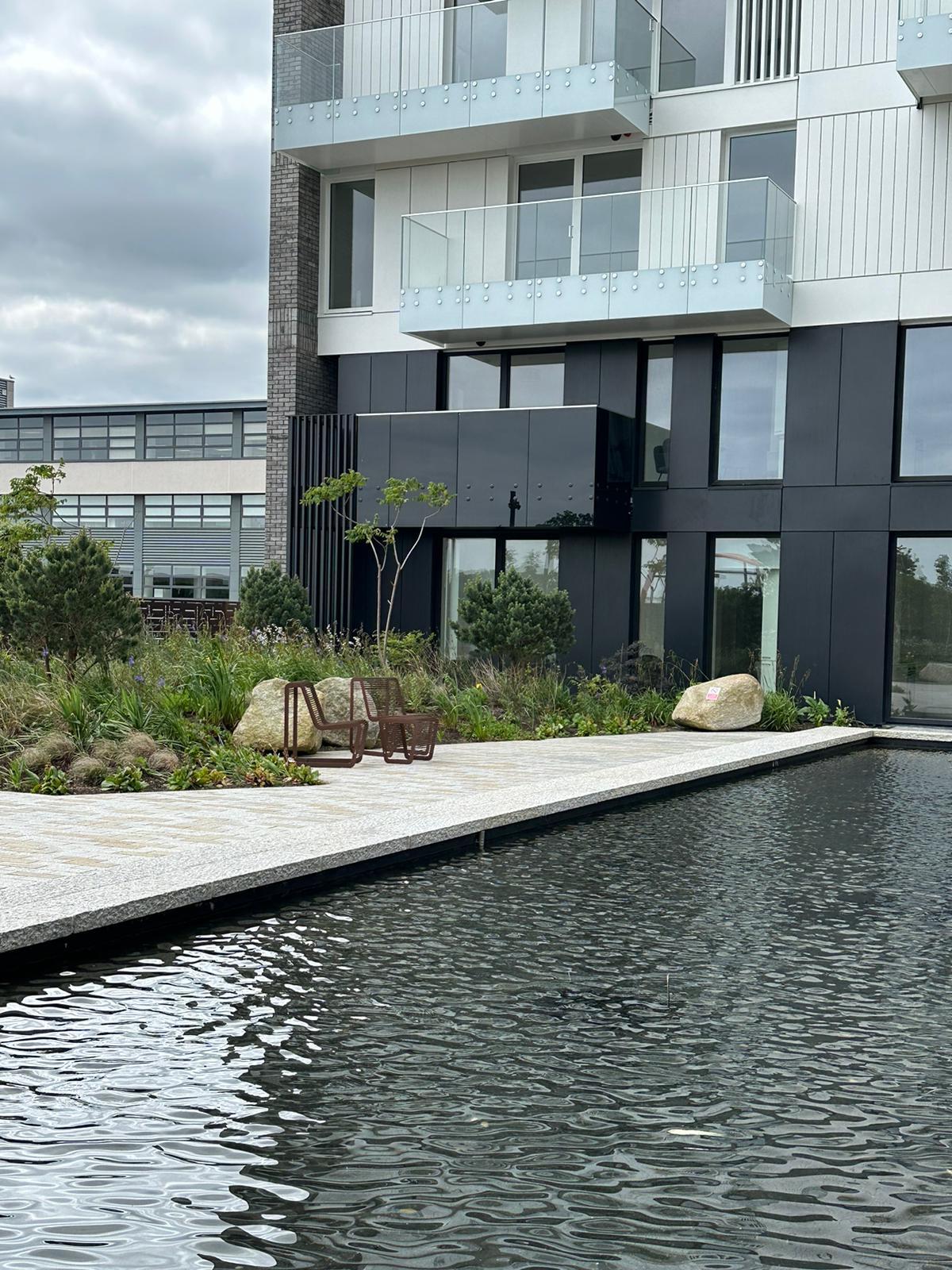
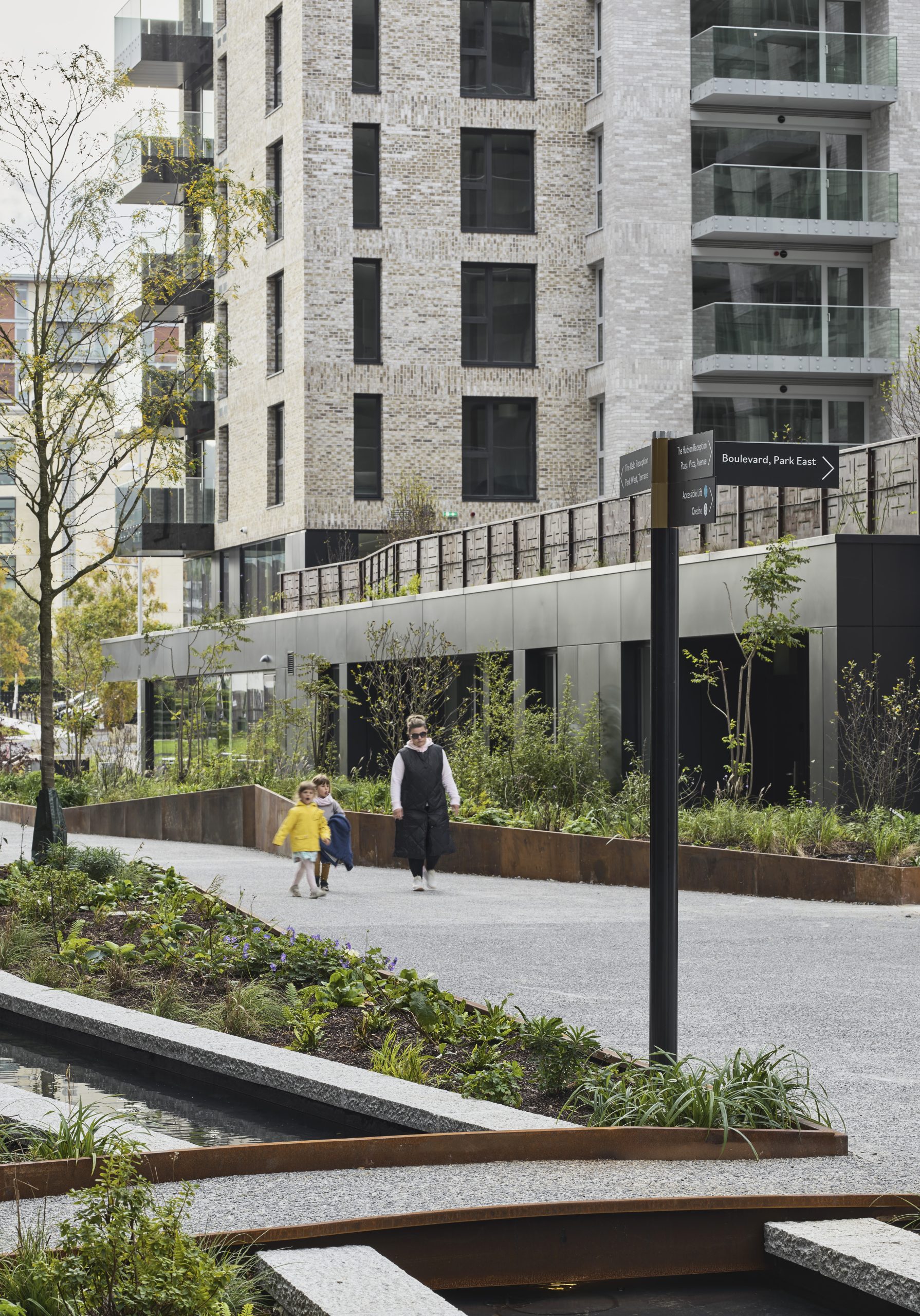
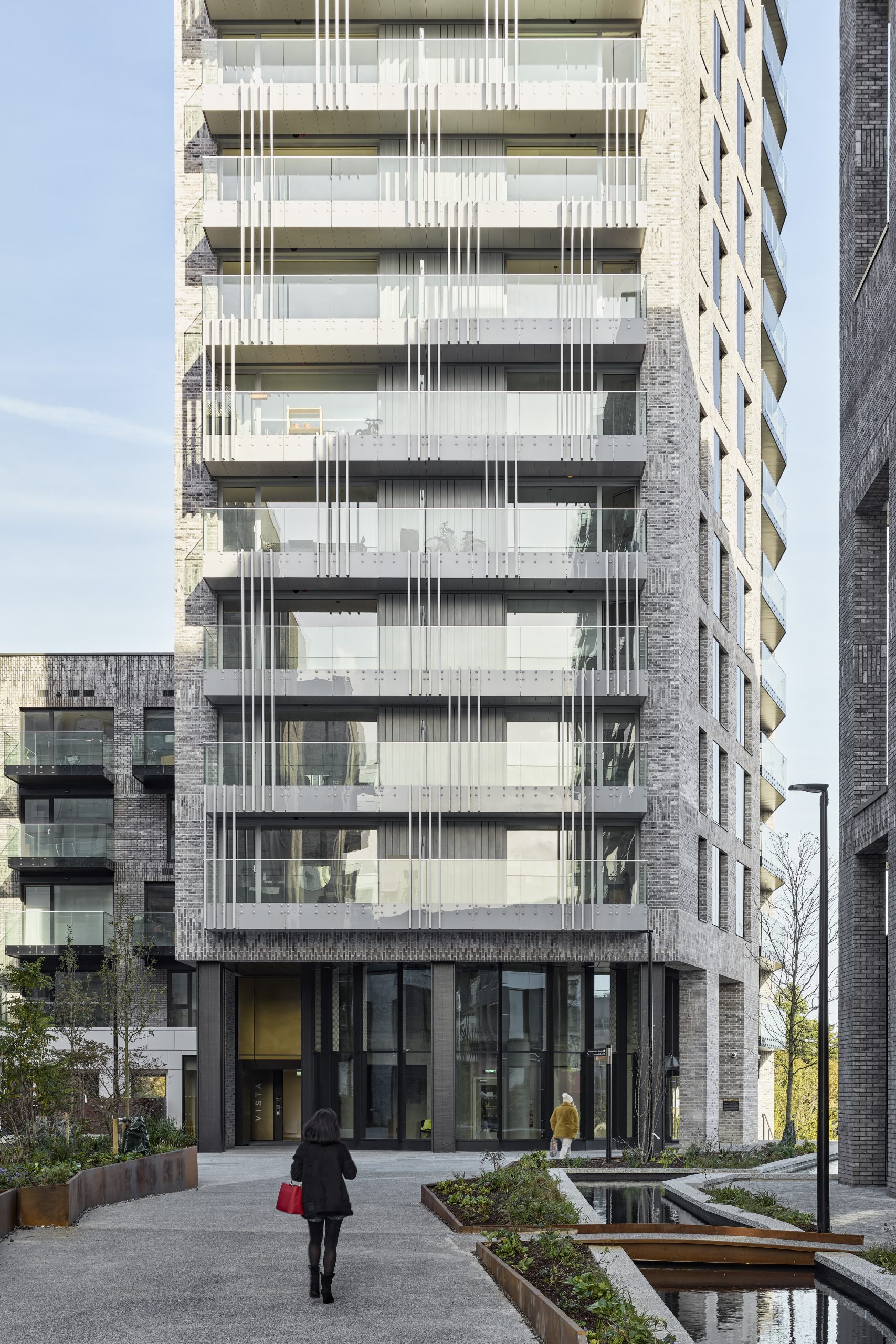
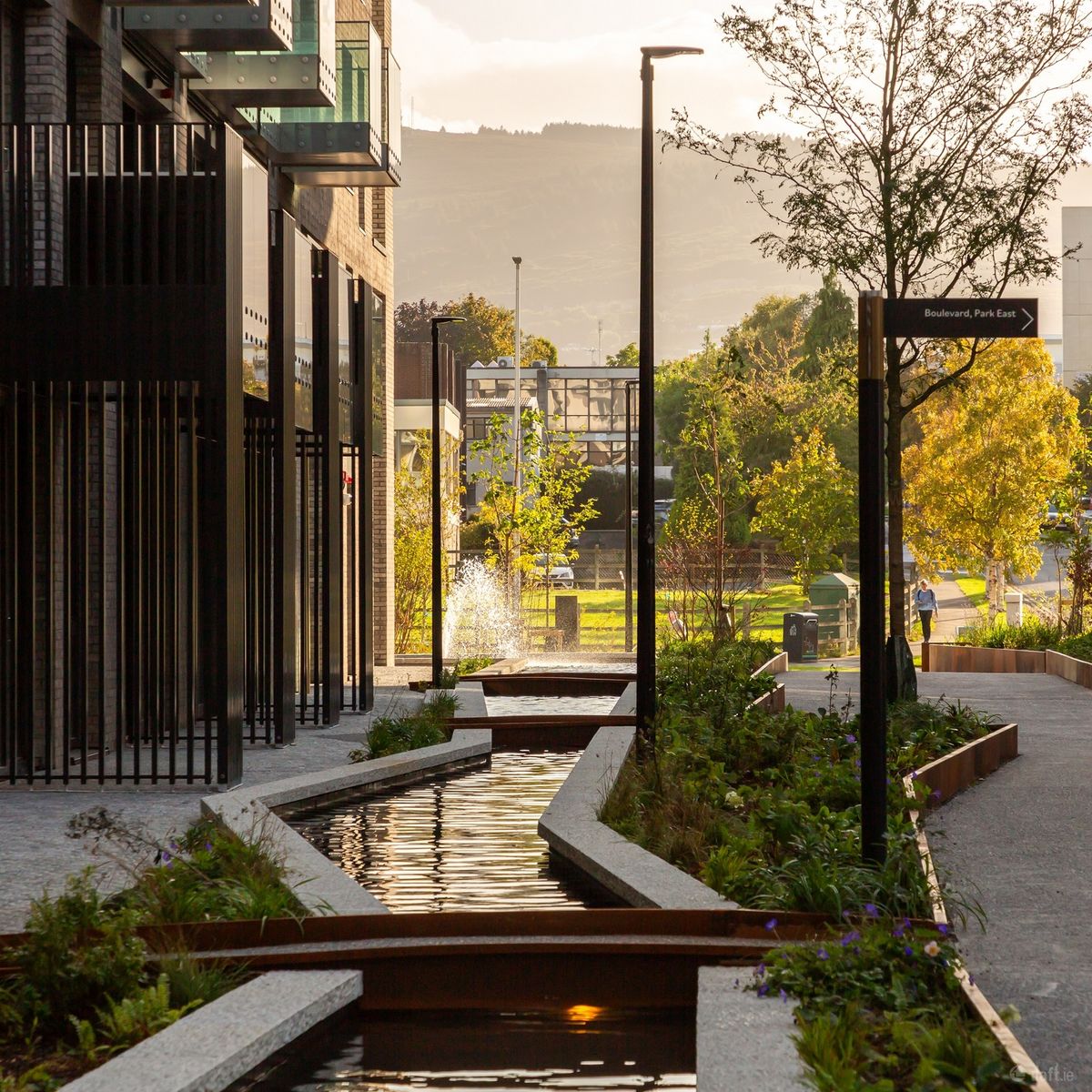
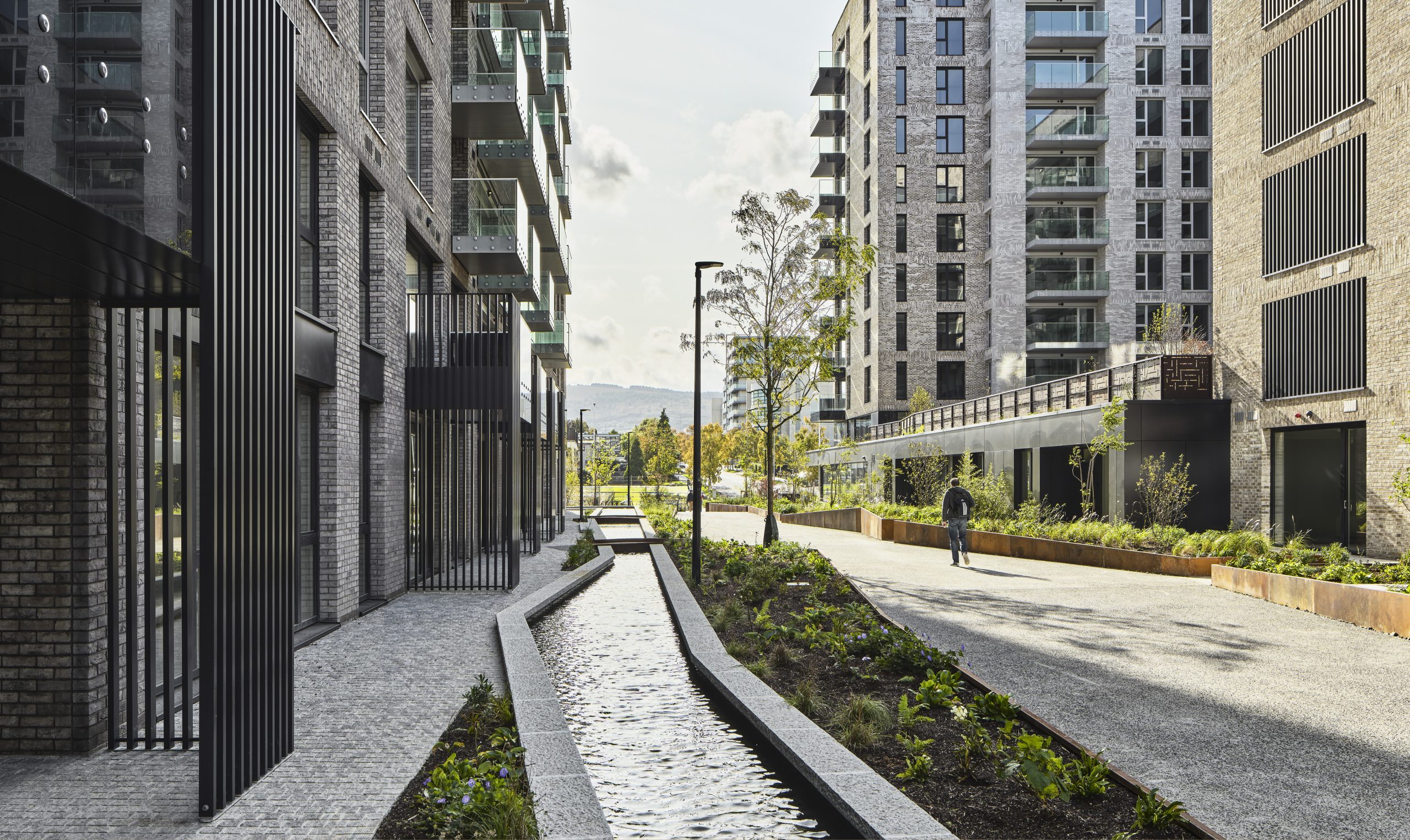
Thresholds between public movement and more private residential domains are carefully articulated through planting and level change. These transitions provide a sense of gradation rather than separation, supporting passive surveillance while maintaining a degree of intimacy for residents. The landscape is designed to be inclusive and accessible, encouraging use across age groups and abilities, with seating, play, and circulation woven into a coherent whole.
From the outset, the technical challenges of building over podium informed the ambition of the scheme. Early design work prioritised the integration of meaningful tree planting within the slab, securing positions for large canopy trees through coordinated substructure and soil strategies that extend below podium level. This approach ensures that the landscape achieves an appropriate scale over time, counterbalancing the density of the surrounding development. The establishment of planting within a windy and dry microclimate was a key consideration, informing both species selection and the configuration of landform and shelter.
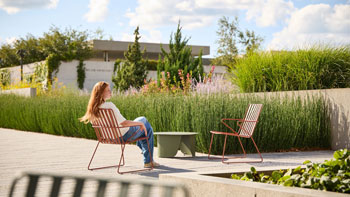
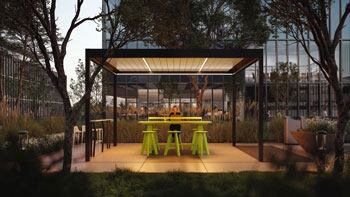
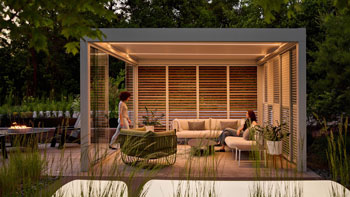
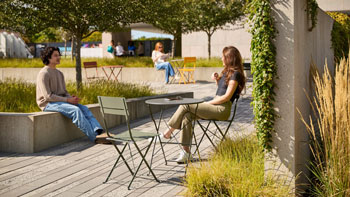
Microclimatic comfort is central to the user experience. Sheltering elements and planting are positioned to mitigate wind exposure and create protected pockets throughout the site. Seating is located to take advantage of favourable conditions, particularly in south facing areas, while more enclosed spaces are formed through dense planting to provide refuge and enclosure. These moments of comfort support longer dwell times and encourage social interaction.
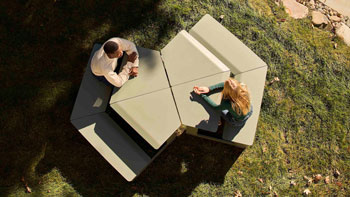
Play is integrated as an informal and exploratory layer within the landscape. The shallow rill and the placement of boulders invite natural play and interaction with water, while a more structured play area incorporates sensory elements to broaden accessibility and engagement. Together, these elements foster a landscape that supports both active and passive use.
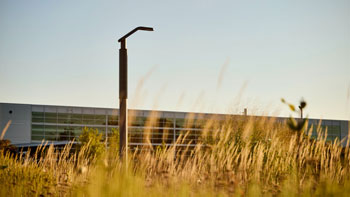
Planting of humanizing scale that seems wispy and delicate contrast with the architectural articulation of the spaces but used to extents and proportion as to humanize the ground plane. Large canopy trees are dotted along the main route, supported by substantial below ground volumes, while a secondary layer of smaller trees establishes more quickly within deeper planter zones. In non podium areas, greater thickets of shrubby material to provide forage and nesting as well as shelter are used, while underplanting of early bulbs provides a recurring seasonal signal across the site.
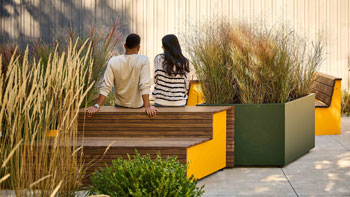
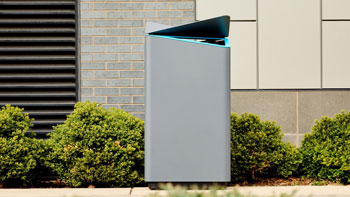
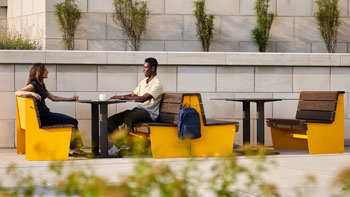
Materiality is robust and tactile, reflecting the urban character of the setting. Exposed aggregate concrete paving is complemented by stone detailing and cor-ten planters, providing durability while maintaining a refined texture. Significant level changes across the site are addressed through a combination of steps and lifts, ensuring full accessibility at all times. Seating with backs and armrests are dispersed along the routes at regular intervals, with increased clustering in sheltered and sunlit locations or when surrounded by planting.
The external spaces are not treated as a setting for the buildings, but as an equal and defining component of the overall composition, informing how the scheme is entered, navigated, and experienced over time. This approach allows the spaces between buildings to carry continuity and meaning, particularly within an evolving and fragmented context.
Credits:
Architects – Henry J Lyons
53.27882202979357, -6.211582274830053
73583


LILA 2026 Sponsor