New Sydney Fish Market
www.aspect-studios.com/
2026 Landscape and Architecture / 2026 Public Projects / Australia / Built in 2025 /

![The Sydney Harbour Bridge Cycleway Ramp delivers a long‑overdue piece of civic landscape infrastructure within one of Australia’s most recognised and carefully protected heritage settings. Officially opened in January 2026, the 185‑metre ramp provides a continuous, step‑free connection between central Sydney and North Sydney, transforming access across the Harbour Bridge for cyclists of all ages […]](https://landezine-award.com/wp-content/uploads/2026/05/01_HERO_SHB_CyclewayRamp_Ruth-Gold-1-600x337.jpg "Sydney Harbour Bridge Cycleway Ramp")
![The Alibaba Xixi Campus, a 26-hectare urban landscape, redefines ecological integration within a dense urban campus environment. This ambitious project, comparable in scale to London’s Hyde Park, showcases the power of the BioHabiNet concept, a strategic framework that weaves biodiversity, resilience, and human experience into a cohesive whole. At the heart of BioHabiNet lies a […]](https://landezine-award.com/wp-content/uploads/2025/05/00-ASPECT-Studios-Alibaba-Xixi-Campus-Park-C-Wangwenjie-16-600x337.jpg "Alibaba Xixi Campus (Park C) by ASPECT Studios")
![The Ribbon Playground has revitalized central Sydney’s connection to its iconic waterfront, creating an exciting and freely accessible destination for children and young people. Its opening marked the culmination of 12 years of design and collaboration with stakeholders. This high-impact harbourfront play space replaces a tired and nondescript area, now attracting families from across Sydney […]](https://landezine-award.com/wp-content/uploads/2025/05/00-TheRibbonPlayground-SaraVita-07-600x400.jpg "The Ribbon Playground by ASPECT Studios")
![The new Student Precinct at the University of Melbourne has transformed the on-campus student experience by delivering a collection of sophisticated indoor and outdoor spaces that meet the needs of a diverse student body. The precinct is both a major entrance to the university campus and the connective tissue between public transport nodes and nine […]](https://landezine-award.com/wp-content/uploads/2024/05/00-University-of-Melbourne-Student-Precinct-Peter-Bennetts-03-600x400.jpg "University of Melbourne Student Precinct")
![This vibrant public square is the embodiment of character, purpose, and a sense of community. It is a valuable contribution to daily life in North Sydney, Australia. Berry Square is a warm, green, and welcoming public space designed to cater to a growing and transforming residential community and to shift typical expectations about what is […]](https://landezine-award.com/wp-content/uploads/2024/05/00-BerrySquare-FlorianGroehn-02-600x400.jpg "Berry Square")
![A green jewel in Melbourne’s regenerating Docklands district, NewQuay Central Park consciously breaks from the area’s formal, linear, polished spaces to offer an assertion of wind and water in a pre-settlement landscape that connects people to a more fundamental sense of place. NewQuay Central Park envelops the new Banksia Apartments building in terraces and shading […]](https://landezine-award.com/wp-content/uploads/2023/05/00-ASPECT_Studios_NewQuayCentralPark_Main-Photo_Credit-Dianna-Snape-600x391.jpg "NewQuay Central Park")
![This porous city precinct in central Sydney layers different kinds of public activity to create a novel and generous urban experience. Comprising a sequence of places connected by a pedestrian-focused public domain, Quay Quarter builds upon the existing network of streets and laneways to create new platforms for public activity. The project stitches together the […]](https://landezine-award.com/wp-content/uploads/2023/05/00-ASPECT_Studios_QuayQuarterLanes_Main-Photo_Credit-FlorianGroehn-600x400.jpg "Quay Quarter Lanes")
![The Urban Retreat knits a skyscraper into the urban fabric of Shenzhen’s Qianhai district by creating a lush park that emphasizes the qualities of both the tower and the city. Responding to the intensity of life in downtown Shenzhen, the design reconsiders the fundamental form of the park itself, creating something that offers both an […]](https://landezine-award.com/wp-content/uploads/2023/05/00-ASPECT_Studios_Hony-Tower-04-Credit-Wenjie-Wang-copy-600x480.jpg "Hony Tower")
![The Central Courtyard Precinct at Macquarie University improves the educational experience by integrating student values at the core of its design. It takes the form of a green heart for the University campus that supports students socially and emotionally. The precinct expands and blurs educational conventions to create a generous outdoor space that elevates and […]](https://landezine-award.com/wp-content/uploads/2022/05/00-MacquarieUniversity-BrettBoardman-HERO-600x400.jpg "The Central Courtyard, Macquarie University")
![The municipality of Chongqing, in China’s southwest, is home to more than 32 million people who live in a dense megalopolis. As is the case in many Asian cities, increased density comes with reduced access to meaningful public open space and proximity to areas for recreation and for the community to come together. The Ring, […]](https://landezine-award.com/wp-content/uploads/2022/05/00-THE-RING-Wang-Wenjie-Hero-Image-600x337.jpg "The Ring")
![Prahran Square responds to the a very real need for to create more public open space in a dense and diverse inner-city neighbourhood of Melbourne. It is a leading example of a new form of urban spaceplace;, a hybrid typology that combines urban park, square, amphitheatre, waterplay, and & sensory garden, lawn, streets, car park […]](https://landezine-award.com/wp-content/uploads/2021/05/00-PrahranSquare-PeterBennetts-600x391.jpg "Prahran Square")
![Sub Base Platypus in Kirribilli, Sydney, which is on the traditional lands of the Cammeraygal has a rich and interesting history. In 1876, the site had its first major transformation, becoming a gasworks for residents of North Sydney. In 1942, it was transformed into a torpedo factory to support the war effort, and in 1967 […]](https://landezine-award.com/wp-content/uploads/2021/04/00-SubBasePlatypus-FlorianGroehn-600x415.jpg "Sub Base Platypus Precinct")
![Despite being one of the most popular coastal trails in Australia, the Bondi to Bronte Coastal Walk was closed over concerns for the safety of its users due to significant erosion from a storm surge which slammed Sydney in June 2016. This granted an opportunity to rethink, redevelop and restore the famous track, also home […]](https://landezine-award.com/wp-content/uploads/2021/04/00-Bondi-Bronte-Florian-Groehn-600x400.jpg "Bondi to Bronte Coastal Walk Extension")
![The Roof | Bold. Biophilic. Identity Unlike the hustle and bustle of contemporary Shanghai, the Li’long streets intrinsically immerse people into a slow-paced environment at human scale. The designers were deeply inspired by the linear corridors framed with vivid red brick and beige walls, paired with an abundance of potted and cascading plantings. The DNA […]](https://landezine-award.com/wp-content/uploads/2021/04/00-The-Roof-Project-Main-Photos-600x422.jpg "The Roof")
![The Hyperlane is a 2.4km multi-level linear sky park, and aims to be a social-orientated, pocket place for the community to come together. The vision was to create a hyper connective, multiple level linear social platform that responded to the unique and characteristics of the students. The design connects in every direction, creating a barrier […]](https://landezine-award.com/wp-content/uploads/2021/04/00-Urban-Gallery-Hero-Image-600x444.jpg "The Urban Gallery at Hyperlane, Chengdu")
![The Caulfield to Dandenong Level Crossing Removal Project is a Victorian State Government project to remove nine at-grade level crossings along 16km of a major railway corridor and across seven suburbs in Melbourne’s south-east. ASPECT Studios and Cox Architects collaborated with multidisciplinary partners to deliver an elevated rail solution far more sophisticated and visionary than […]](https://landezine-award.com/wp-content/uploads/2020/05/00-Caulfield_to_Dandenong_Level_Crossing_Removal_Project_PeterBennetts-600x391.jpg "Caulfield to Dandenong Level Crossing Removal Project")
![Darling Square embodies a new urban typology; fusing landscape, architecture, art, food and culture. A captivating new world-class urban neighbourhood has rejuvenated the heart of Sydney. It is home to 4,200 residents, 2,500 workers, and more than 60 retail and food outlets, attracting visitors and locals alike. The project is located at the southern end […]](https://landezine-award.com/wp-content/uploads/2020/04/00-HERO_Darling-Square_photo-by-Brett-Boardman-600x555.jpg "Darling Square")
![Yagan Square is a project of local and state significance for the city of Perth and Western Australia, located at the east end of the new MRA Citylink development which seeks to physically reconnect Northbridge with the Perth’s CBD (and the Swan River). Yagan Square is located within one of the city’s busiest pedestrian zones, […]](https://landezine-award.com/wp-content/uploads/2019/04/XX-IMAGE-1_HERO-Yagan-1-600x424.jpg "Yagan Square")
![Project Ambitions Melbourne is a growing and densifying city, entering a period of growth of above 6% and will eventually grow larger than Sydney. The city’s rail system has not been improved for some time and is now over capacity. A few years ago, the government launched a program to remove level crossings between roads […]](https://landezine-award.com/wp-content/uploads/2019/04/XX-HERO-Caulfield_to_Dandenong_Level_Crossing_Removal_Project_PeterBennetts-600x391.jpg "Caulfield to Dandenong Level Crossing Removal Project")
![A colorful and bold people-oriented design brings a community social plaza to the people of Hefei, Anhui, China where community space is dominated by empty plaza or complicated trails. Sitting in a developing district, Paradise Art Wonderland mainly serves for millennials who have a unique pursuit for high-quality urban living environment. Responding to the increasing […]](https://landezine-award.com/wp-content/uploads/2018/04/Wantou-Vanke-Paradise-Art-Wonderland_ASPECT-Studios_19-MAIN-IMAGE-600x400.jpg "Paradise Art Wonderland")
The redevelopment of the new Sydney Fish Market represents a reconfiguration of Sydney’s working harbour into an accessible civic landscape. Conceived as a continuous public domain rather than a singular object, it reshapes the edge of Blackwattle Bay by integrating industrial harbour operations, public space and ecological systems within a shared waterfront terrain.
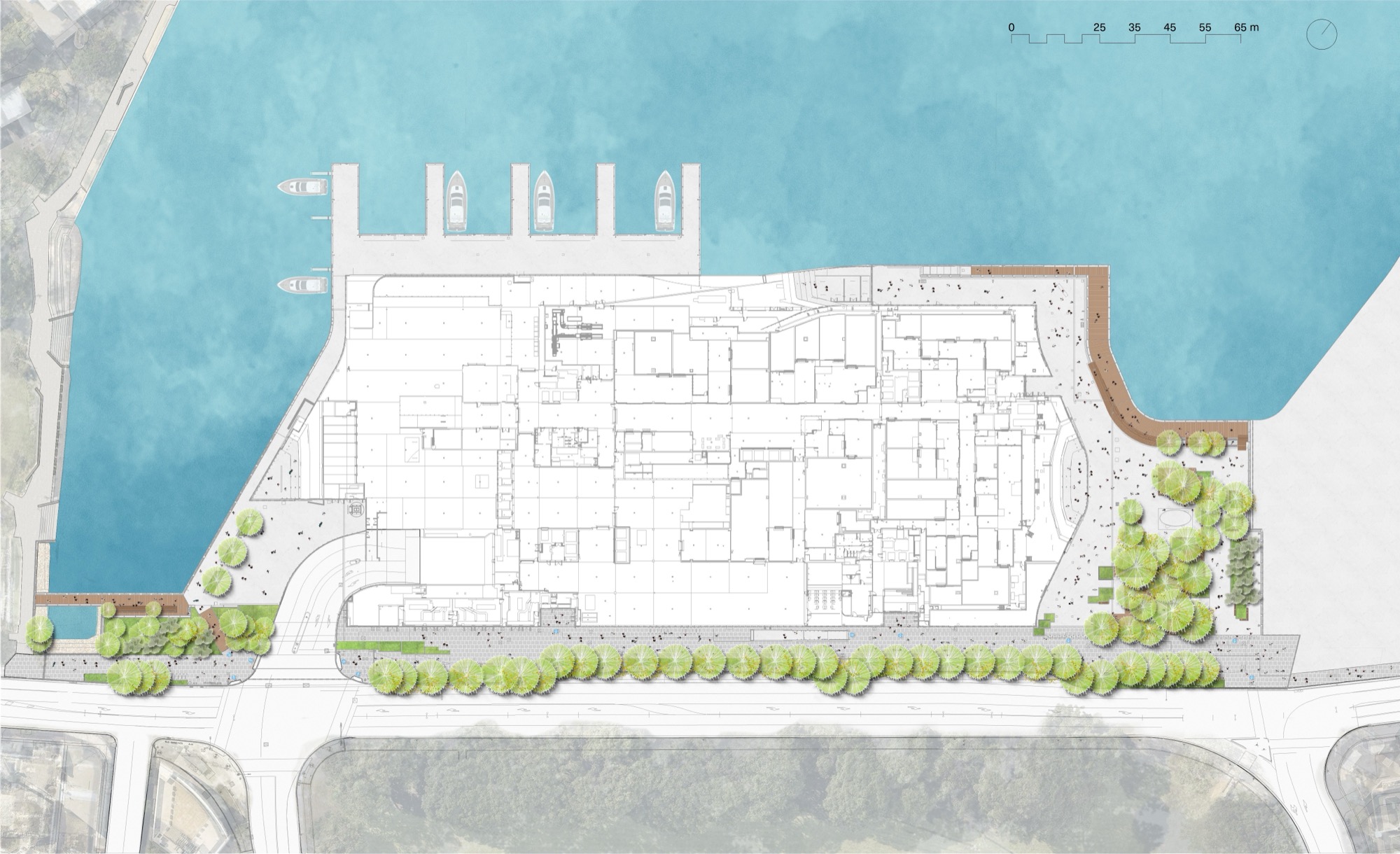
The project is structured as a landscape framework, with the public domain operating as the site’s primary organisational system. Movement, access, ecological processes and harbour operations are coordinated through a single, continuous ground condition that prioritises connectivity and legibility over fixed boundaries or discrete forms.
The working harbour is understood as civic and ecological infrastructure rather than a background function. Commercial fishing activity remains visible and proximate, reinforcing the site’s identity as a productive landscape where social, economic and environmental exchange continue as part of everyday public life.
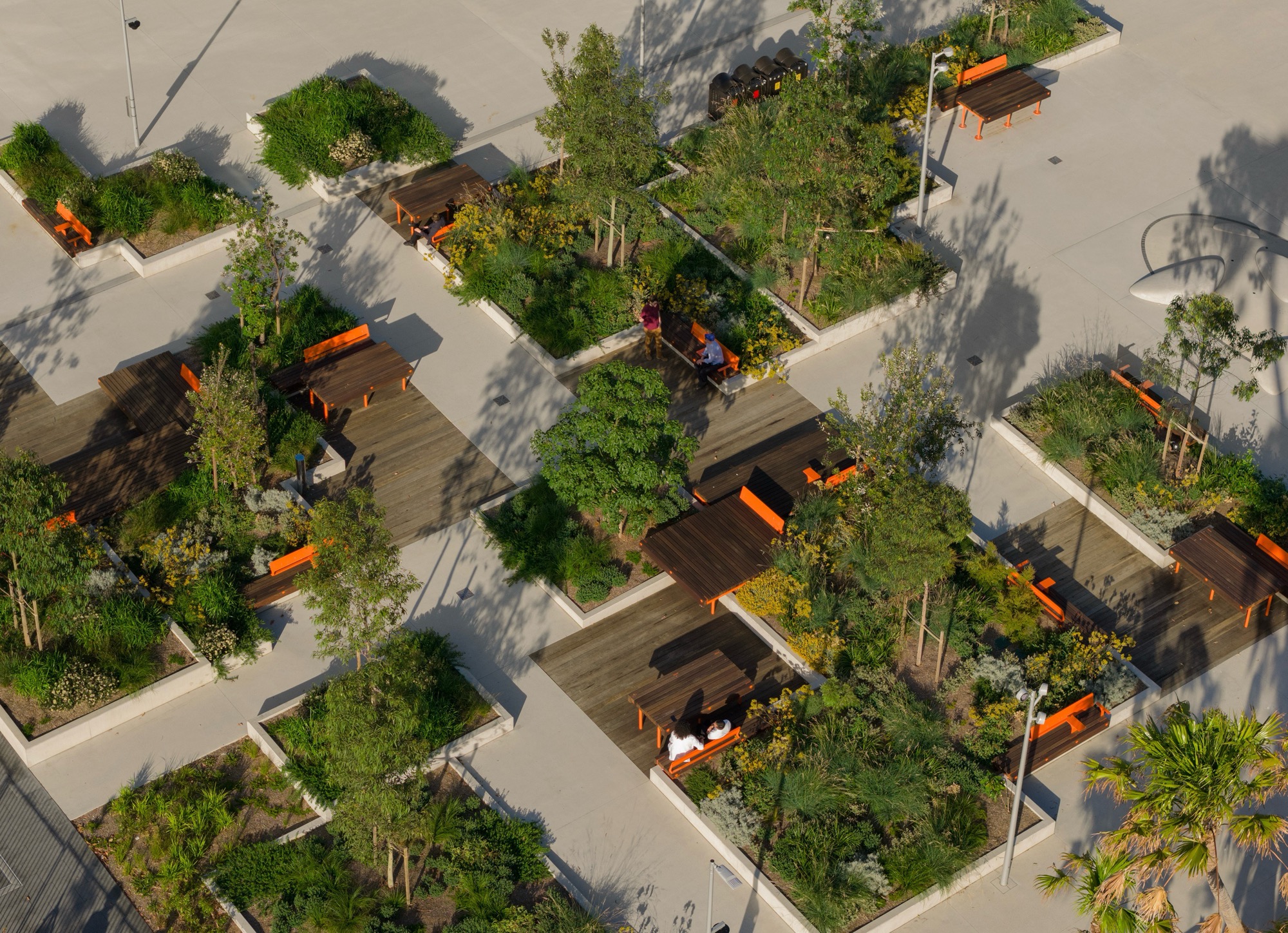
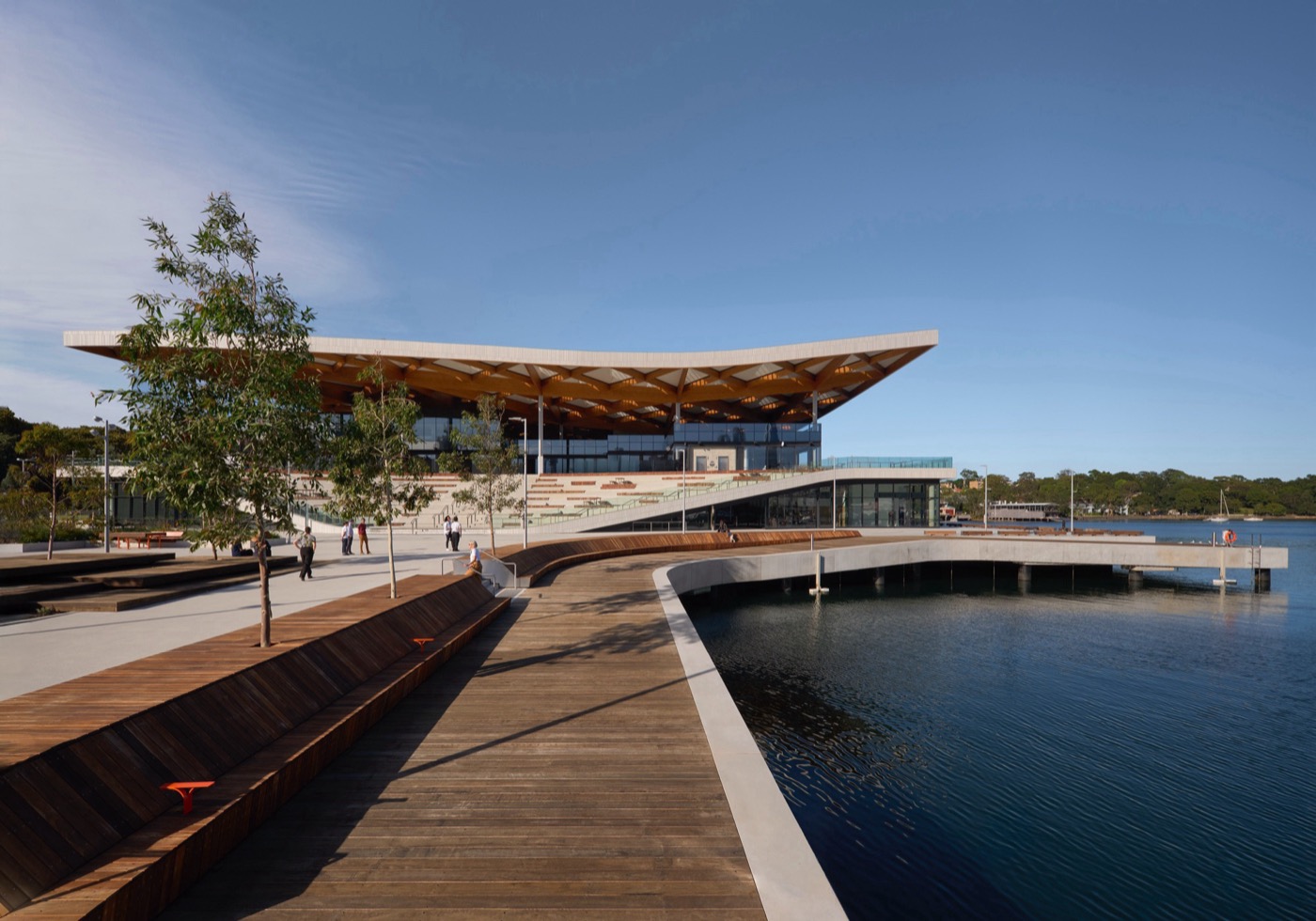
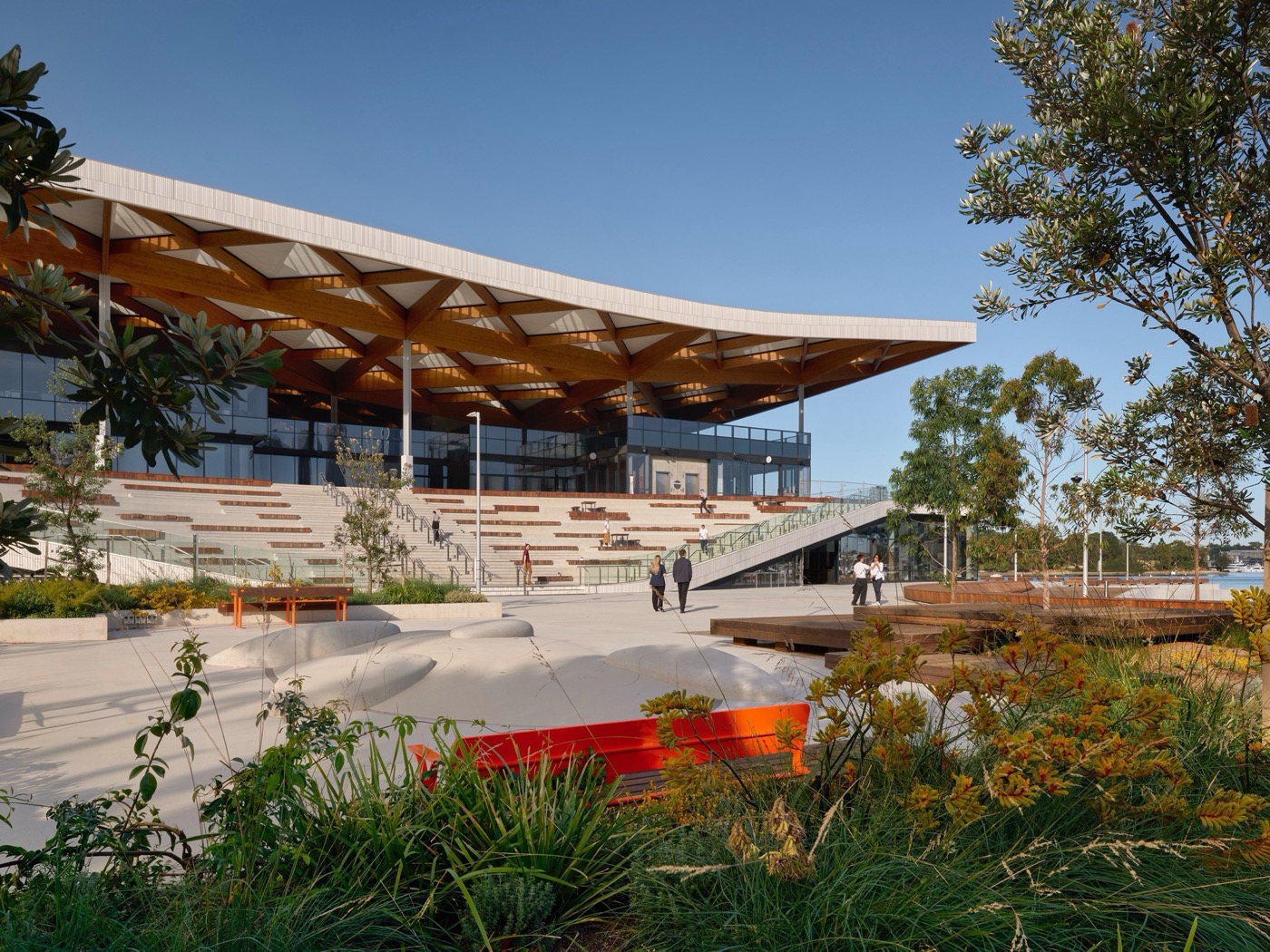
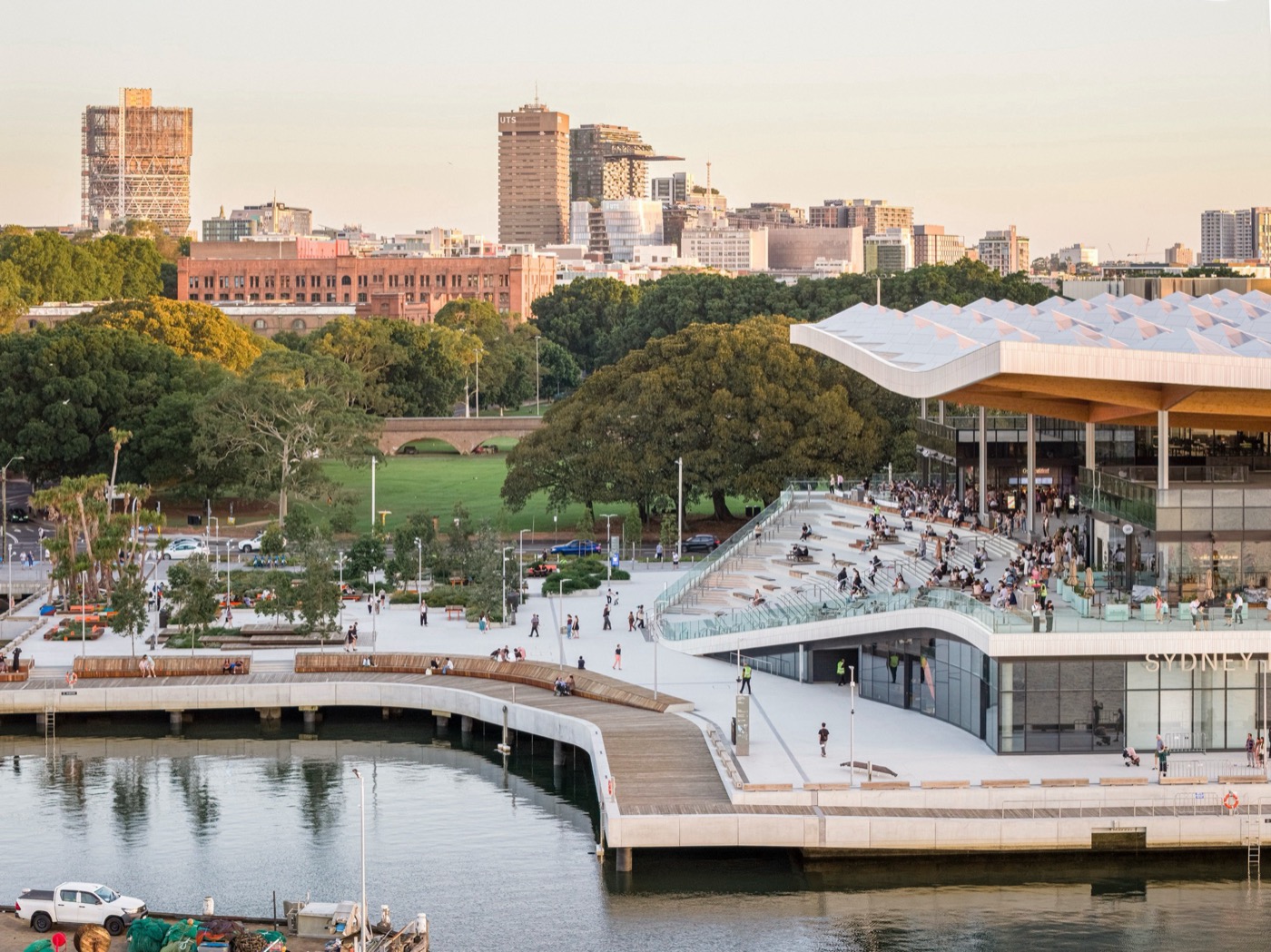
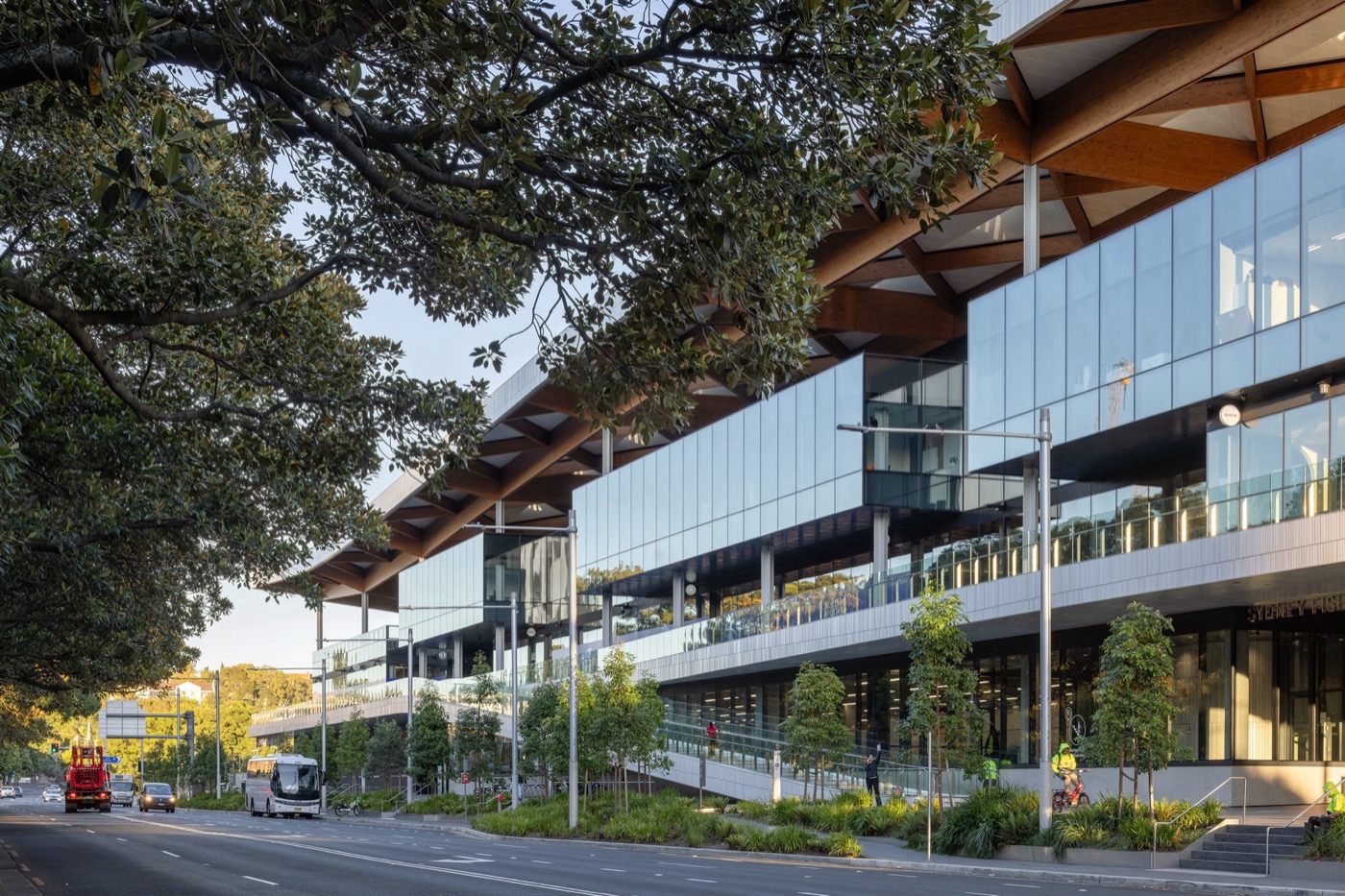
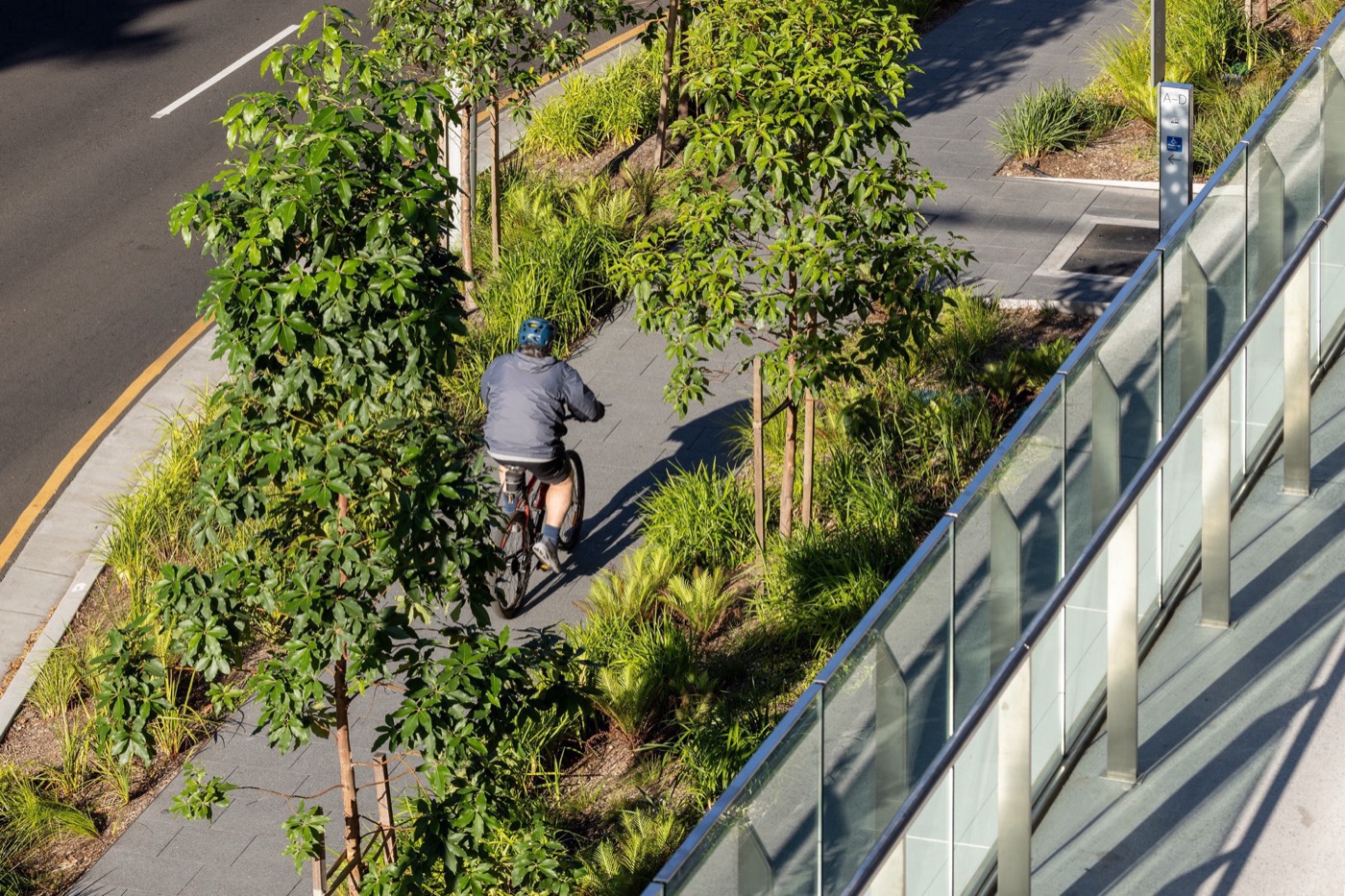
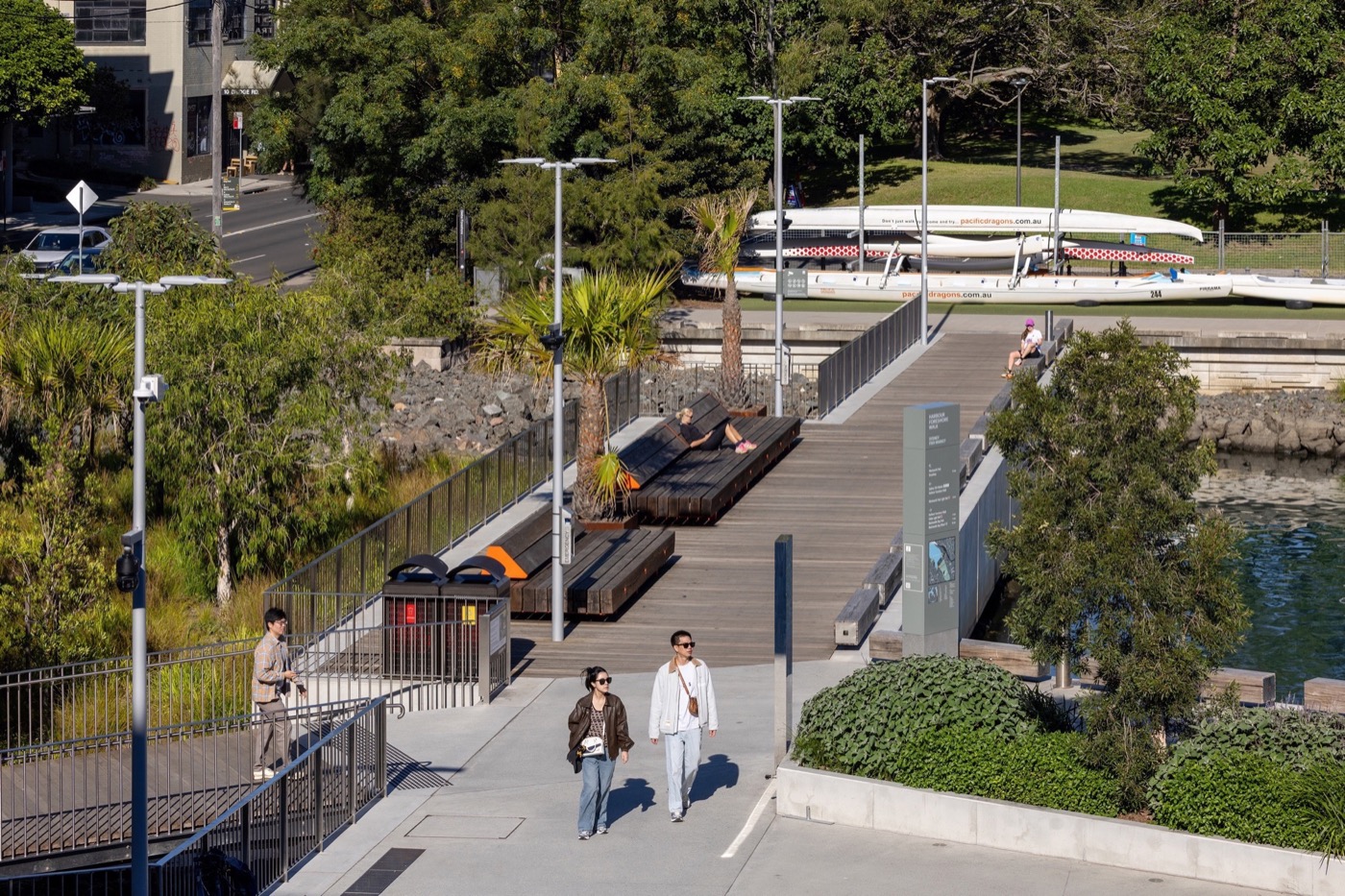
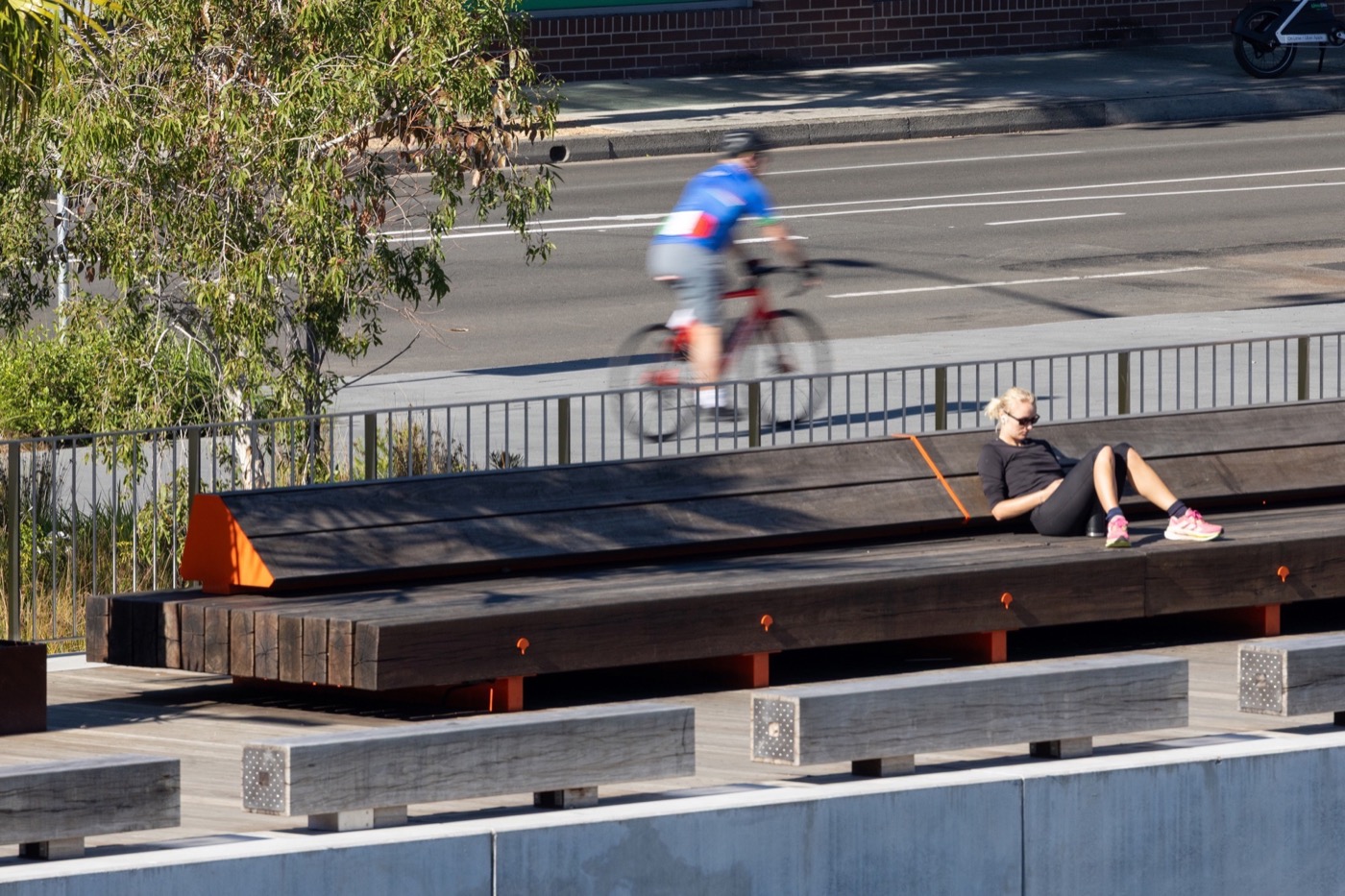
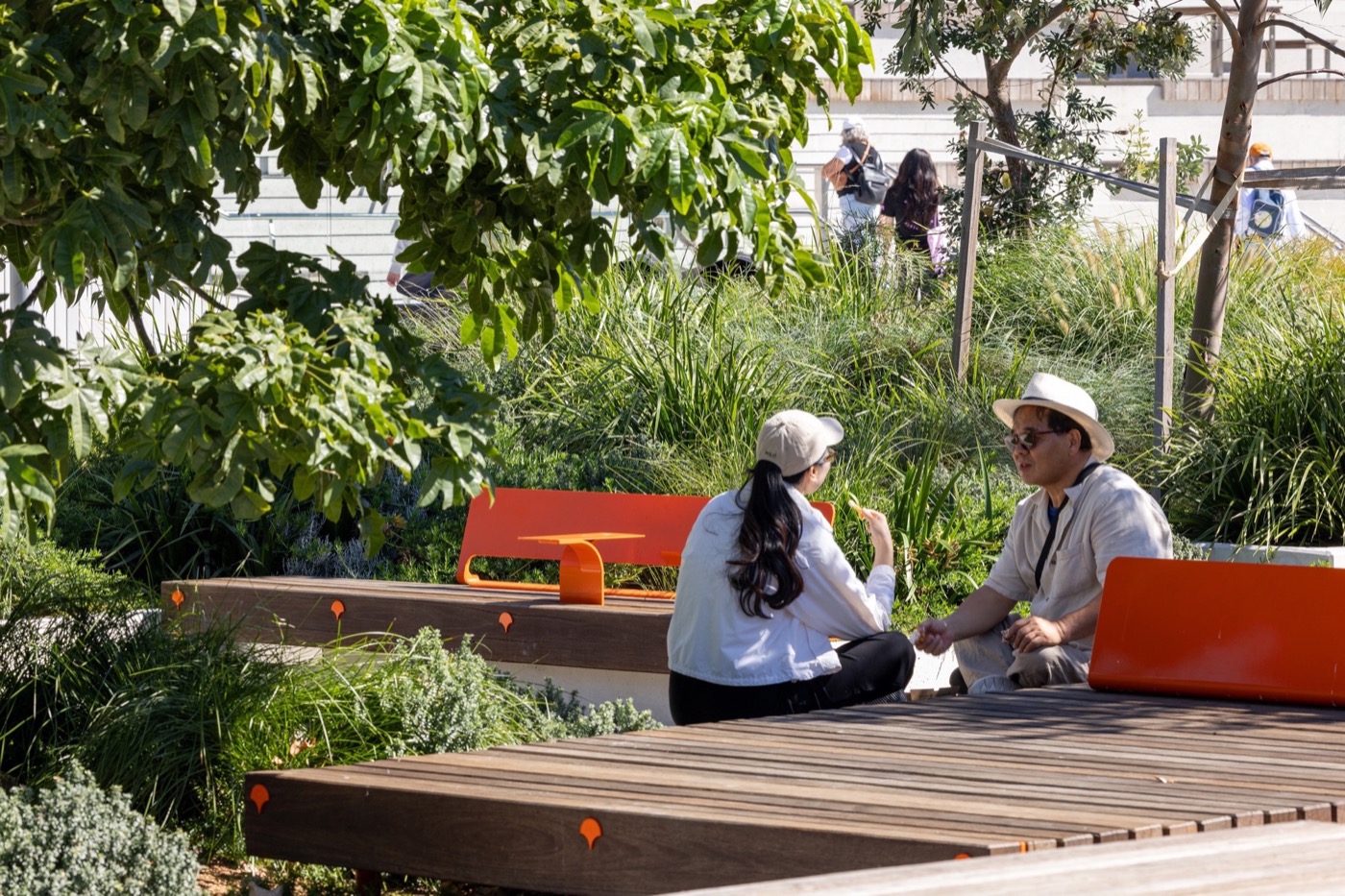
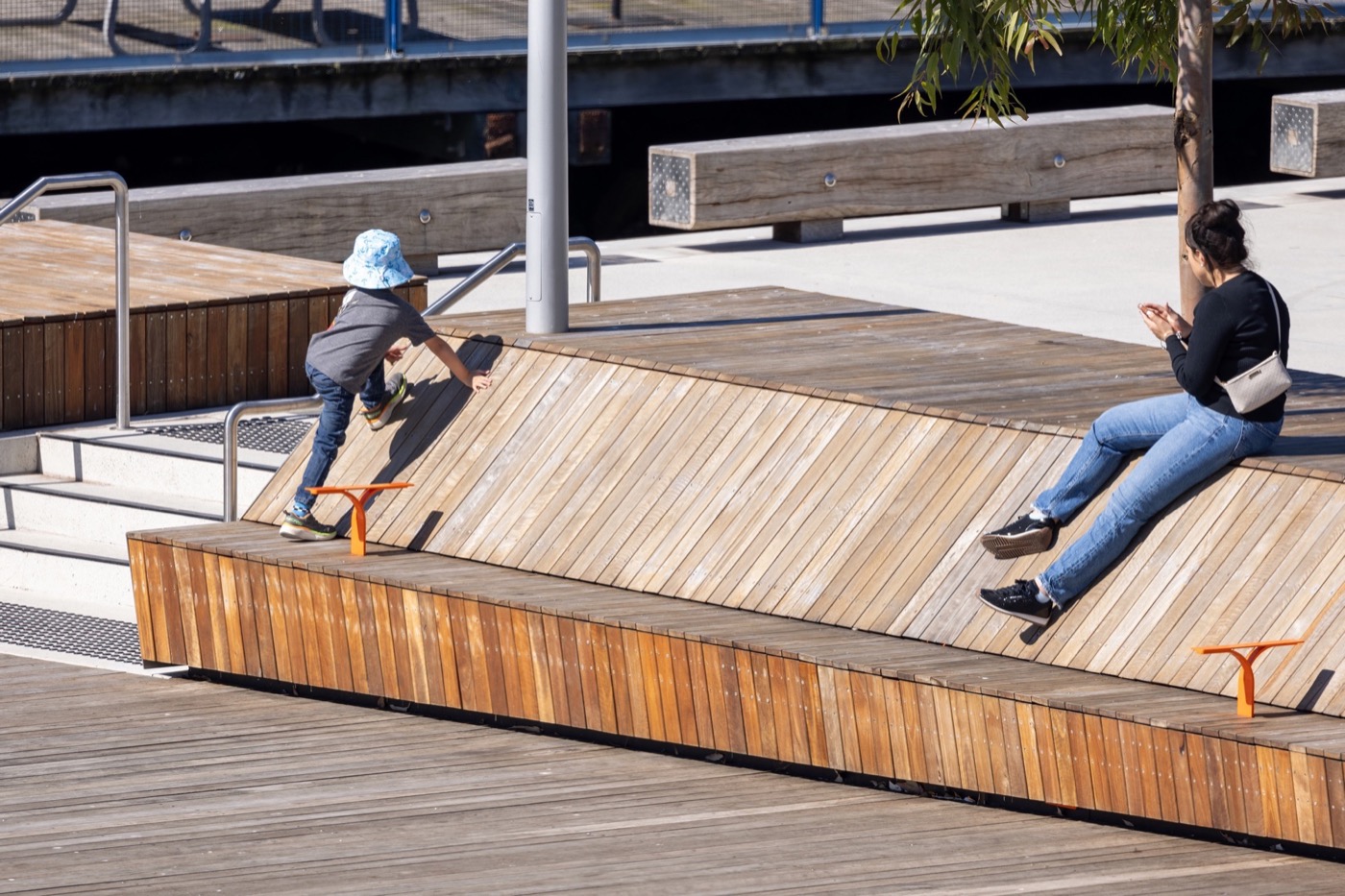
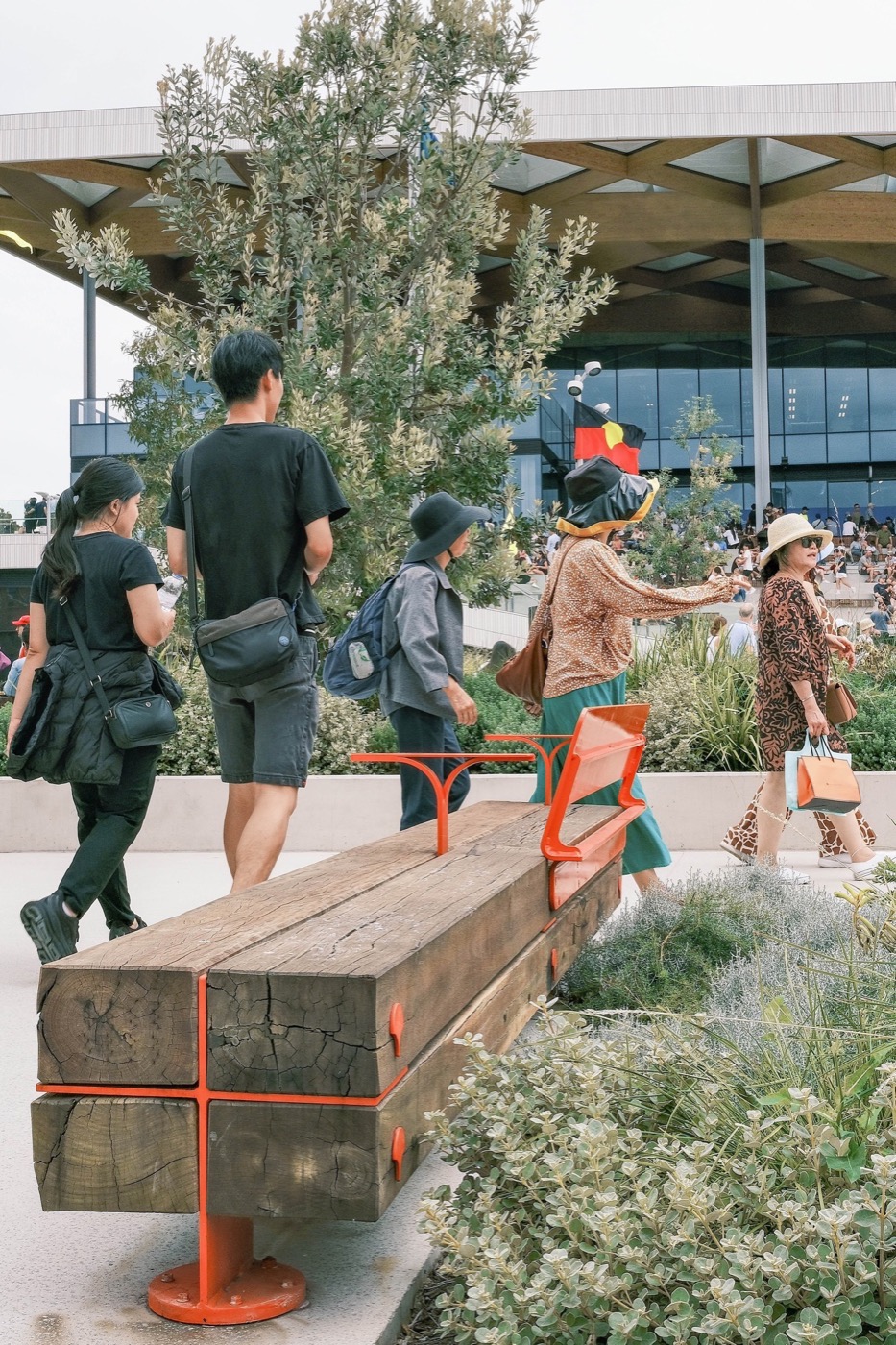
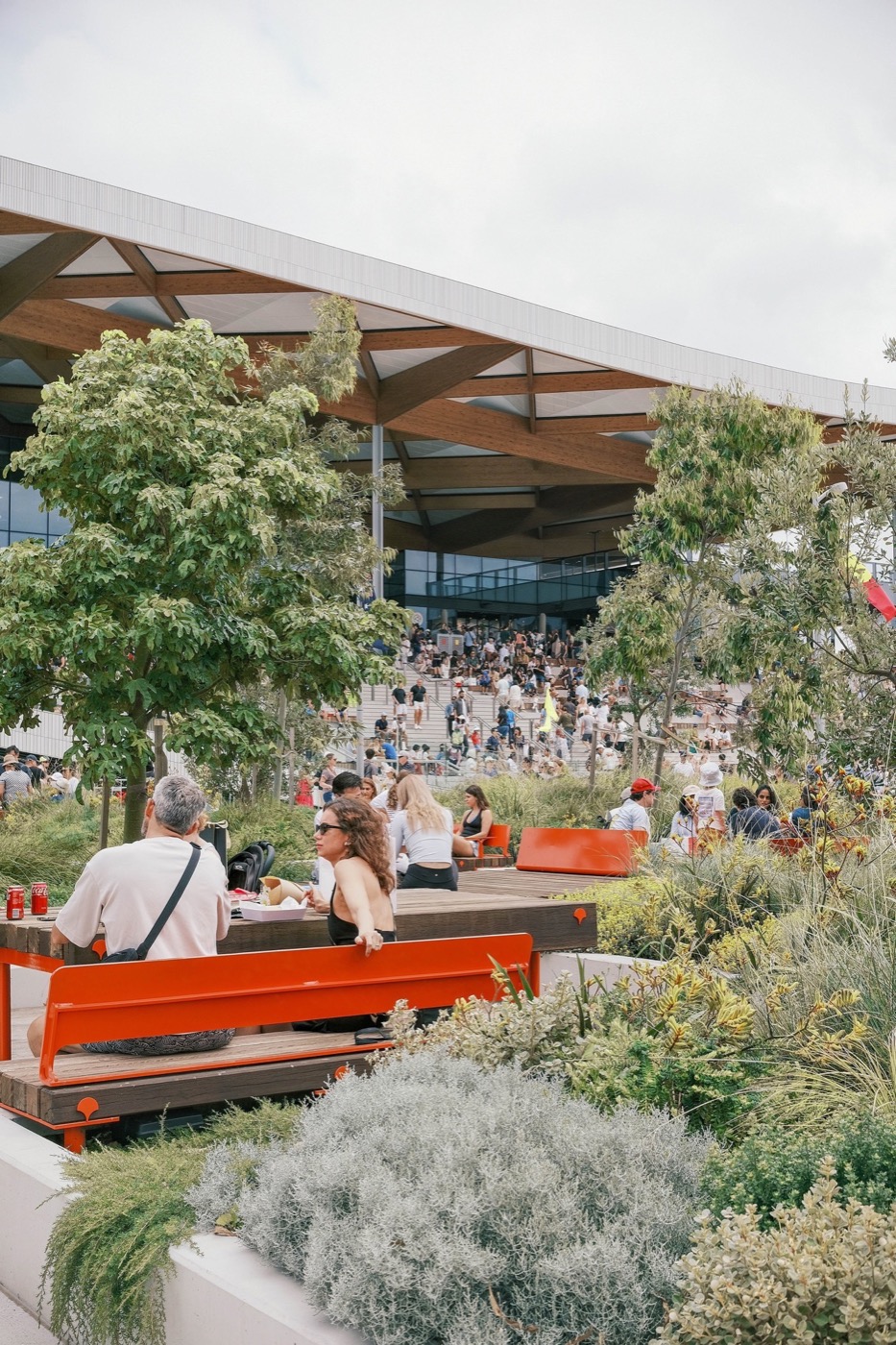
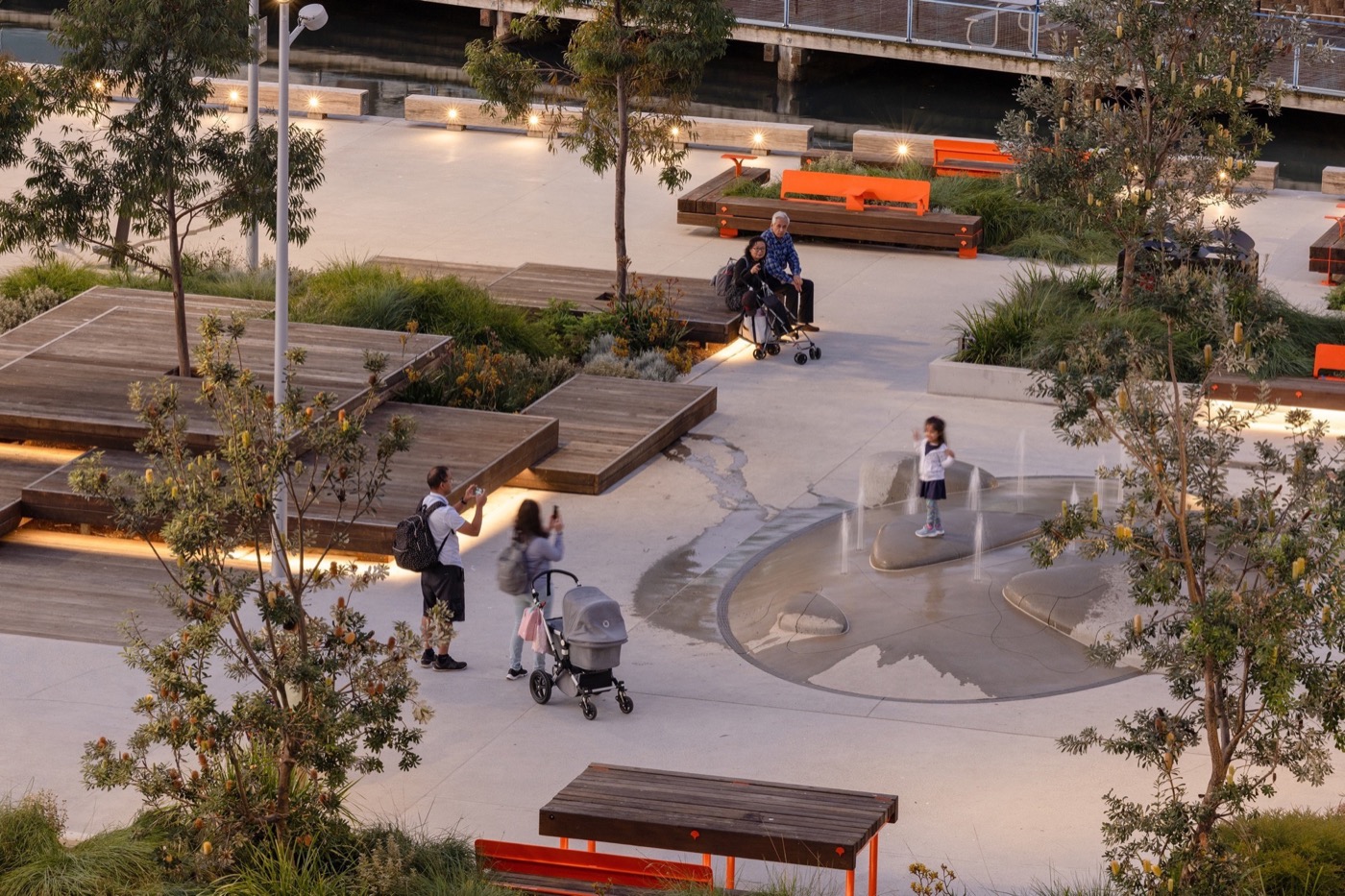
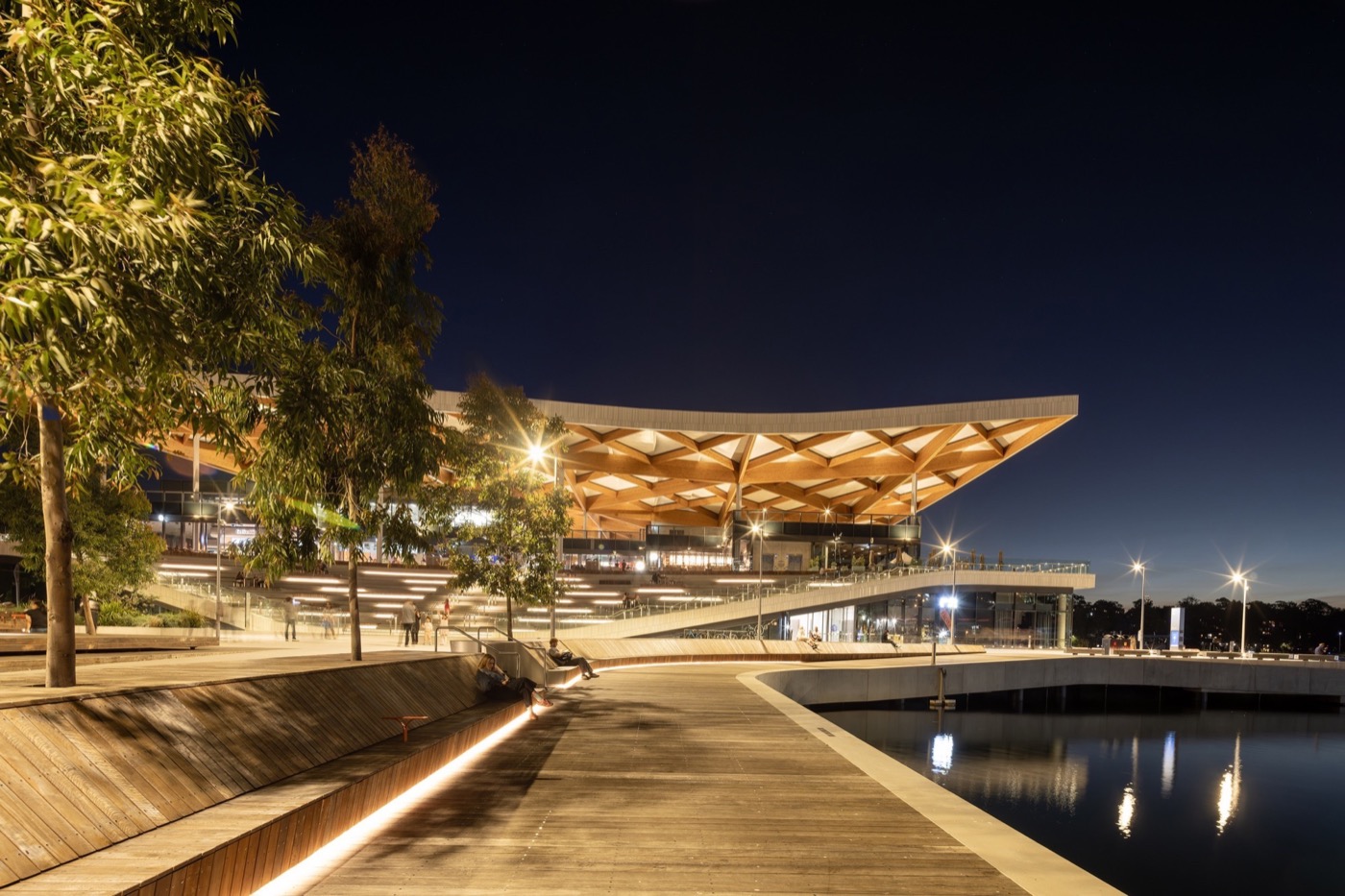
A waterfront promenade forms a key connective armature, extending the Glebe Foreshore Walk and establishing a continuous pedestrian link to Pyrmont. In doing so more than 6,000sqm of new public open space is made accessible, returning a previously restricted stretch of Sydney Harbour to daily occupation. The landscape operates across scales, functioning simultaneously as neighbourhood connection, metropolitan foreshore link and public threshold to the working harbour. The new public domain is a key piece in the evolution of a 15km continuous foreshore walk from Woolloomooloo to Rozelle Bay, which will create one of the world’s longest urban waterfront walks.
Harbour activity is deliberately retained within the public realm. Purpose-built wharves allow fishing vessels to berth directly alongside public space, enabling unloading and exchange to remain legible elements of daily operation. Gently sloping promenades and stepped edge conditions bring people close to the water while maintaining clear, accessible circulation. Public access and maritime infrastructure are not separated; instead, the landscape enables their coexistence through spatial continuity and careful gradation.
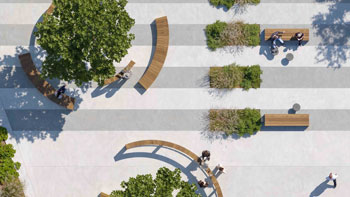
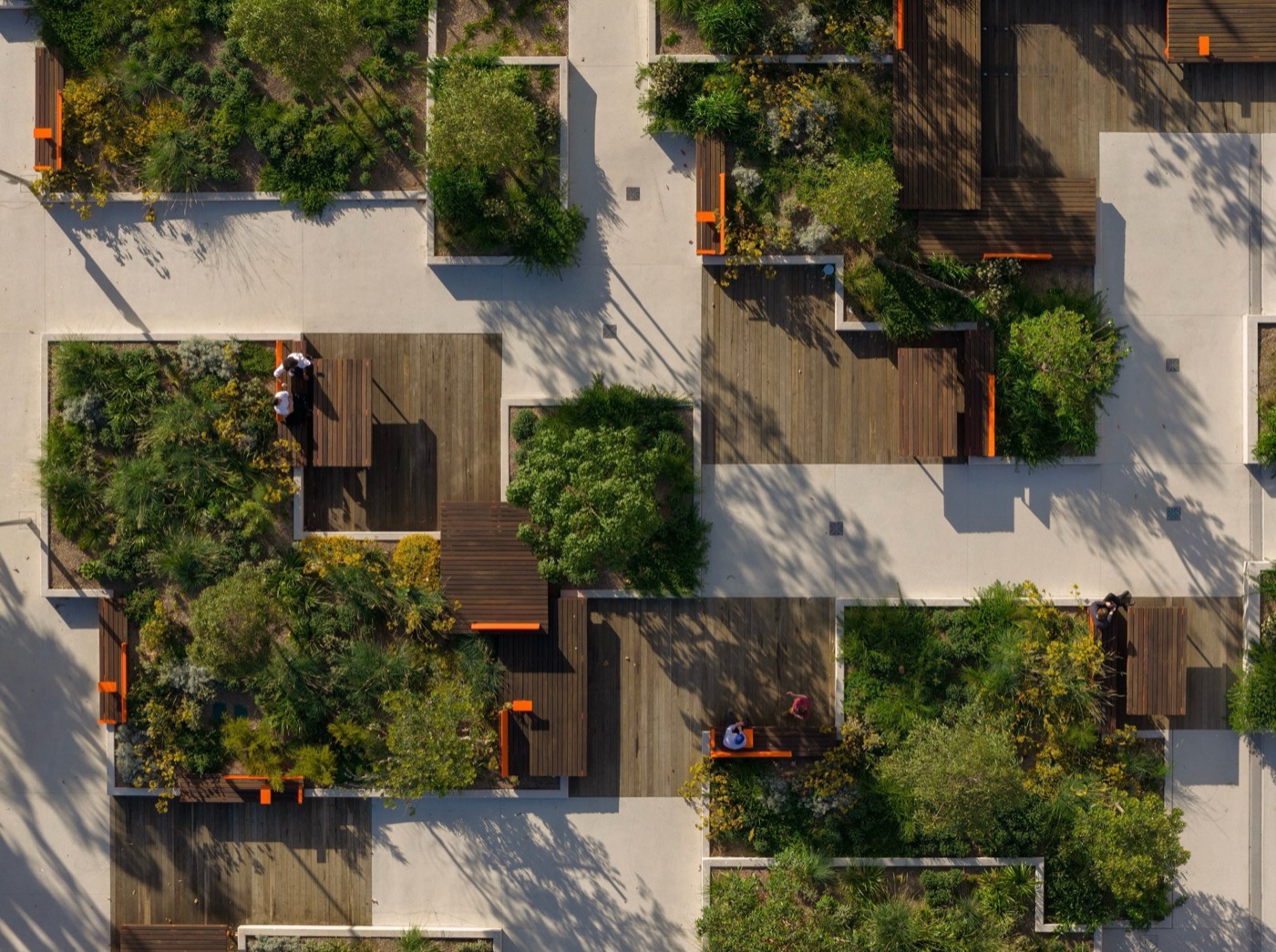
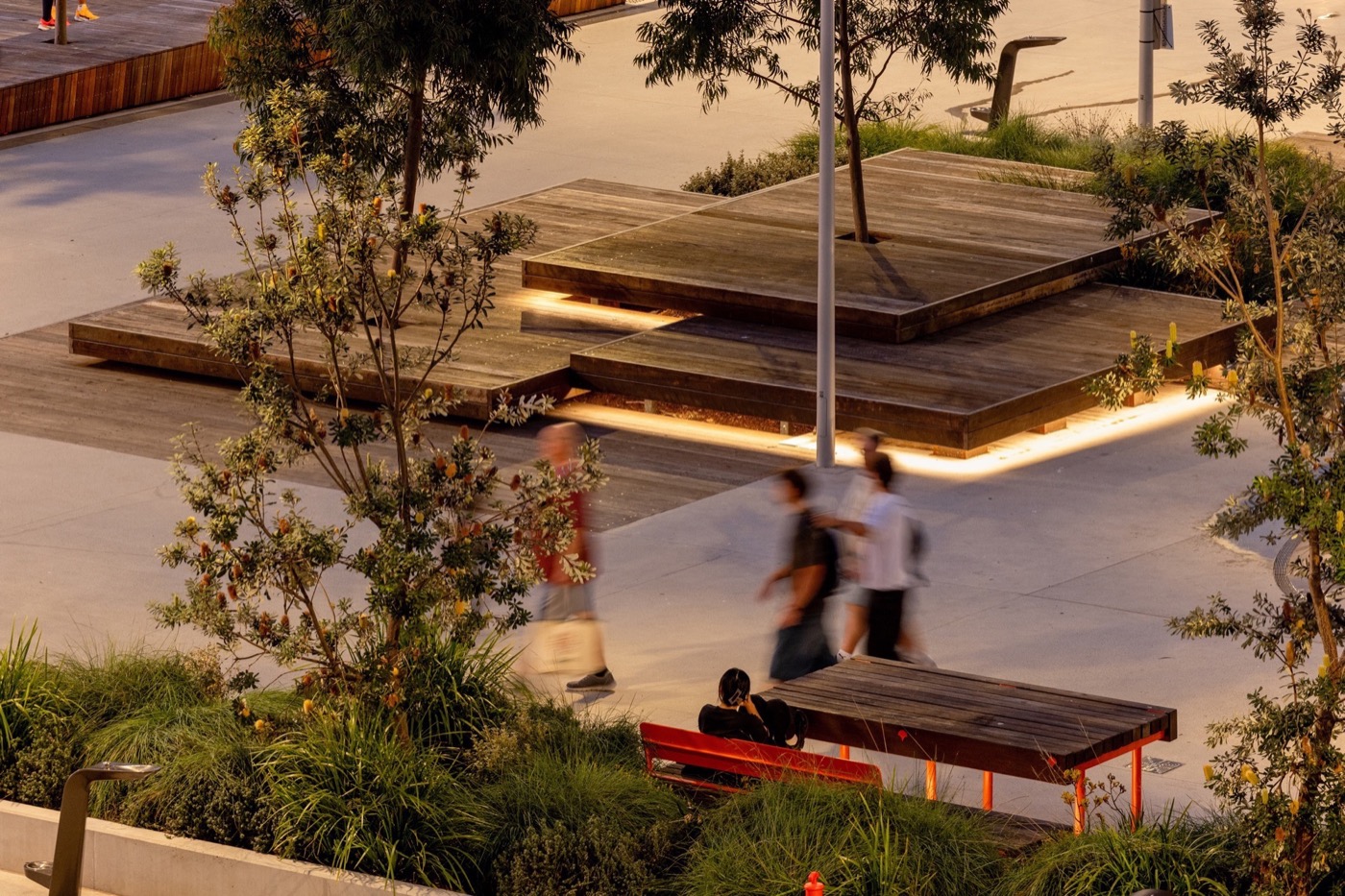
The ground plane sets the project’s spatial logic. A network of plazas, promenades, terraces and steps supports fluid movement along and across the harbour, strengthening foreshore continuity. Terraces, ramps and broad steps mediate between water, wharf and city, creating gradual transitions. Varied edges enable informal gathering and pause, allowing everyday use to emerge without prescriptive programming. This public domain forms a flexible framework able to adapt to changing use, climate and operational needs over time.
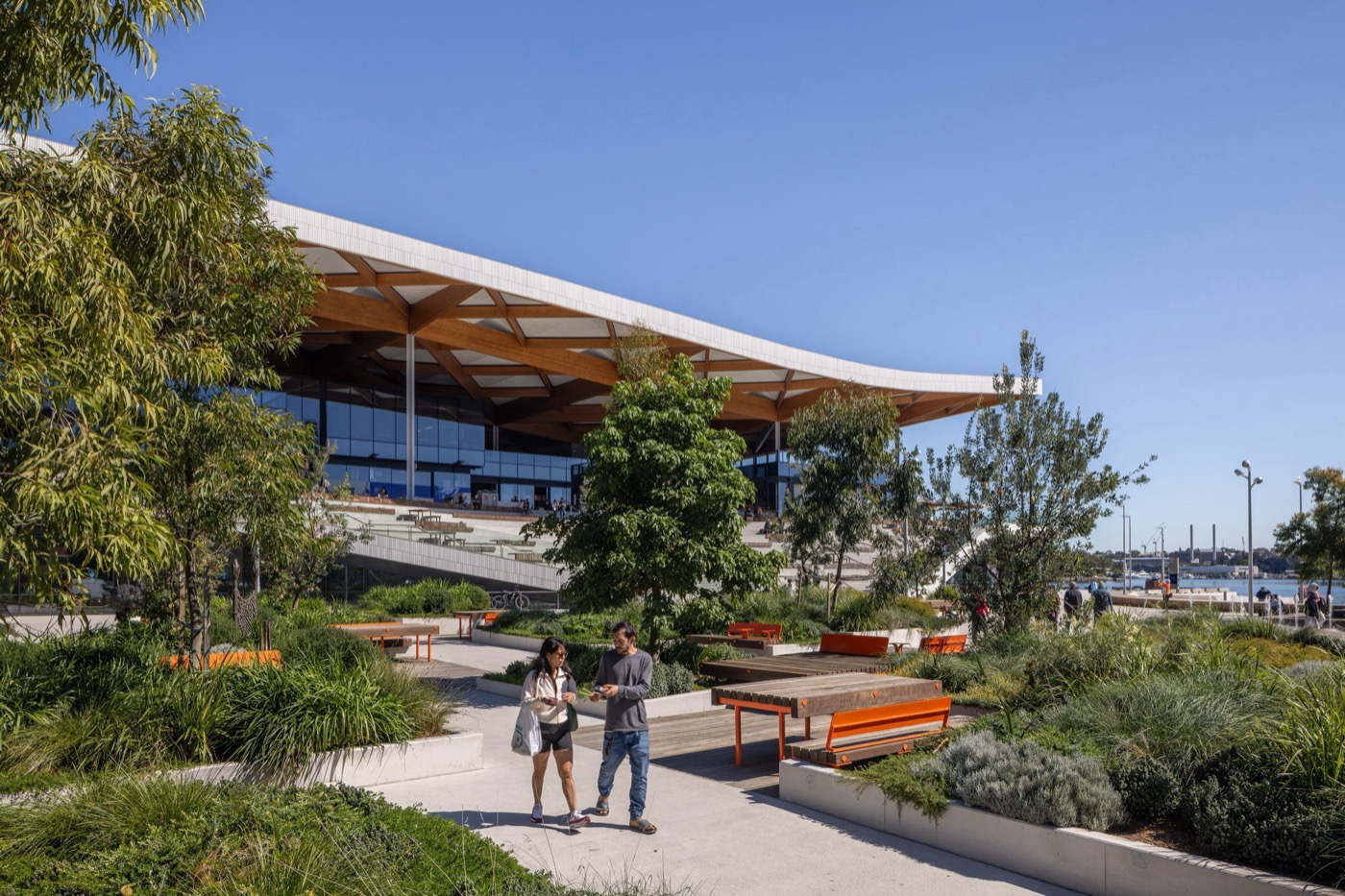
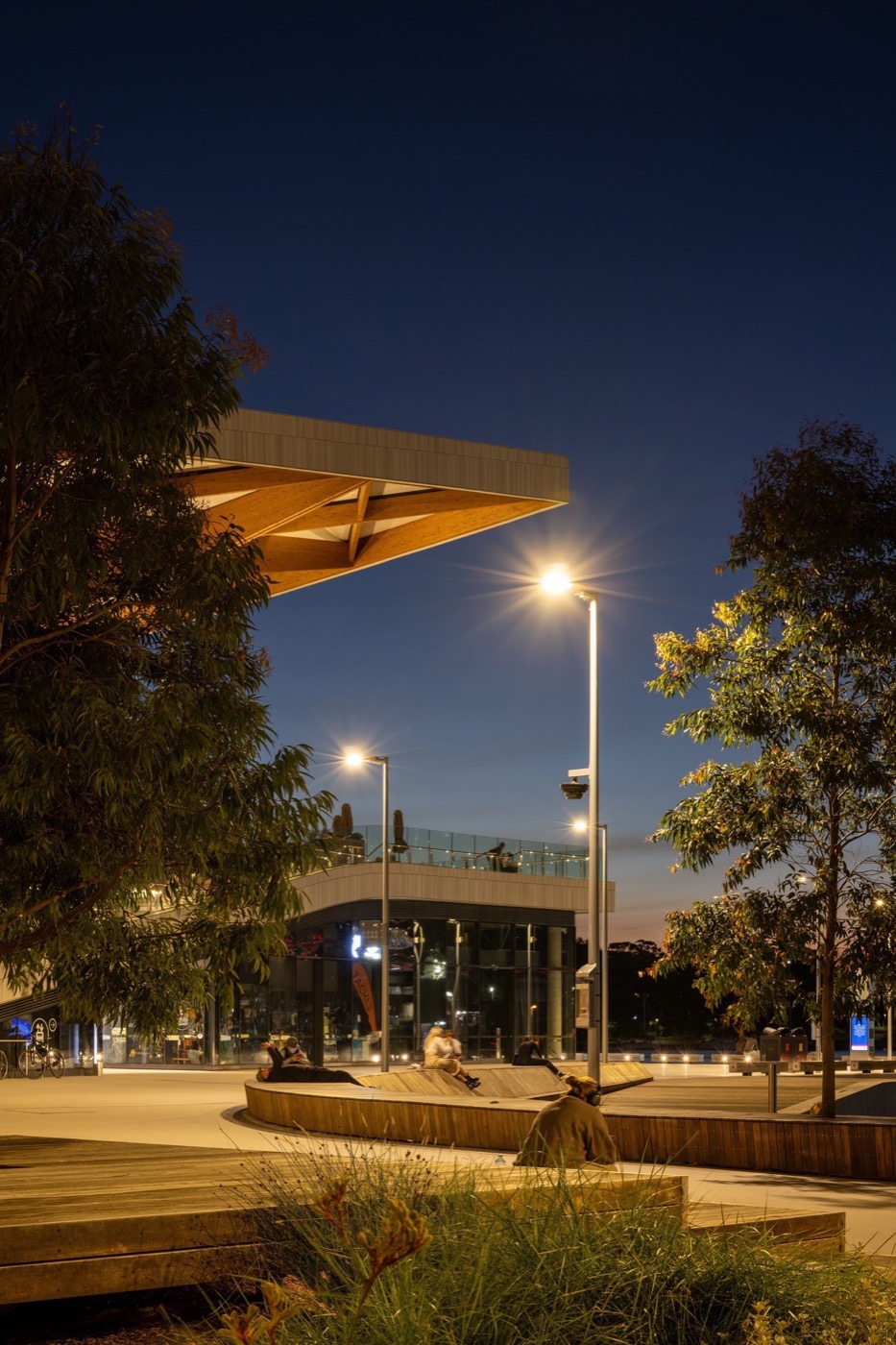
Above the ground plane, a continuous roof structure contributes to environmental moderation across the site. As an inviting architectural gesture, it supports the public realm by shaping light, shade and ventilation, contributing to a shared microclimate that benefits both market activity and outdoor occupation. Landscape and built form operate together as an environmental system, reinforcing continuity between ground and structure.
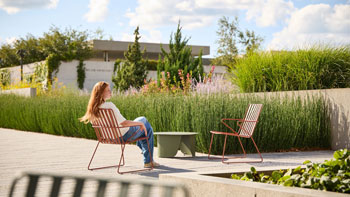
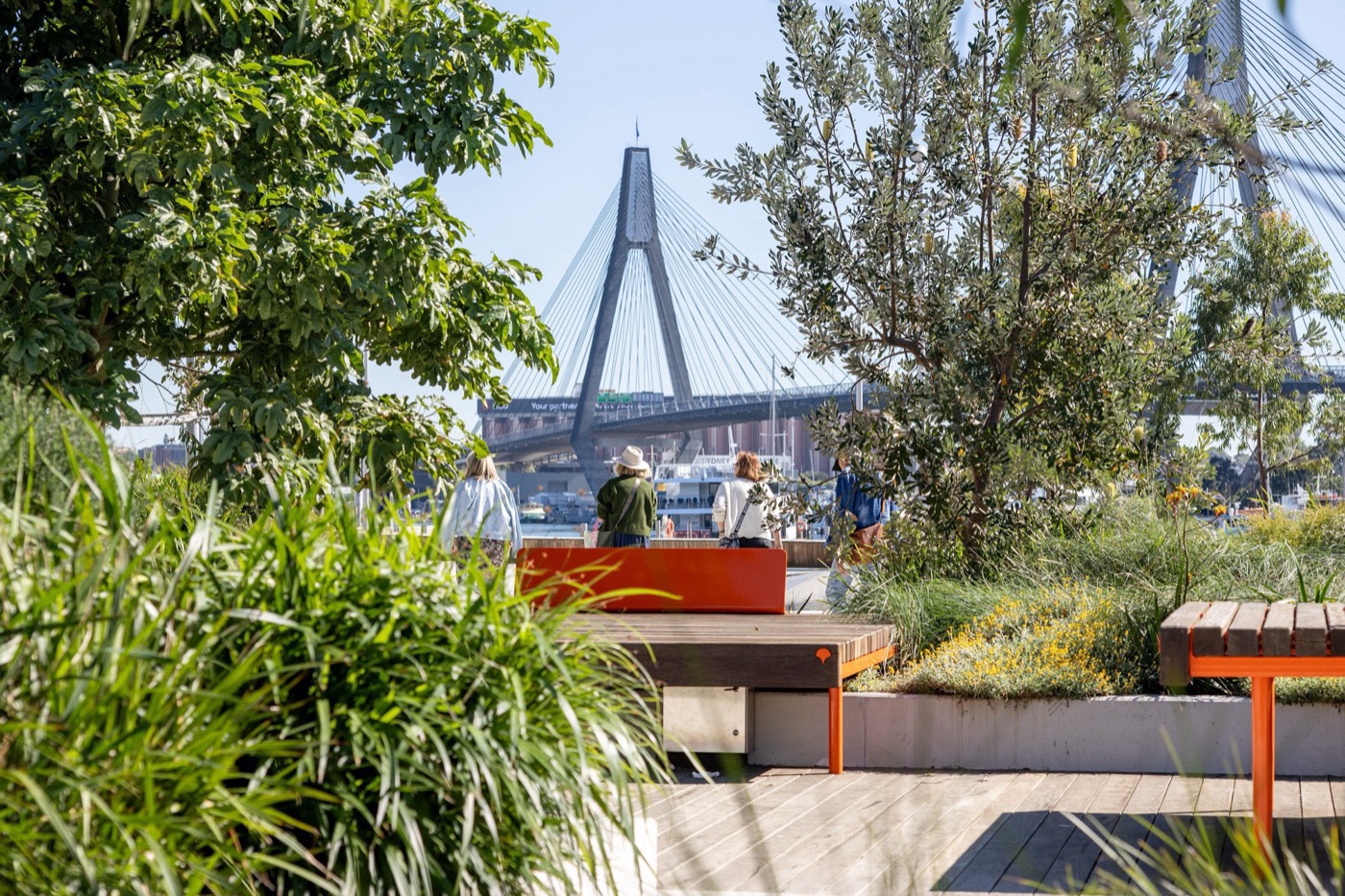
Rainwater capture, treatment and reuse reduce potable water demand, while living seawalls and in-water interventions enhance habitat complexity and improve the ecological condition of Blackwattle Bay. A native planting strategy introduces shade, shelter and seasonal variation, strengthening biodiversity and improving comfort throughout the public domain.
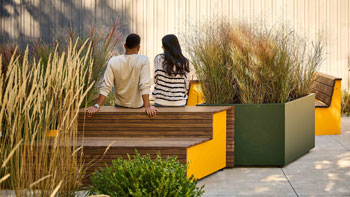
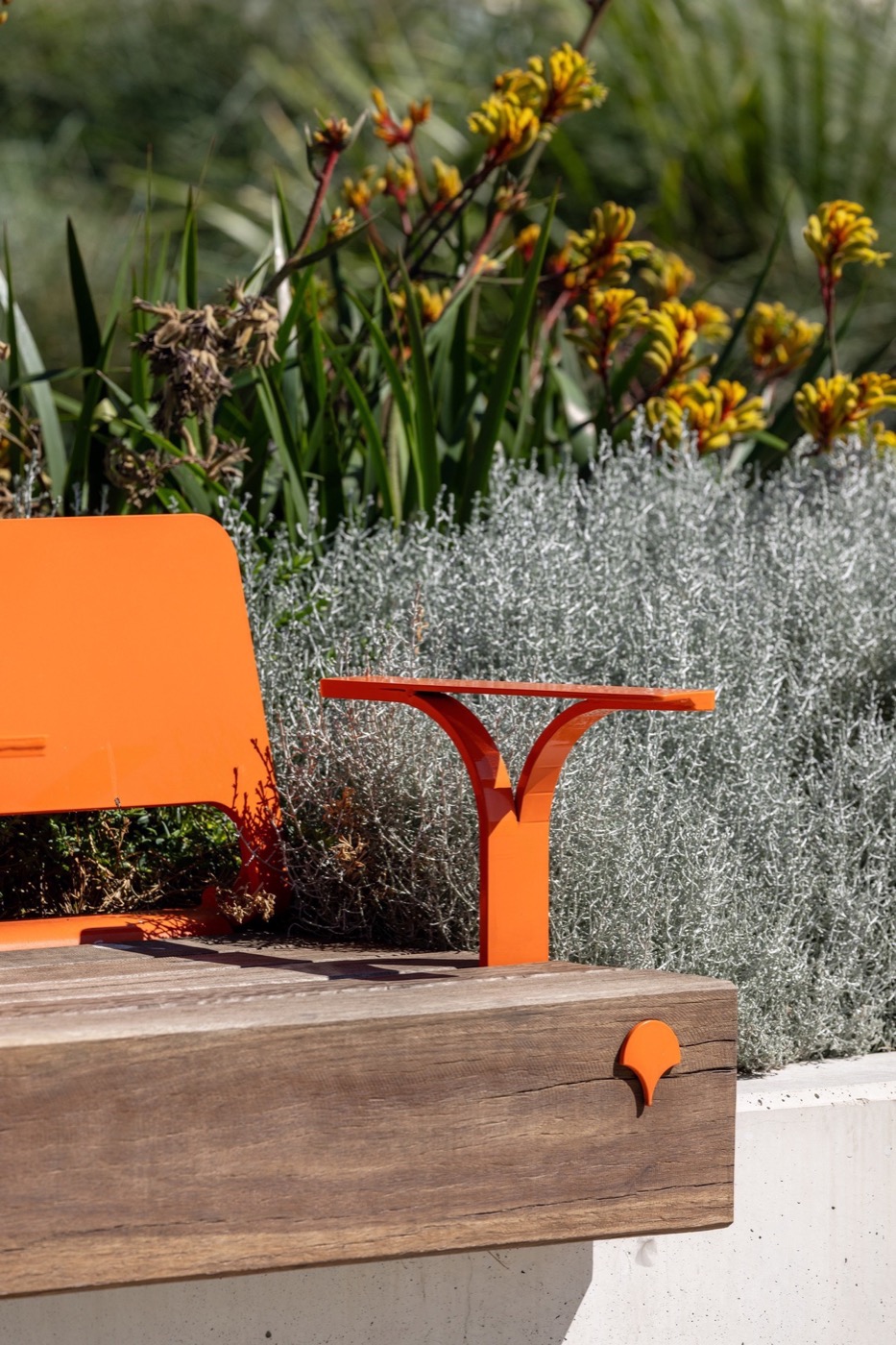
Material strategies draw from the site’s industrial character, favouring durable elements intended to weather over time. Furniture features Australian hardwoods – wharflike in character, with robust details that speak to the site’s industrial heritage.
As part of Sydney’s evolving foreshore, the project strengthens public access while maintaining an active relationship between infrastructure, landscape and public life. By framing the harbour edge as a shared working landscape – where ecological, social and operational processes are openly negotiated – the project contributes a durable civic ground designed to remain meaningful through use, change and time.
Key facts
• 6,000sqm of new public open space forming part of a visionary 15km foreshore walk from Woolloomooloo to Rozelle Bay, strengthening access to Sydney Harbour.
• The largest fish market in the Southern Hemisphere, integrated with a new public ferry wharf and public transport connections.
• A fully native coastal landscape with 87 trees and 13,415 plants across 65 species, reducing potable water use by 45%, removing ~6,000kg of pollutants annually, improving marine habitat through living seawalls, and embedding First Nations and contemporary public art.
Credits
Client: Infrastructure NSW
Landscape Architect: ASPECT Studios
Architect: 3XN GXN Architects with BVN Architecture
Sustainability lead: GXN
General contractor: Multiplex
-33.875025440156875, 151.19023118505163
73649


LILA 2026 Sponsor