Sydney Harbour Bridge Cycleway Ramp
www.aspect-studios.com
2026 Infrastructure Projects / Australia / Built in 2025 /

![The redevelopment of the new Sydney Fish Market represents a reconfiguration of Sydney’s working harbour into an accessible civic landscape. Conceived as a continuous public domain rather than a singular object, it reshapes the edge of Blackwattle Bay by integrating industrial harbour operations, public space and ecological systems within a shared waterfront terrain. The project […]](https://landezine-award.com/wp-content/uploads/2026/05/01_HERO_SydneyFishMarket_Tom-Roe-600x434.jpg "New Sydney Fish Market")
![The Alibaba Xixi Campus, a 26-hectare urban landscape, redefines ecological integration within a dense urban campus environment. This ambitious project, comparable in scale to London’s Hyde Park, showcases the power of the BioHabiNet concept, a strategic framework that weaves biodiversity, resilience, and human experience into a cohesive whole. At the heart of BioHabiNet lies a […]](https://landezine-award.com/wp-content/uploads/2025/05/00-ASPECT-Studios-Alibaba-Xixi-Campus-Park-C-Wangwenjie-16-600x337.jpg "Alibaba Xixi Campus (Park C) by ASPECT Studios")
![The Ribbon Playground has revitalized central Sydney’s connection to its iconic waterfront, creating an exciting and freely accessible destination for children and young people. Its opening marked the culmination of 12 years of design and collaboration with stakeholders. This high-impact harbourfront play space replaces a tired and nondescript area, now attracting families from across Sydney […]](https://landezine-award.com/wp-content/uploads/2025/05/00-TheRibbonPlayground-SaraVita-07-600x400.jpg "The Ribbon Playground by ASPECT Studios")
![The new Student Precinct at the University of Melbourne has transformed the on-campus student experience by delivering a collection of sophisticated indoor and outdoor spaces that meet the needs of a diverse student body. The precinct is both a major entrance to the university campus and the connective tissue between public transport nodes and nine […]](https://landezine-award.com/wp-content/uploads/2024/05/00-University-of-Melbourne-Student-Precinct-Peter-Bennetts-03-600x400.jpg "University of Melbourne Student Precinct")
![This vibrant public square is the embodiment of character, purpose, and a sense of community. It is a valuable contribution to daily life in North Sydney, Australia. Berry Square is a warm, green, and welcoming public space designed to cater to a growing and transforming residential community and to shift typical expectations about what is […]](https://landezine-award.com/wp-content/uploads/2024/05/00-BerrySquare-FlorianGroehn-02-600x400.jpg "Berry Square")
![A green jewel in Melbourne’s regenerating Docklands district, NewQuay Central Park consciously breaks from the area’s formal, linear, polished spaces to offer an assertion of wind and water in a pre-settlement landscape that connects people to a more fundamental sense of place. NewQuay Central Park envelops the new Banksia Apartments building in terraces and shading […]](https://landezine-award.com/wp-content/uploads/2023/05/00-ASPECT_Studios_NewQuayCentralPark_Main-Photo_Credit-Dianna-Snape-600x391.jpg "NewQuay Central Park")
![This porous city precinct in central Sydney layers different kinds of public activity to create a novel and generous urban experience. Comprising a sequence of places connected by a pedestrian-focused public domain, Quay Quarter builds upon the existing network of streets and laneways to create new platforms for public activity. The project stitches together the […]](https://landezine-award.com/wp-content/uploads/2023/05/00-ASPECT_Studios_QuayQuarterLanes_Main-Photo_Credit-FlorianGroehn-600x400.jpg "Quay Quarter Lanes")
![The Urban Retreat knits a skyscraper into the urban fabric of Shenzhen’s Qianhai district by creating a lush park that emphasizes the qualities of both the tower and the city. Responding to the intensity of life in downtown Shenzhen, the design reconsiders the fundamental form of the park itself, creating something that offers both an […]](https://landezine-award.com/wp-content/uploads/2023/05/00-ASPECT_Studios_Hony-Tower-04-Credit-Wenjie-Wang-copy-600x480.jpg "Hony Tower")
![The Central Courtyard Precinct at Macquarie University improves the educational experience by integrating student values at the core of its design. It takes the form of a green heart for the University campus that supports students socially and emotionally. The precinct expands and blurs educational conventions to create a generous outdoor space that elevates and […]](https://landezine-award.com/wp-content/uploads/2022/05/00-MacquarieUniversity-BrettBoardman-HERO-600x400.jpg "The Central Courtyard, Macquarie University")
![The municipality of Chongqing, in China’s southwest, is home to more than 32 million people who live in a dense megalopolis. As is the case in many Asian cities, increased density comes with reduced access to meaningful public open space and proximity to areas for recreation and for the community to come together. The Ring, […]](https://landezine-award.com/wp-content/uploads/2022/05/00-THE-RING-Wang-Wenjie-Hero-Image-600x337.jpg "The Ring")
![Prahran Square responds to the a very real need for to create more public open space in a dense and diverse inner-city neighbourhood of Melbourne. It is a leading example of a new form of urban spaceplace;, a hybrid typology that combines urban park, square, amphitheatre, waterplay, and & sensory garden, lawn, streets, car park […]](https://landezine-award.com/wp-content/uploads/2021/05/00-PrahranSquare-PeterBennetts-600x391.jpg "Prahran Square")
![Sub Base Platypus in Kirribilli, Sydney, which is on the traditional lands of the Cammeraygal has a rich and interesting history. In 1876, the site had its first major transformation, becoming a gasworks for residents of North Sydney. In 1942, it was transformed into a torpedo factory to support the war effort, and in 1967 […]](https://landezine-award.com/wp-content/uploads/2021/04/00-SubBasePlatypus-FlorianGroehn-600x415.jpg "Sub Base Platypus Precinct")
![Despite being one of the most popular coastal trails in Australia, the Bondi to Bronte Coastal Walk was closed over concerns for the safety of its users due to significant erosion from a storm surge which slammed Sydney in June 2016. This granted an opportunity to rethink, redevelop and restore the famous track, also home […]](https://landezine-award.com/wp-content/uploads/2021/04/00-Bondi-Bronte-Florian-Groehn-600x400.jpg "Bondi to Bronte Coastal Walk Extension")
![The Roof | Bold. Biophilic. Identity Unlike the hustle and bustle of contemporary Shanghai, the Li’long streets intrinsically immerse people into a slow-paced environment at human scale. The designers were deeply inspired by the linear corridors framed with vivid red brick and beige walls, paired with an abundance of potted and cascading plantings. The DNA […]](https://landezine-award.com/wp-content/uploads/2021/04/00-The-Roof-Project-Main-Photos-600x422.jpg "The Roof")
![The Hyperlane is a 2.4km multi-level linear sky park, and aims to be a social-orientated, pocket place for the community to come together. The vision was to create a hyper connective, multiple level linear social platform that responded to the unique and characteristics of the students. The design connects in every direction, creating a barrier […]](https://landezine-award.com/wp-content/uploads/2021/04/00-Urban-Gallery-Hero-Image-600x444.jpg "The Urban Gallery at Hyperlane, Chengdu")
![The Caulfield to Dandenong Level Crossing Removal Project is a Victorian State Government project to remove nine at-grade level crossings along 16km of a major railway corridor and across seven suburbs in Melbourne’s south-east. ASPECT Studios and Cox Architects collaborated with multidisciplinary partners to deliver an elevated rail solution far more sophisticated and visionary than […]](https://landezine-award.com/wp-content/uploads/2020/05/00-Caulfield_to_Dandenong_Level_Crossing_Removal_Project_PeterBennetts-600x391.jpg "Caulfield to Dandenong Level Crossing Removal Project")
![Darling Square embodies a new urban typology; fusing landscape, architecture, art, food and culture. A captivating new world-class urban neighbourhood has rejuvenated the heart of Sydney. It is home to 4,200 residents, 2,500 workers, and more than 60 retail and food outlets, attracting visitors and locals alike. The project is located at the southern end […]](https://landezine-award.com/wp-content/uploads/2020/04/00-HERO_Darling-Square_photo-by-Brett-Boardman-600x555.jpg "Darling Square")
![Yagan Square is a project of local and state significance for the city of Perth and Western Australia, located at the east end of the new MRA Citylink development which seeks to physically reconnect Northbridge with the Perth’s CBD (and the Swan River). Yagan Square is located within one of the city’s busiest pedestrian zones, […]](https://landezine-award.com/wp-content/uploads/2019/04/XX-IMAGE-1_HERO-Yagan-1-600x424.jpg "Yagan Square")
![Project Ambitions Melbourne is a growing and densifying city, entering a period of growth of above 6% and will eventually grow larger than Sydney. The city’s rail system has not been improved for some time and is now over capacity. A few years ago, the government launched a program to remove level crossings between roads […]](https://landezine-award.com/wp-content/uploads/2019/04/XX-HERO-Caulfield_to_Dandenong_Level_Crossing_Removal_Project_PeterBennetts-600x391.jpg "Caulfield to Dandenong Level Crossing Removal Project")
![A colorful and bold people-oriented design brings a community social plaza to the people of Hefei, Anhui, China where community space is dominated by empty plaza or complicated trails. Sitting in a developing district, Paradise Art Wonderland mainly serves for millennials who have a unique pursuit for high-quality urban living environment. Responding to the increasing […]](https://landezine-award.com/wp-content/uploads/2018/04/Wantou-Vanke-Paradise-Art-Wonderland_ASPECT-Studios_19-MAIN-IMAGE-600x400.jpg "Paradise Art Wonderland")
The Sydney Harbour Bridge Cycleway Ramp delivers a long‑overdue piece of civic landscape infrastructure within one of Australia’s most recognised and carefully protected heritage settings. Officially opened in January 2026, the 185‑metre ramp provides a continuous, step‑free connection between central Sydney and North Sydney, transforming access across the Harbour Bridge for cyclists of all ages and abilities. For more than 60 years, riders were required to dismount and carry bicycles up 55 steps; the ramp resolves this exclusion through a precise and generous landscape intervention.
Funded and delivered by Transport for New South Wales, the project completes a critical missing link in Sydney’s cycling network, supporting everyday movement, tourism and long‑term mode shift toward low‑carbon transport. Early post‑opening data shows a measurable increase in cycling volumes, with children, older riders, cargo bikes, adaptive cycles and micromobility now visible on a crossing once limited to the physically confident. What was previously a barrier has become an inclusive civic connection.
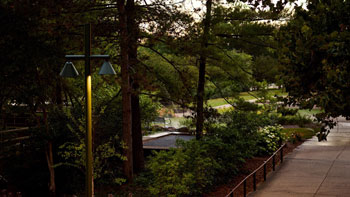
Few contemporary infrastructure projects in Australia sit within a more scrutinised context. The Sydney Harbour Bridge is State and National Heritage‑listed, requiring every design decision to preserve its significance, openness and legibility. The ramp responds through restraint and clarity. Its gently serpentine alignment threads lightly through Bradfield Park, minimising footprint while maintaining accessible gradients. Views to the Bridge and harbour are preserved, and the forecourt remains open and legible as public space.
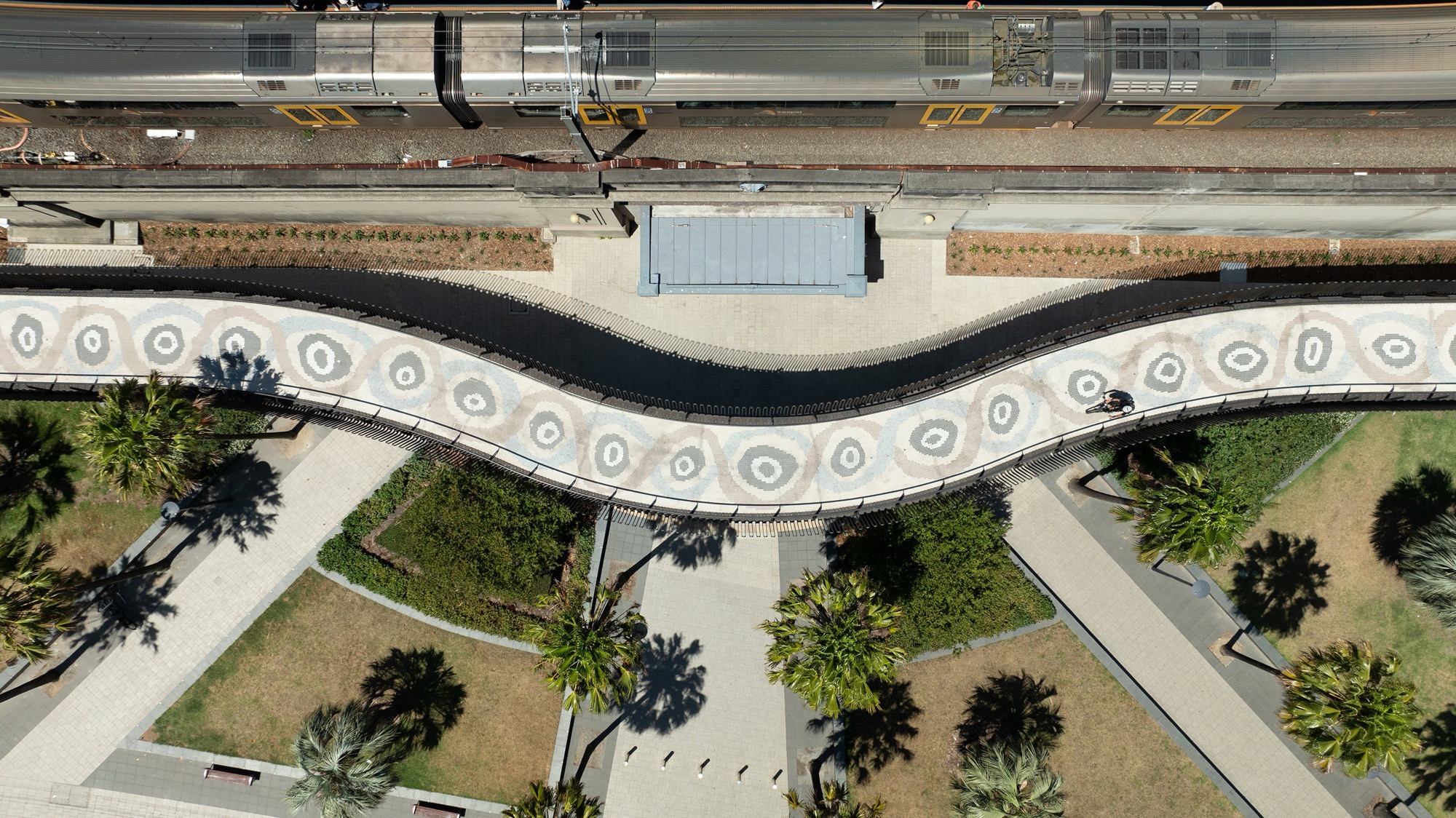
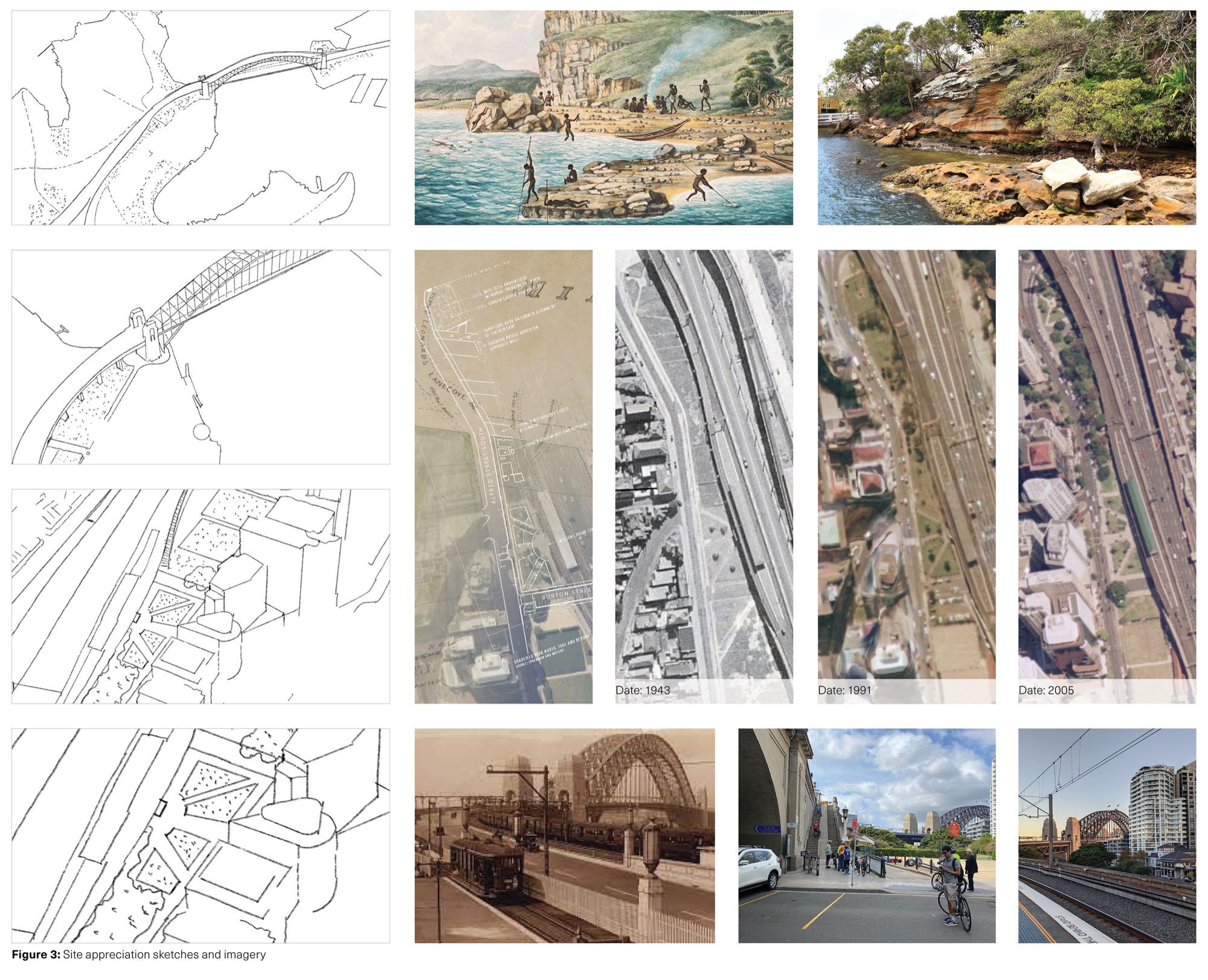
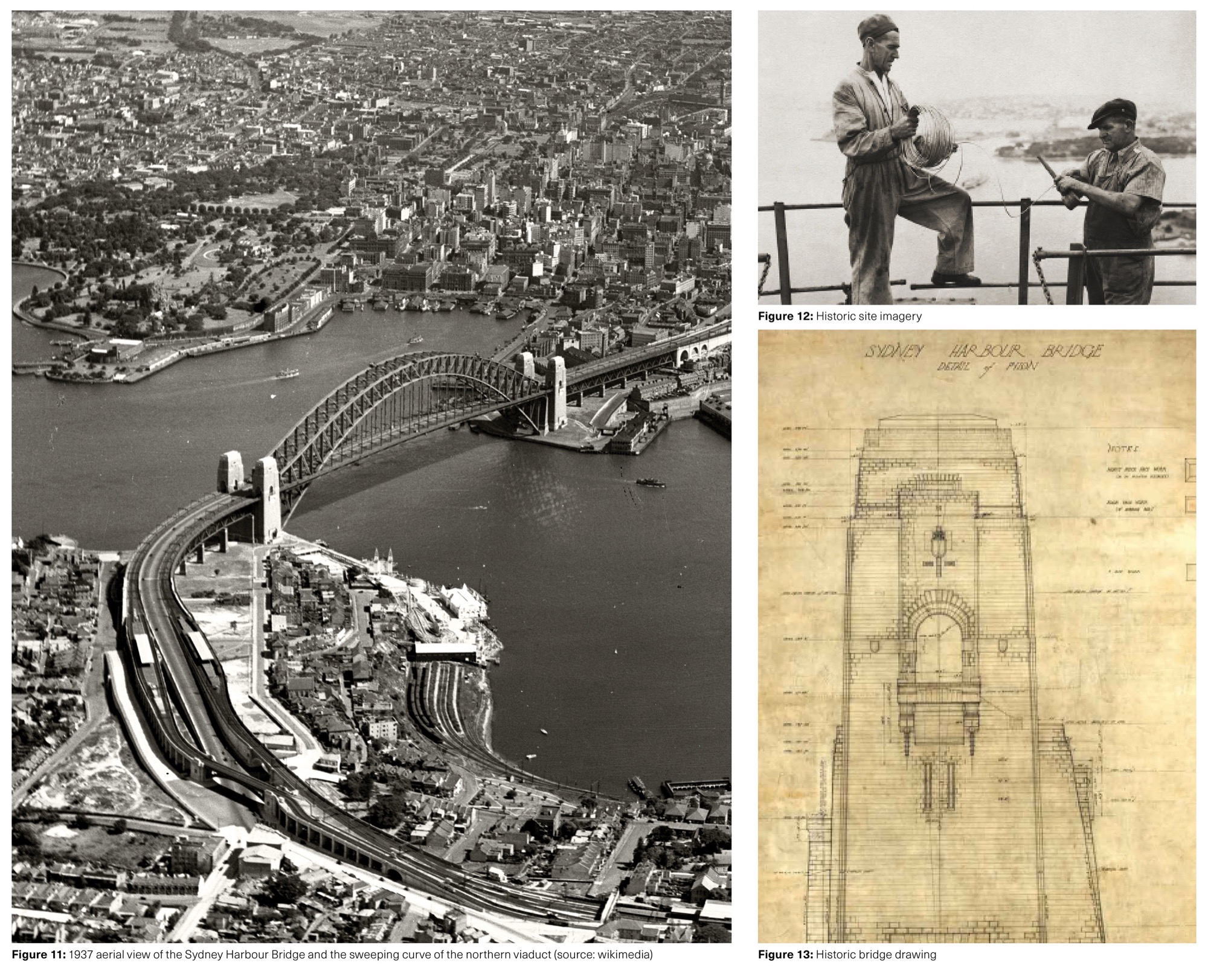
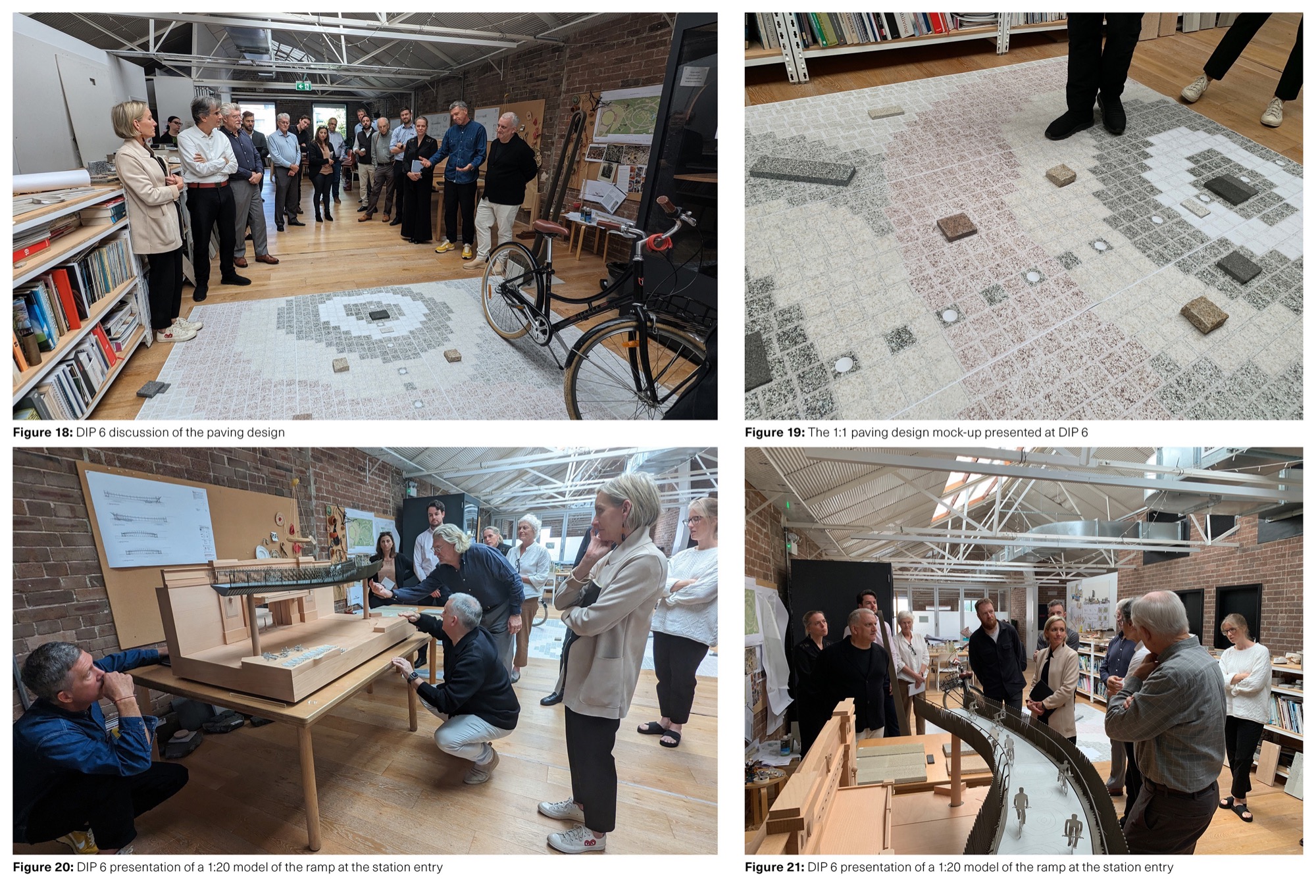
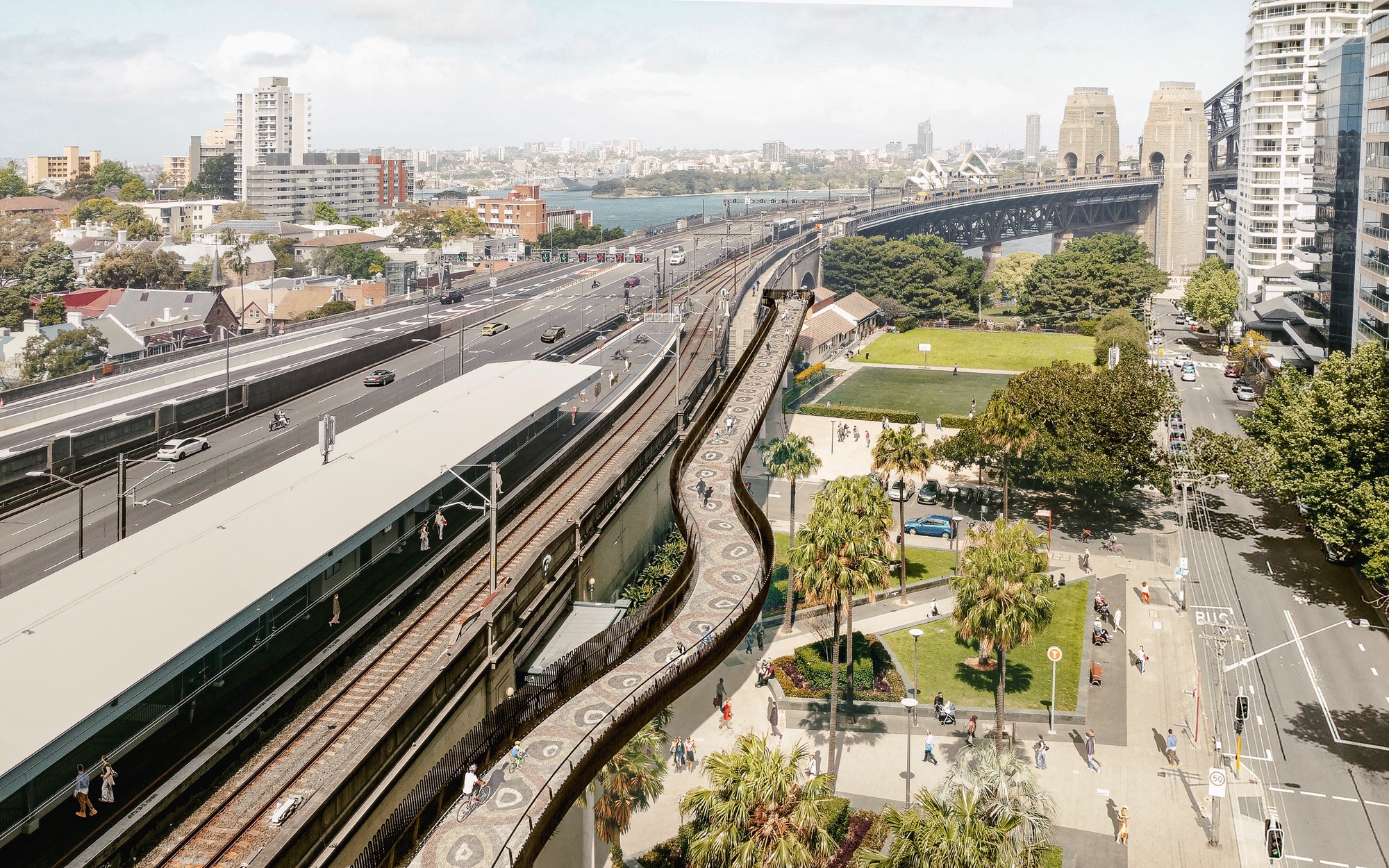
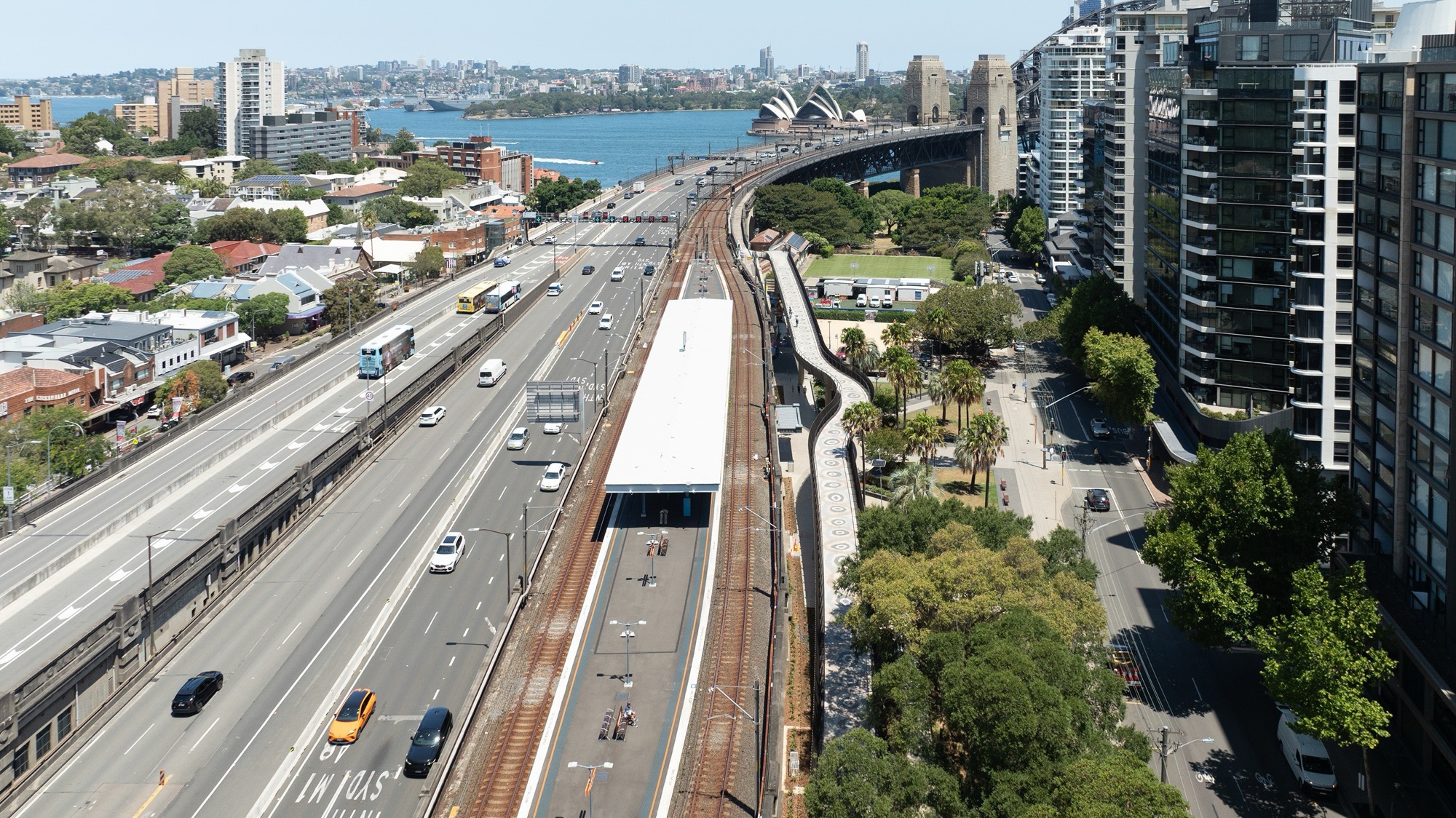
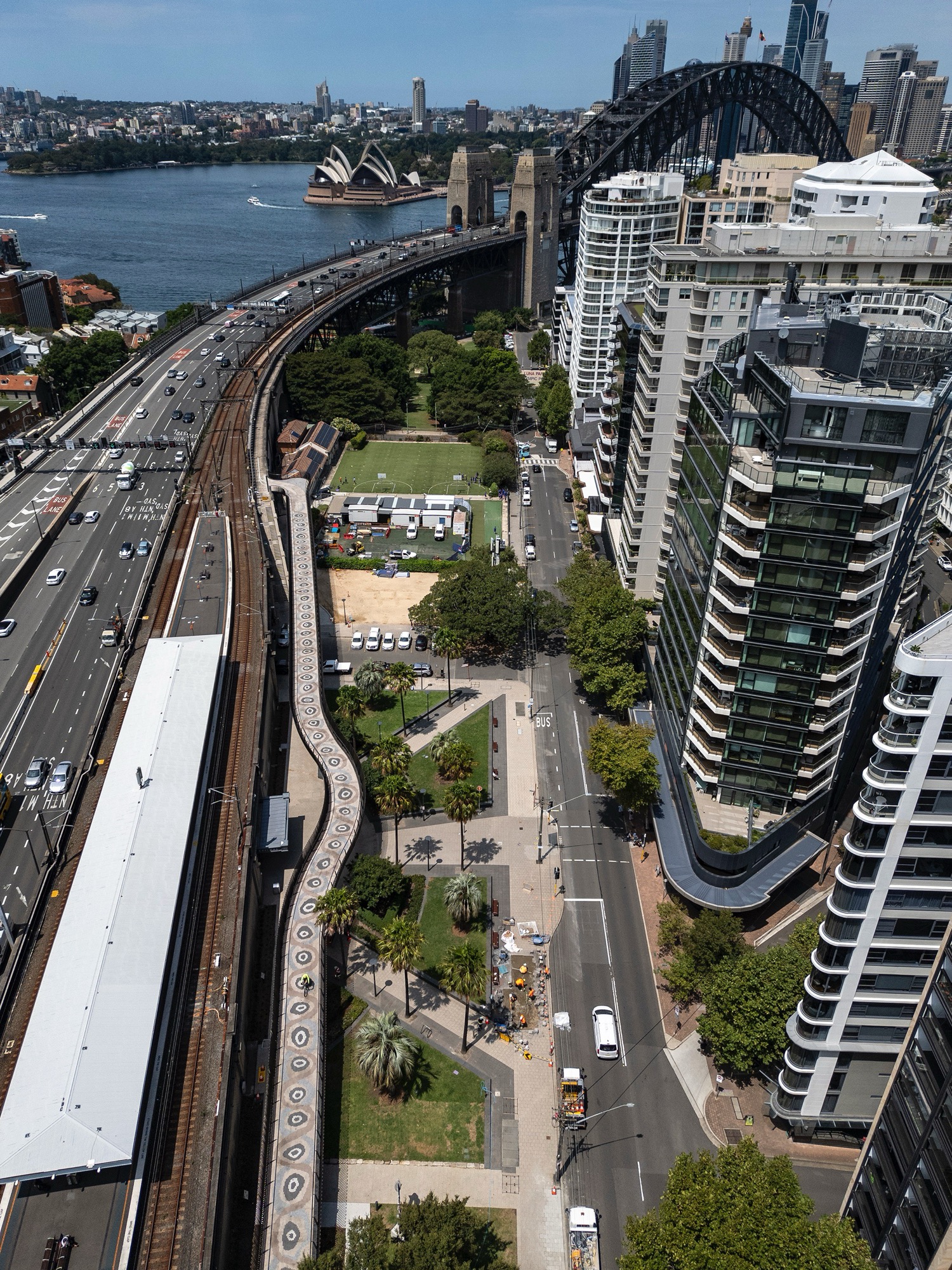
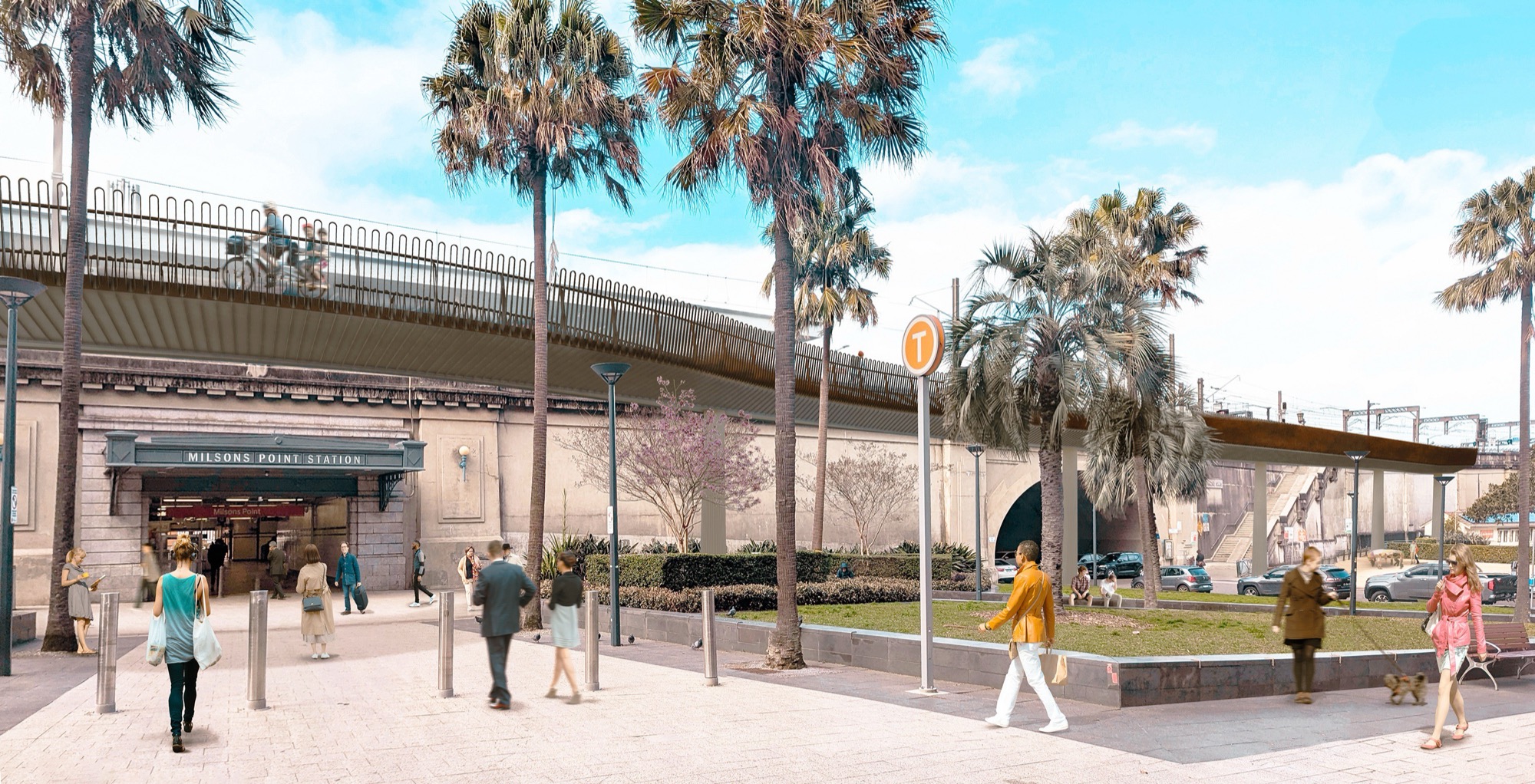
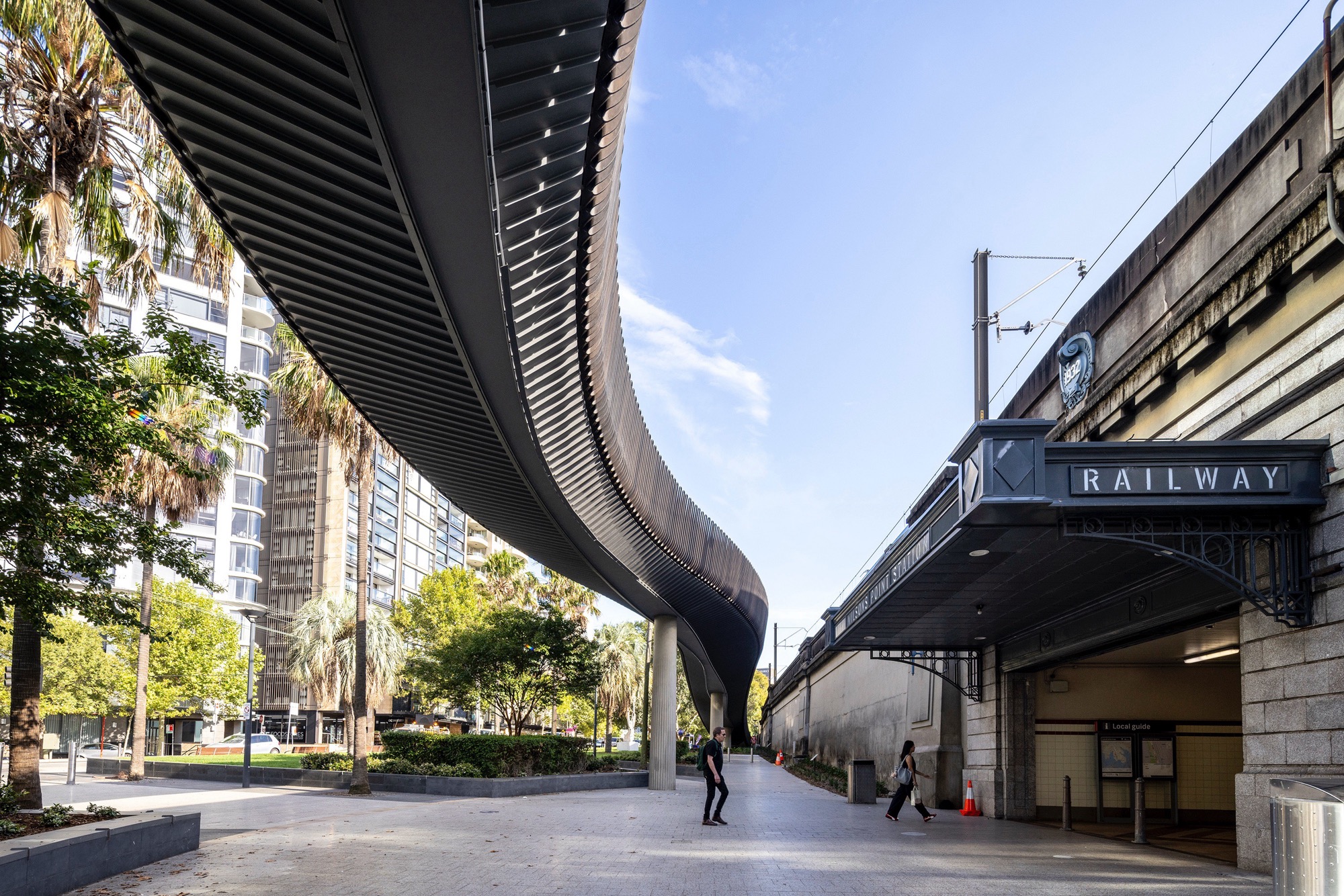
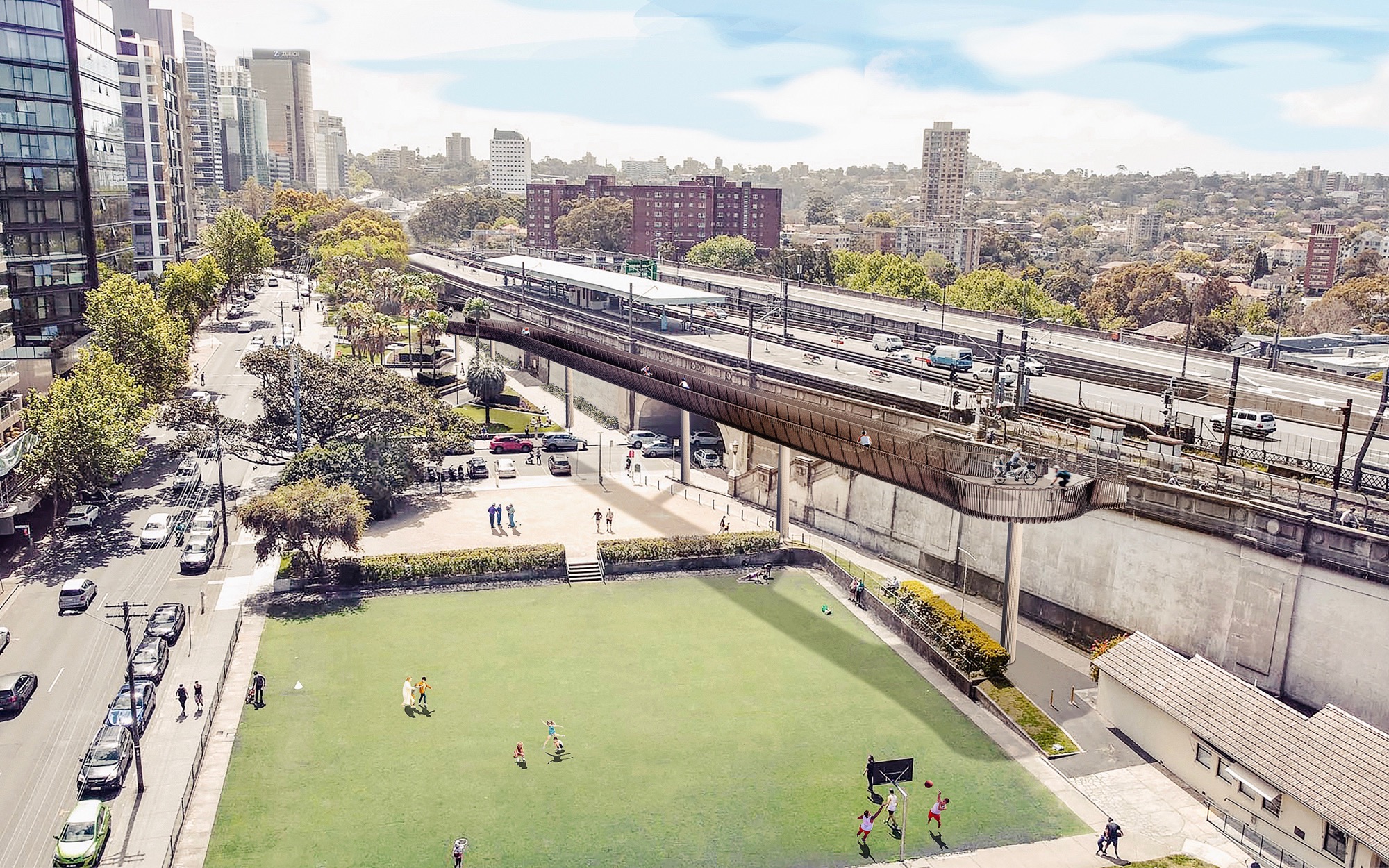
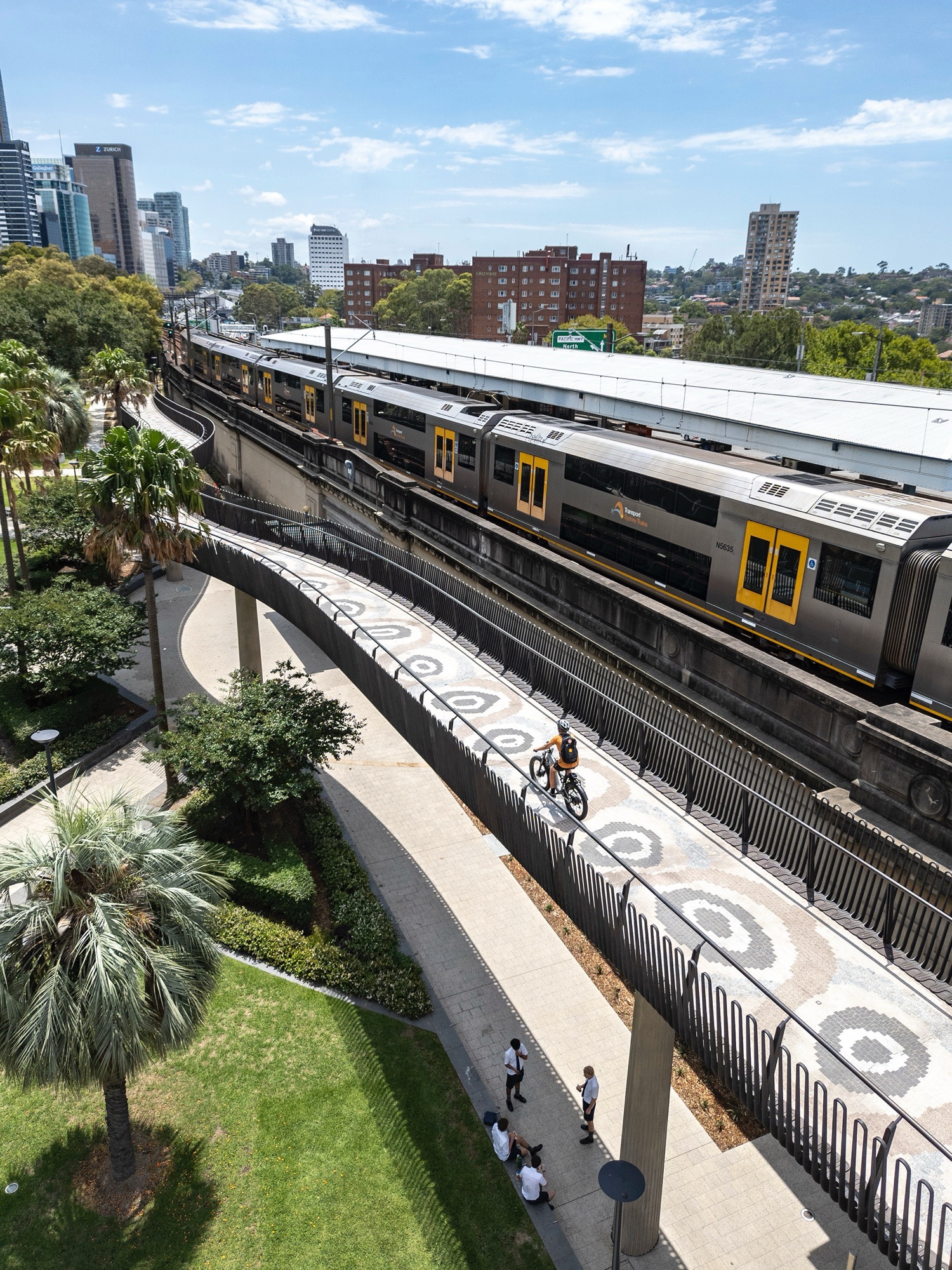
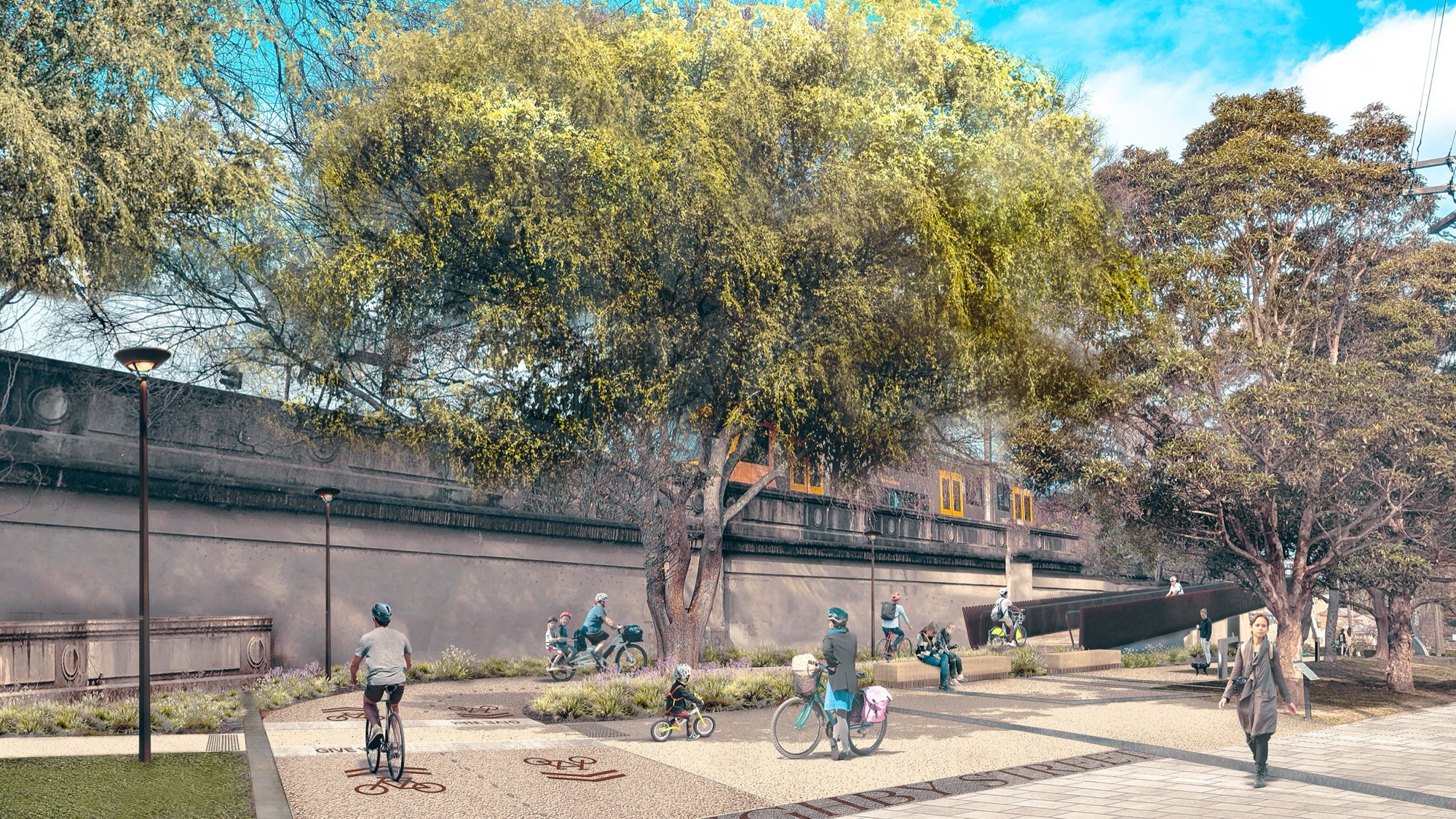
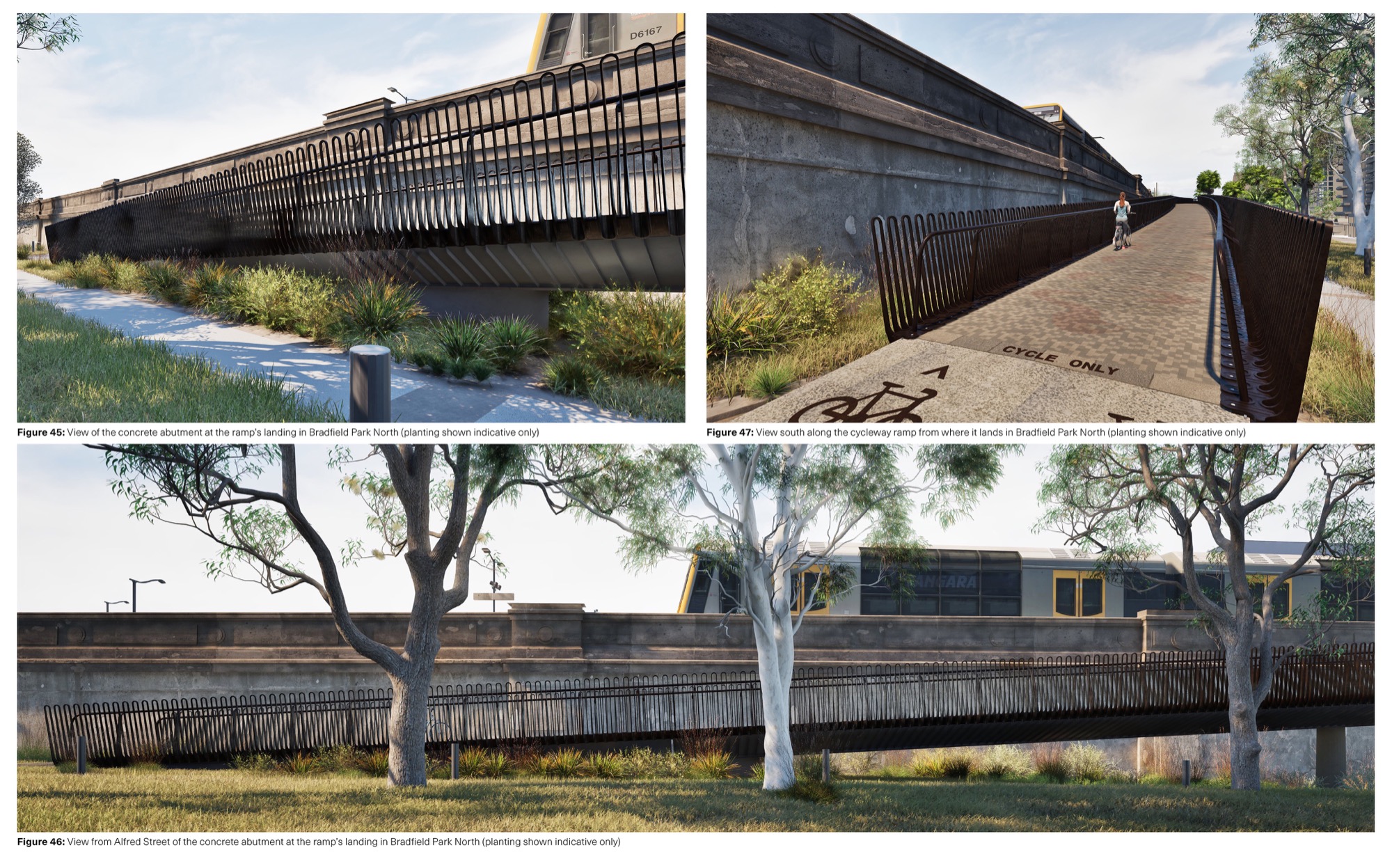
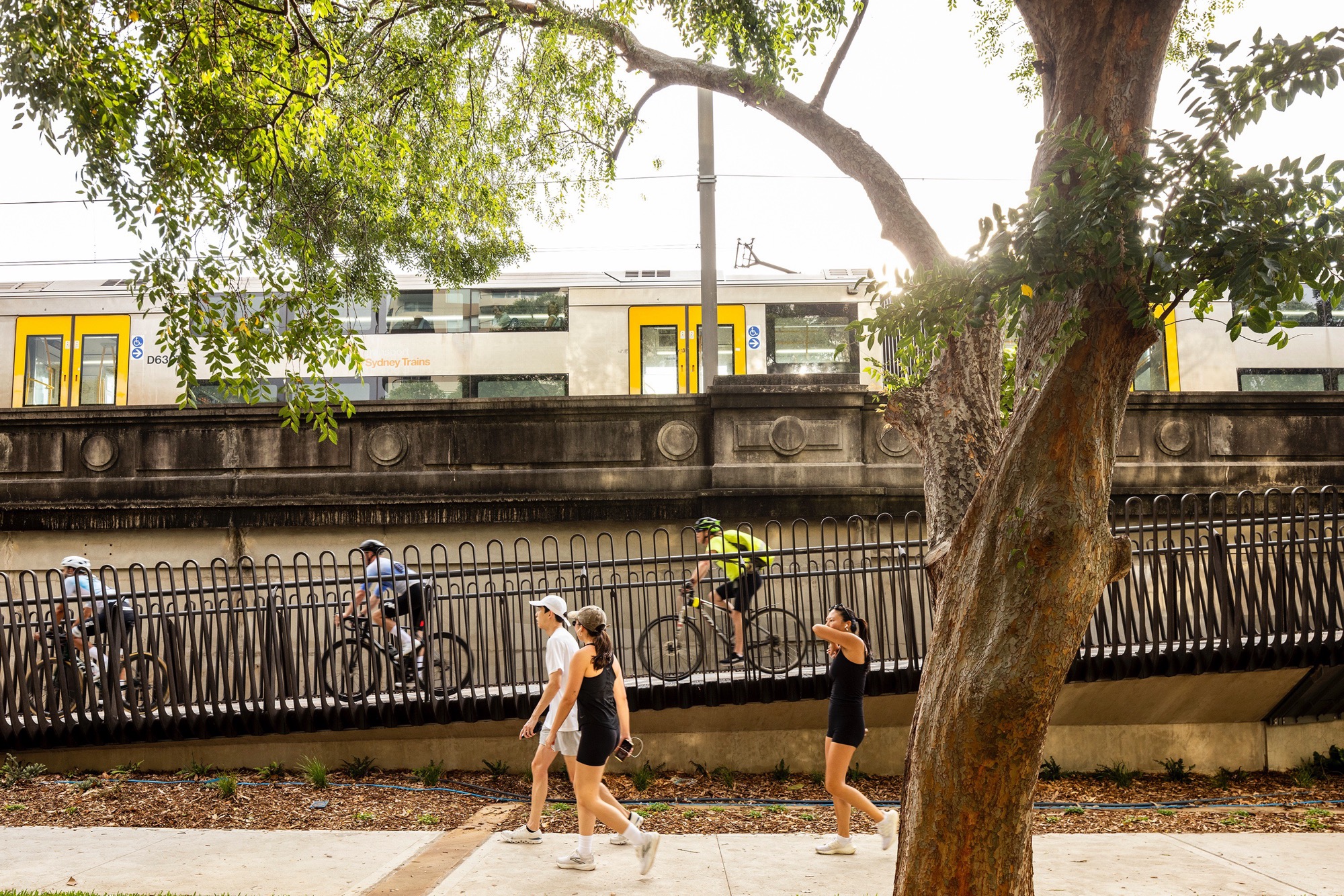
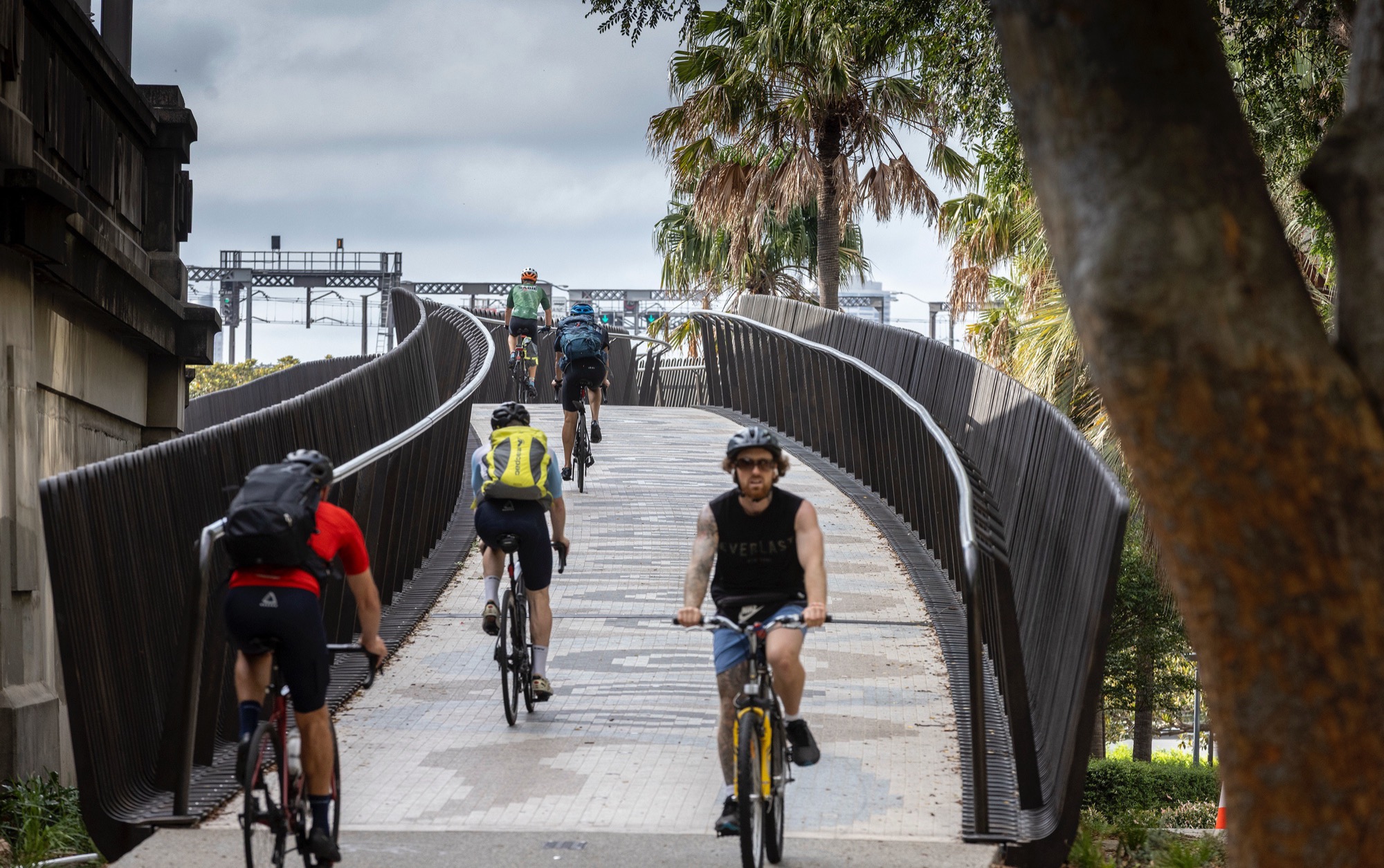
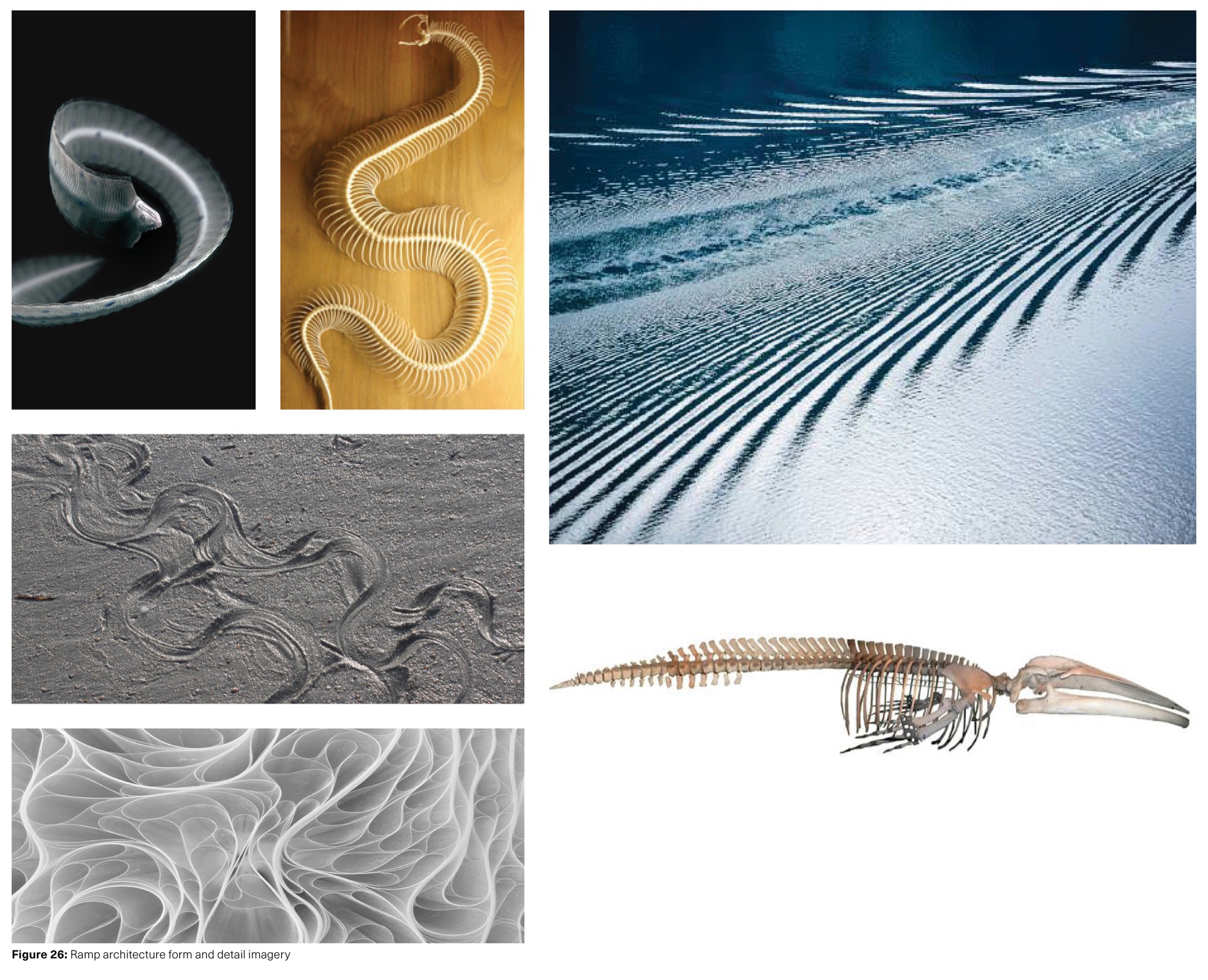
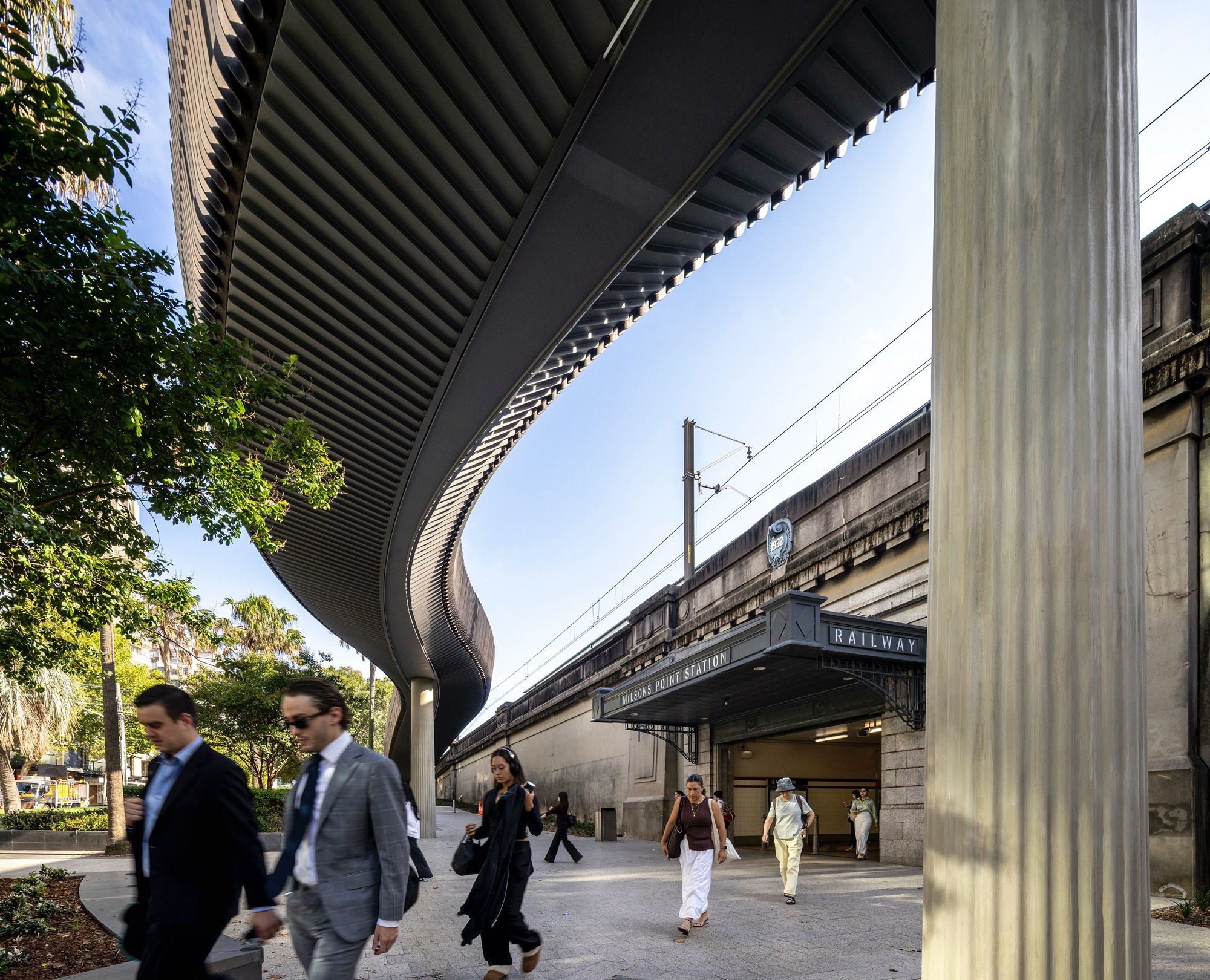
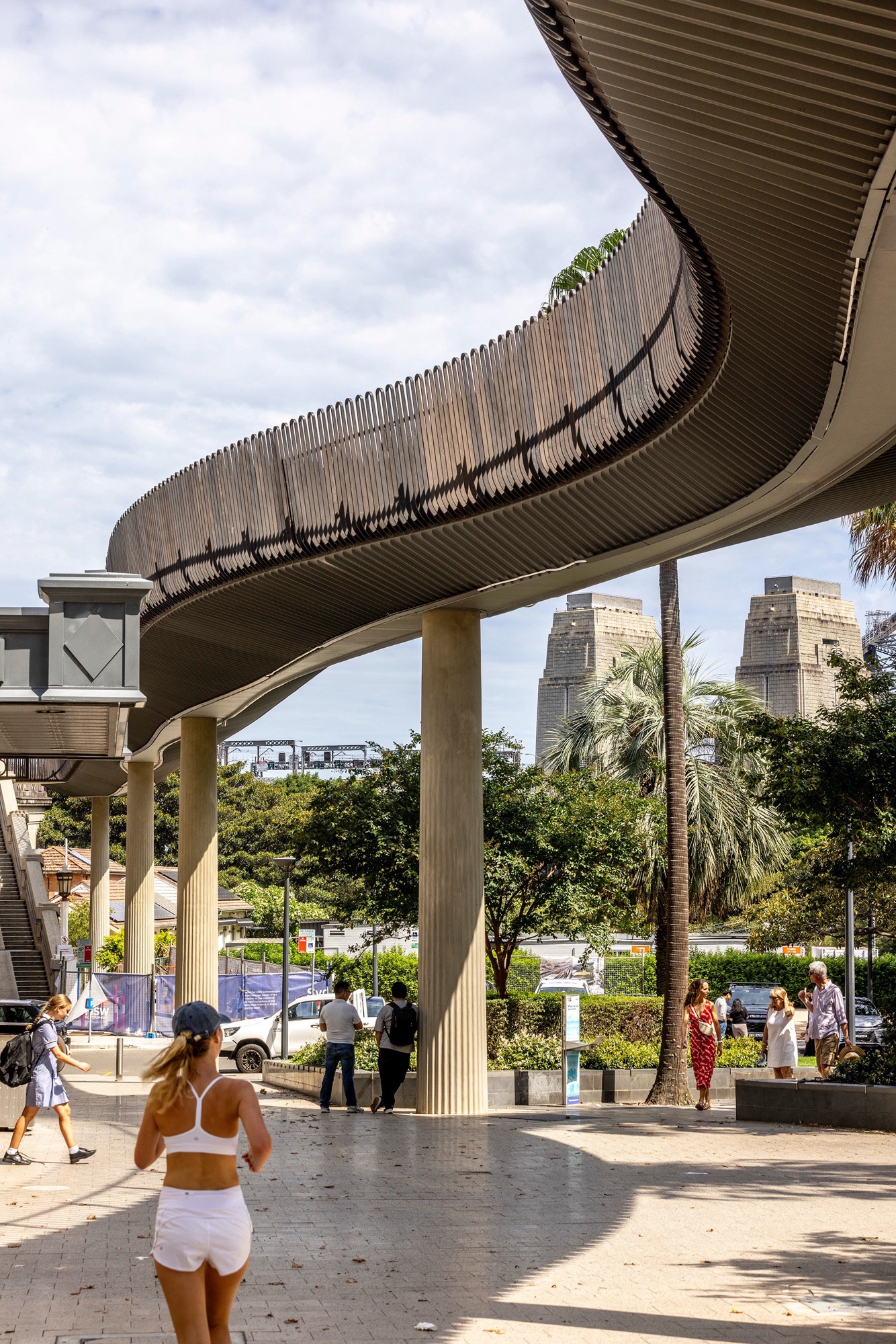
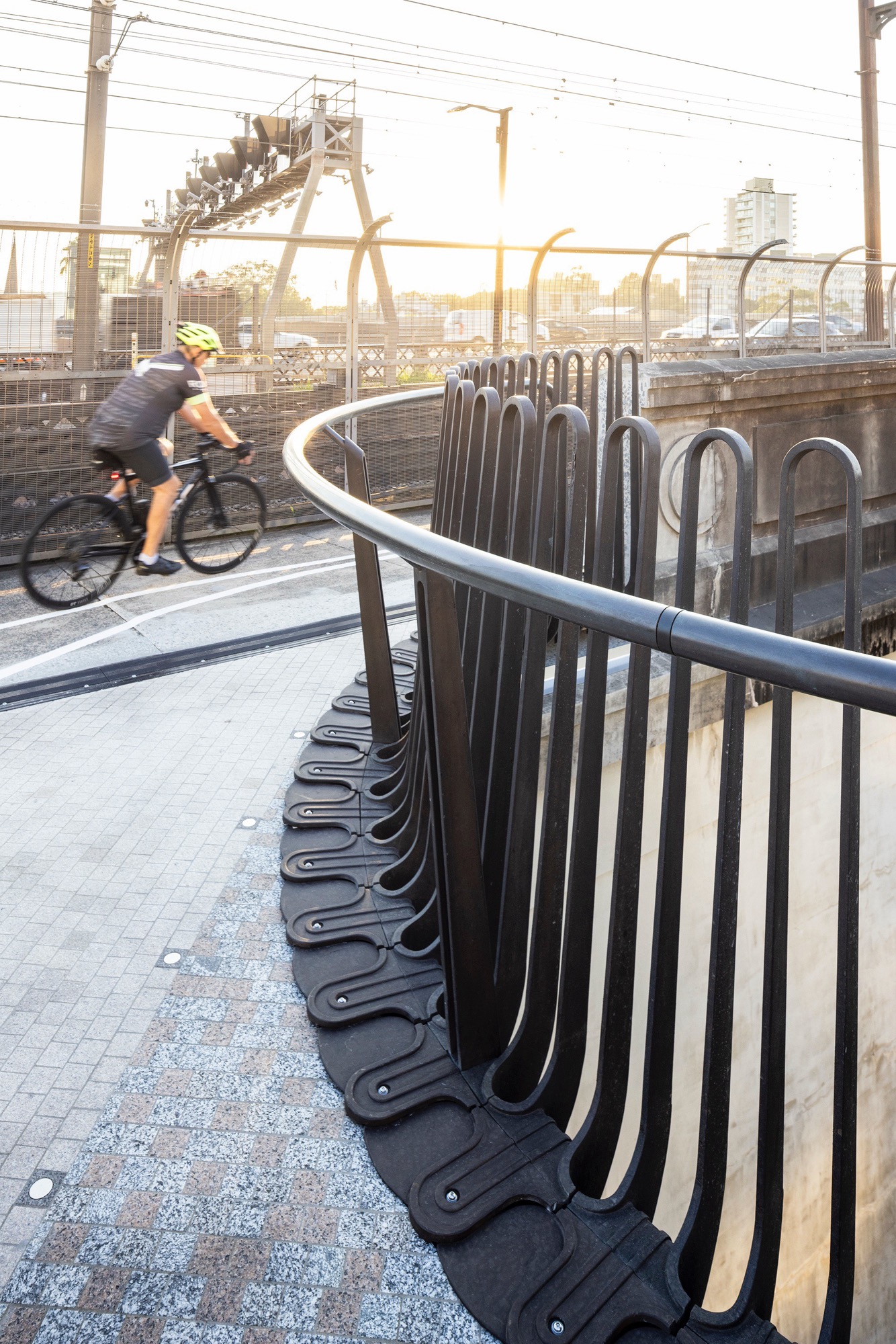
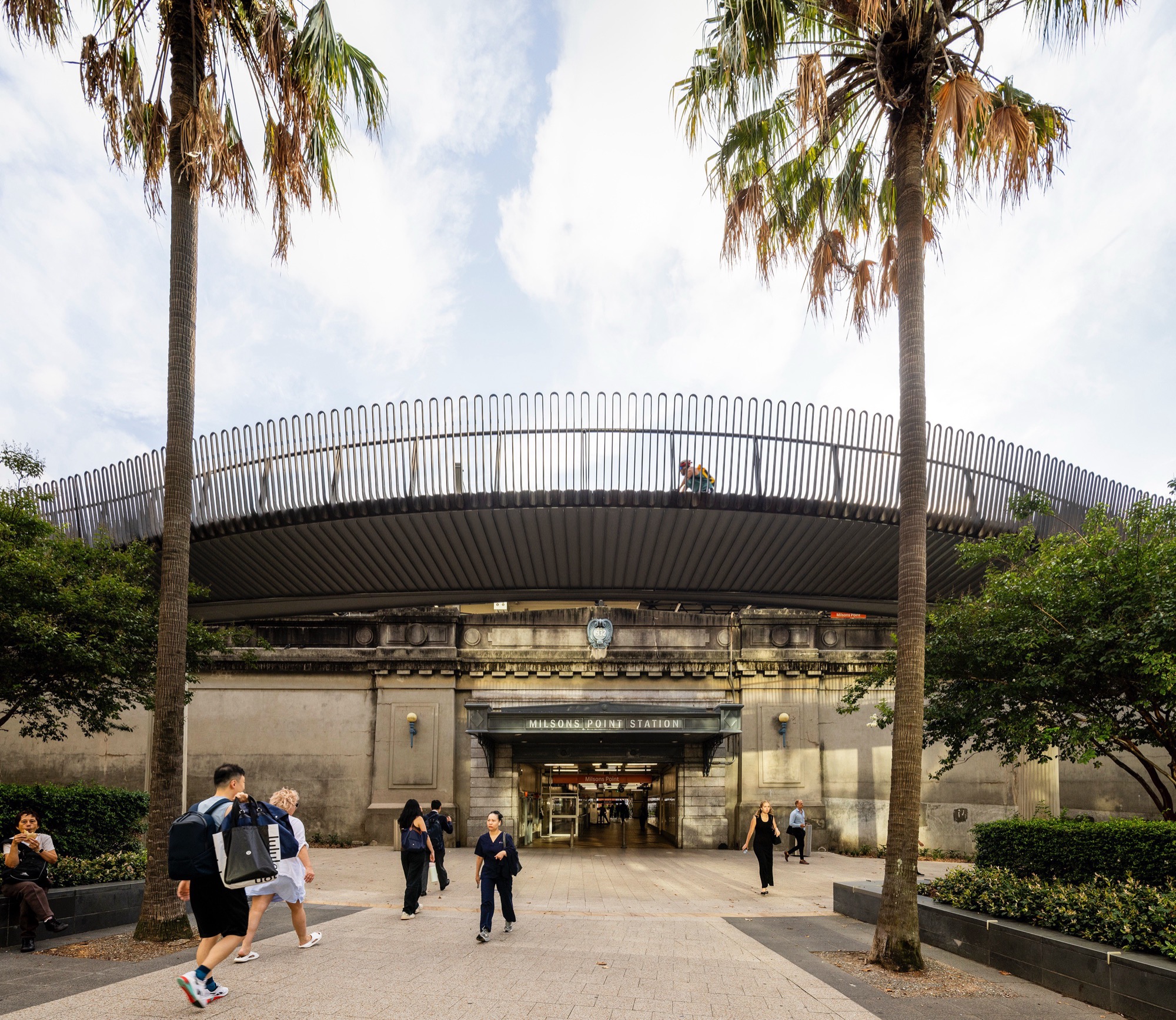
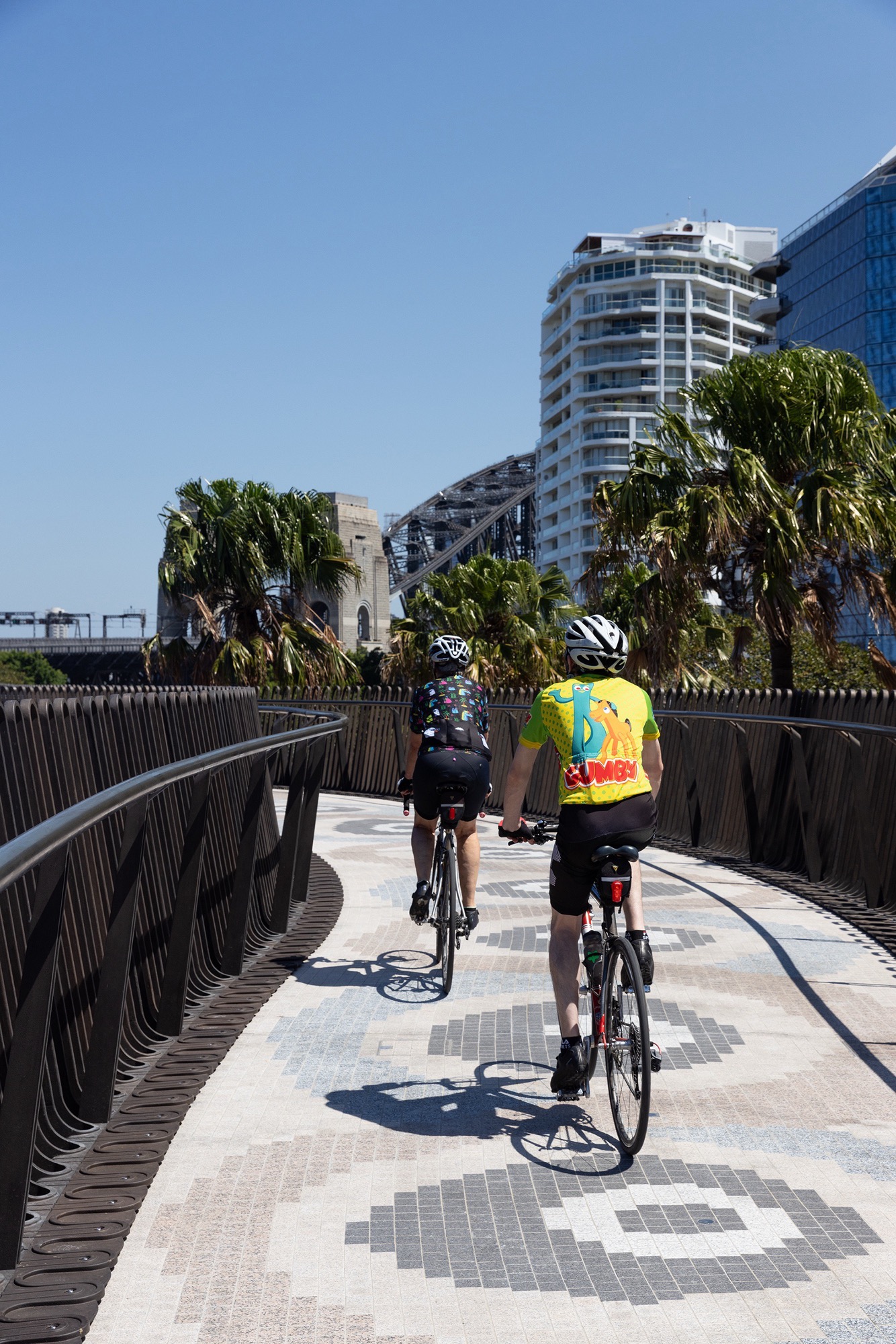
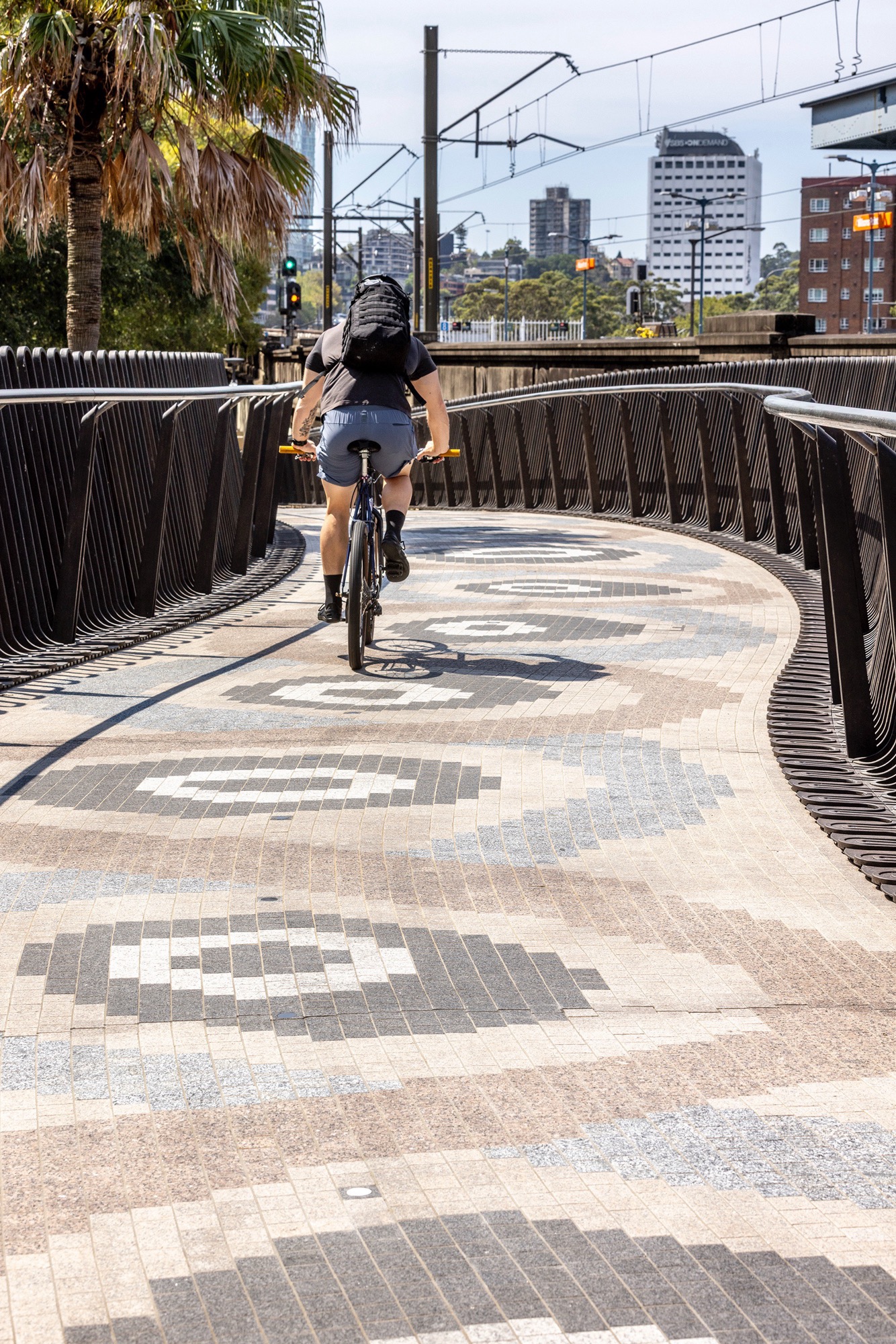
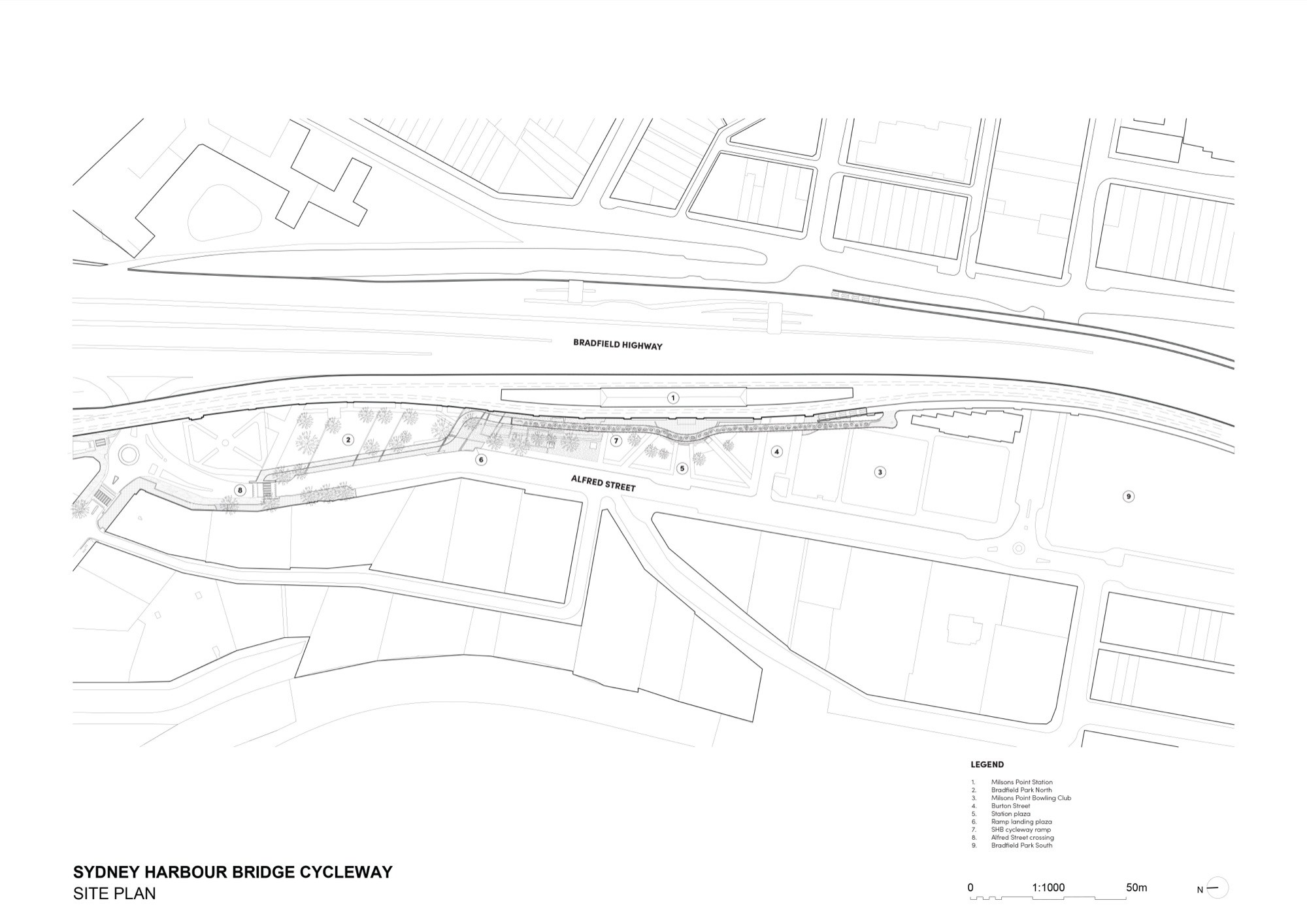
Landscape architecture was integral to the project’s success, synthesising movement, structure, culture and public domain outcomes into a single coherent form. Computational design tools were used to test hundreds of alignments against criteria including comfort, cycling flow, heritage sightlines and structural efficiency. This process informed a fluid geometry capable of accommodating complex constraints while delivering a calm, dignified journey.
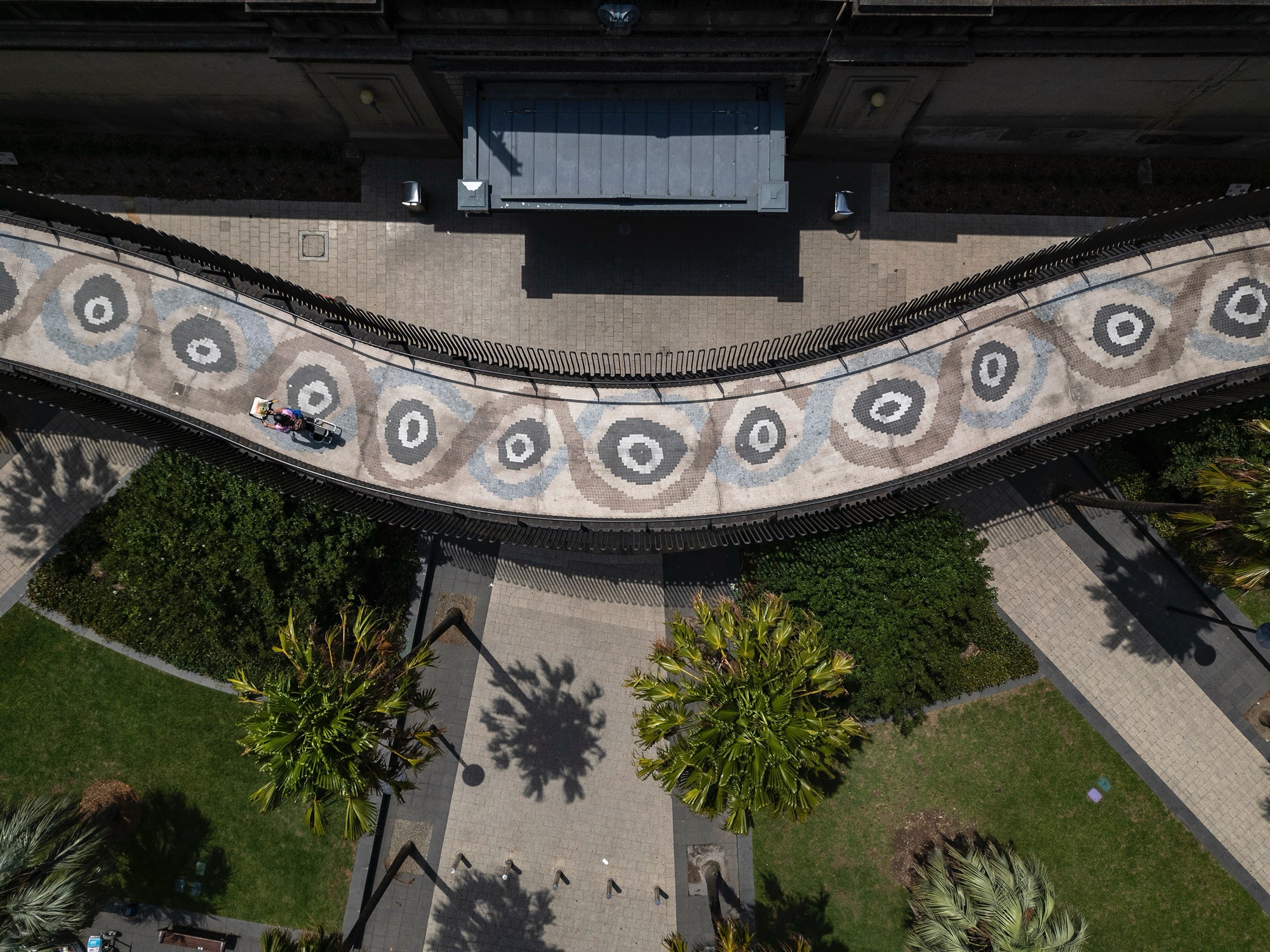
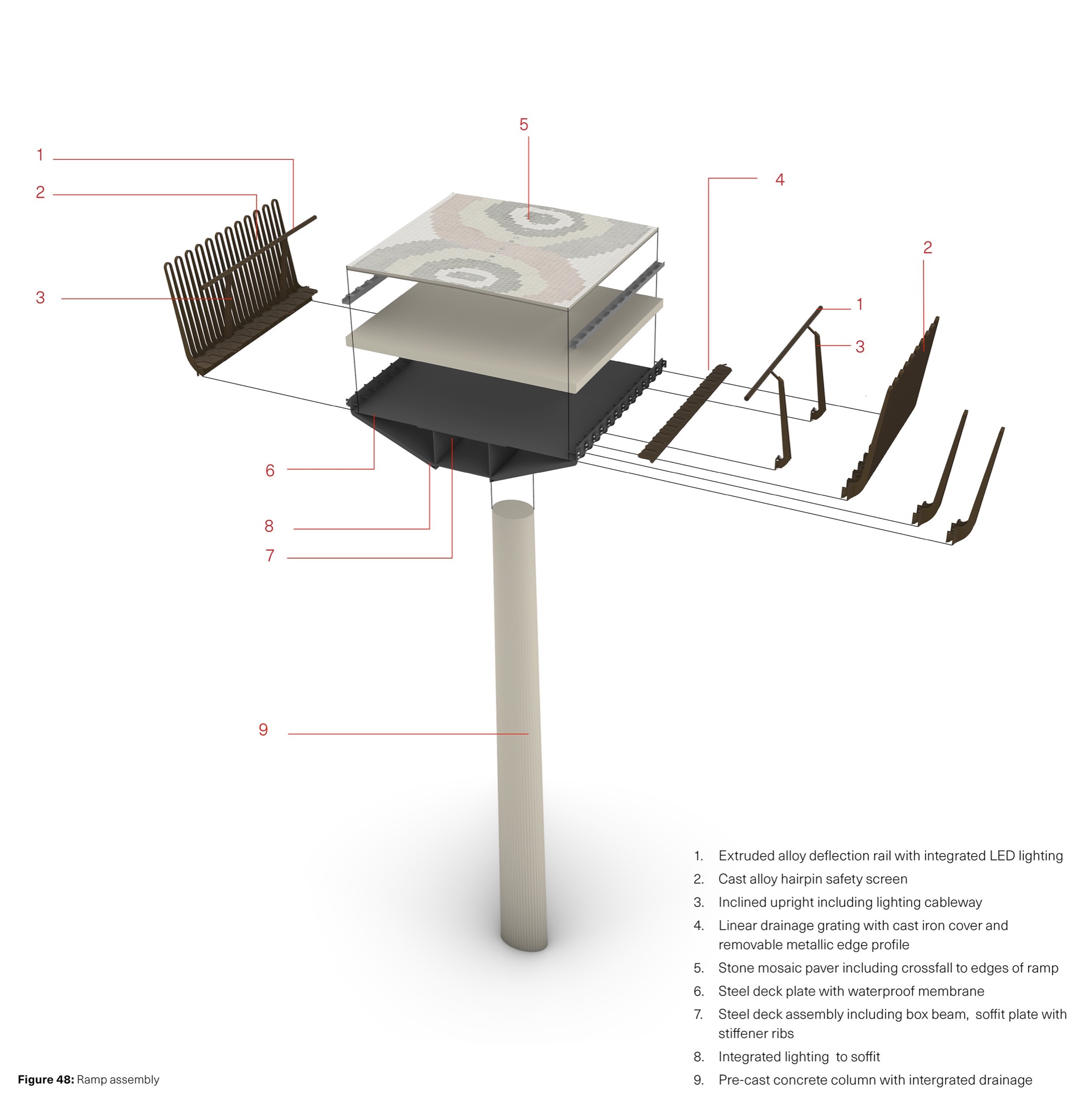
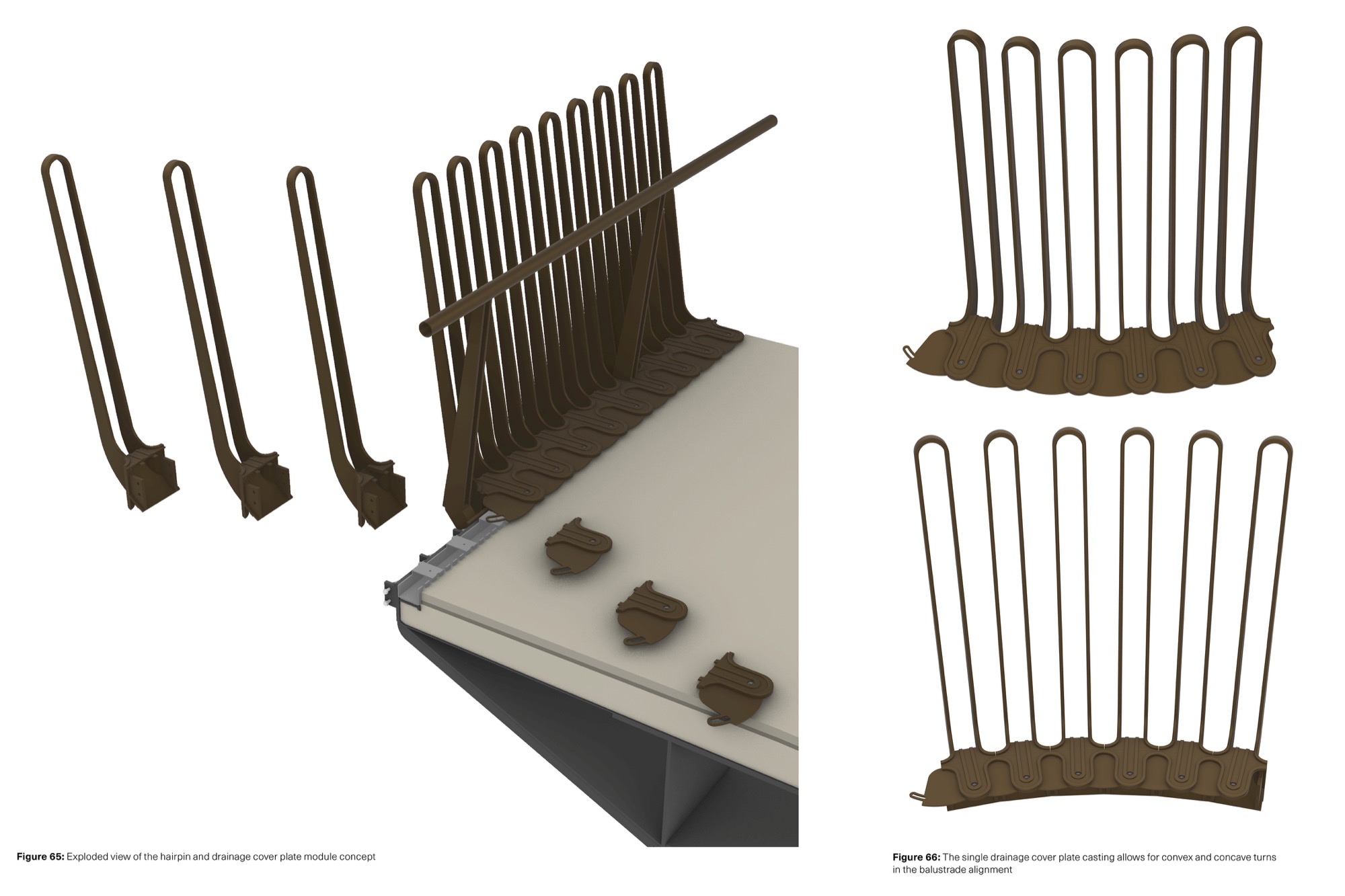
Structural innovation supports this spatial outcome. A slender steel‑and‑concrete deck, inspired by aircraft wing design, spans efficiently between tapered oval columns positioned sensitively within the park. A continuous bronze balustrade wraps the ramp as a woven ribbon, providing safety while contributing materially and symbolically to the experience. Designed to weather naturally, the bronze requires no surface treatment over its lifespan and references both the Bridge’s industrial character and the tradition of civic metalwork elsewhere in Sydney.
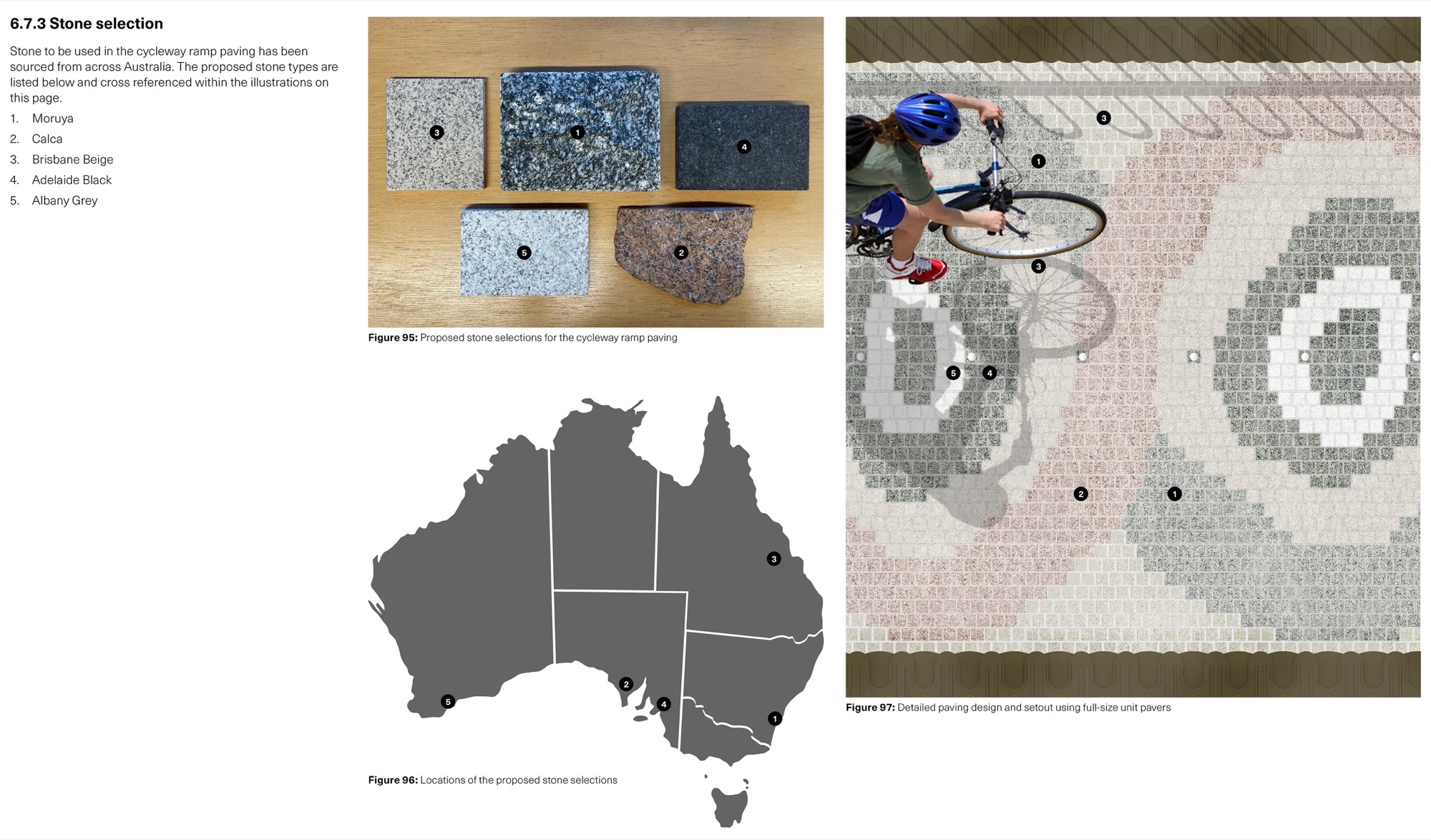
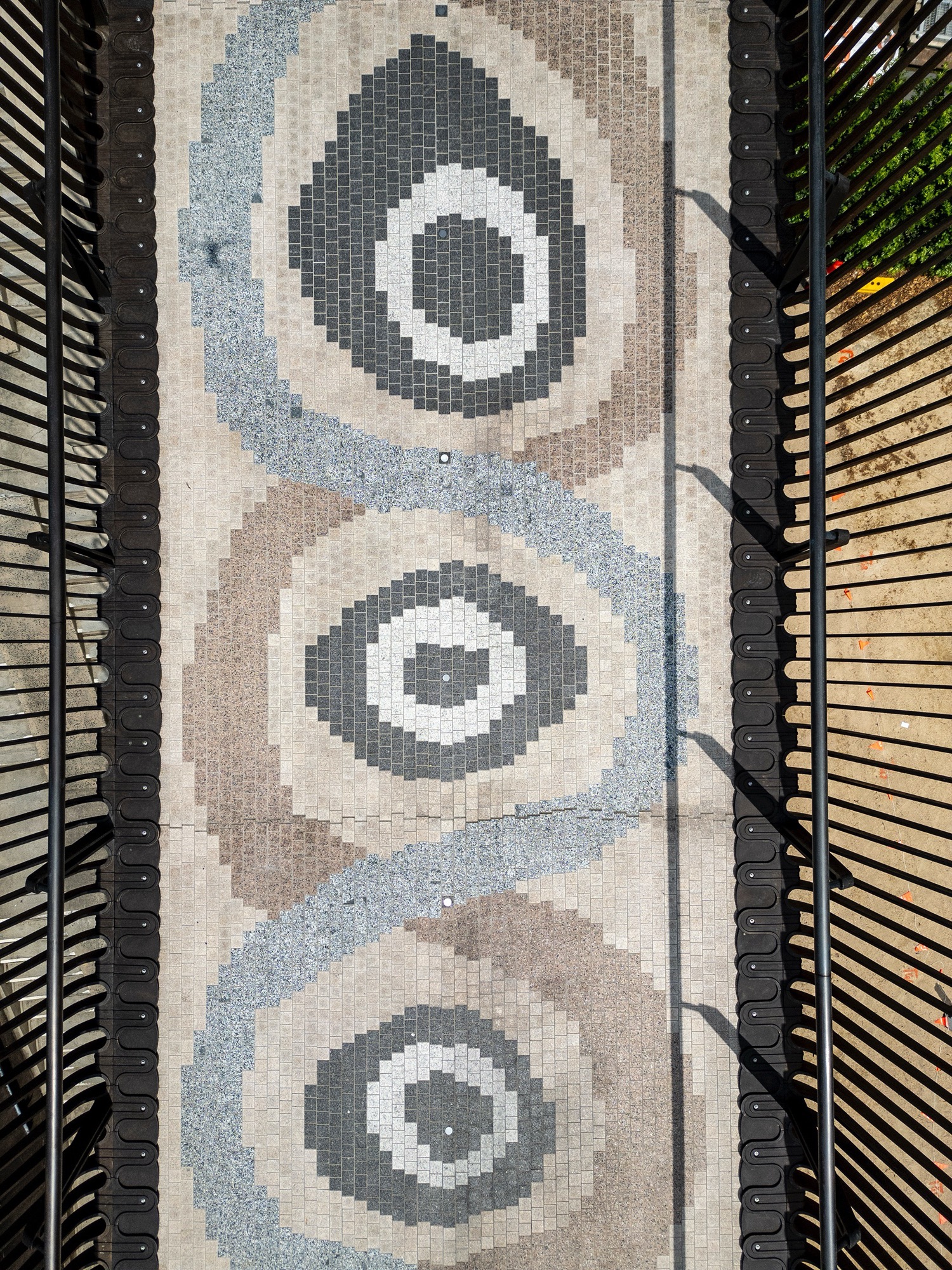
Cultural acknowledgment is embedded within everyday movement rather than applied as interpretation. Hand‑laid granite cobblestones run the full length of the ramp, depicting two eels migrating between saltwater and freshwater. Developed with Indigenous artists and First Nations consultants, this artwork acknowledges the crossing between Gadigal and Cammeraygal Country and situates the Bridge within a much older cultural landscape. A relocated section of the original 1932 bridge parapet is placed within a nearby plaza, marking the beginning of the cycleway while preserving heritage fabric.
Beyond movement, the project delivers place‑based public realm improvements. New plazas, seating, crossings and lighting support both passage and lingering, repositioning Milsons Point and the northern foreshore as an integral part of the Harbour experience. The Bridge is no longer encountered only from the southern CBD edge, but as a connected landscape spanning both sides of the water.
At an urban scale, the ramp recalibrates movement around Milsons Point, stitching Bradfield Park and surrounding streets back into the harbour’s active edge. It normalises cycling as a daily mode rather than a specialist pursuit, reinforcing walk and ride connections and anchoring the Bridge as a legible, human scaled component of Sydney’s active transport network.
The project demonstrates how contemporary landscape infrastructure can extend the life and relevance of major heritage structures. By treating cycling infrastructure as civic infrastructure, the ramp adds a new public layer to the Bridge without diminishing its significance. It stands as a model for how precise, collaborative landscape design can reconcile accessibility, heritage and climate‑responsive mobility in cities worldwide.
**Project Credits**
Project Lead and Landscape Architect: ASPECT Studios
Ramp Architecture: Collins and Turner
Engineering and Industrial Design: Eckersley O’Callaghan
Heritage Architecture and Interpretation: Design 5 Architects
Collaborating Artists: Madwings
First Nations Consultant: Yerrabingin
Client: Transport for NSW
Main Contractor: Arenco
Engineering (Construction): Stantec
Lighting: Electrolight and Lucian Light
-33.845516576903904, 151.2117526951065
73649


LILA 2026 Sponsor