Passerelle Zwolle
www.karresenbrands.com/en/
2026 Infrastructure Projects / 2026 Landscape and Architecture / Netherlands / Built in 2025 /

![Situated at the edge of the glacier ridge, offering sweeping views over the Rhine, Museum Arnhem has reopened after an ambitious renovation and expansion. This renowned museum for 20th-century realistic art, contemporary jewellery, and design now offers a renewed architectural experience that harmonizes with its scenic surroundings. With a clear and elegant architectural concept, the […]](https://landezine-award.com/wp-content/uploads/2025/05/00-LILA-Awards-Karres-en-Brands-Sculpture-Garden-Musem-Arnhem-2500px-600x384.jpg "Museum Arnhem by Karres en Brands")
![From infrastructure to public space The Hart van Zuid area development is one of the largest developments in the Netherlands and symbolizes the approach of social problems that Rotterdam South has; impoverished houses and streets, dodgy landlords, money laundering stores, insecurity, drug crime, high unemployment, debts, low school results, single-parent families. The high turnover rate […]](https://landezine-award.com/wp-content/uploads/2024/05/00-Karres-en-Brands-fotograaf-Sebastian-van-Damme-600x400.jpg "Gooilandsingel and watersquare in Rotterdam-South")
![For Karres en Brands, the redevelopment of the station area and the Rûnwei (ring road) is a great opportunity to strengthen the identity of the village andthe diversion of the ring road allows us to upgrade Feanwâlden station into a transport hub. The design assignment therefore is aimed at realizing a coherent area that matches […]](https://landezine-award.com/wp-content/uploads/2024/05/00-Karres-en-Brands-Parc-Feanwalden-main-photo-600x400.jpg "Parc Feanwâlden")
![Landscape architecture as a link in the cultural change of the banking industry The completion of the ING head office, Cedar, was the first step in the transformation of this larger urban district. In 2015, ING bank decided to relocate its head office within Amsterdam Zuidoost. ING has turned around the long-held image of banking […]](https://landezine-award.com/wp-content/uploads/2022/05/00-Karres-en-Brands-ING-Cedar-1-Chiel-van-Diest-600x450.jpg "ING KANTOOR CEDAR")

![Karres en Brands was established by Sylvia Karres and Bart Brands in 1997. Since than Karres en Brands has worked on diverse projects, studies and competitions, both at home and abroad. Our work encompasses every scale of spatial design, from area strategies and infrastructural projects to parks and gardens, and from urban planning assignments to product […]](https://landezine-award.com/wp-content/uploads/2019/04/karres-en-brands-600x367.jpg "Karres en Brands")
![The municipality of Leiden is working to improve the city’s accessibility, and particularly that of its Bio Science Park. To fully utilise the development potential of the Bio Science Park, the implementation of a new access road from the Plesmanlaan to the Bio Science Park is imperative, as is the improvement of the flow of […]](https://landezine-award.com/wp-content/uploads/2019/04/00-HEIJ.08-Bio-Science-Park-Leiden-ipv-Delft-IMG_2846-600x400.jpg "Bio Science Park Entrance")
![Hoekenrodeplein forms the link between the Amsterdamse Poort shopping centre and the Arena Boulevard. With the redevelopment of the New Amsterdam Building, the square has been developed as one of the final phases of the Zuidoost Centre Area. The existing, U-shaped building that wraps around the square was expanded on the ground and first floors, […]](https://landezine-award.com/wp-content/uploads/2017/07/Hoekenrodeplein-03-600x366.jpg "Hoekenrodeplein")
![“A new centre unfolds on a peninsula” In early 2015, karres+brands won together with Ghilardi+Hellsten a parallel assignment for the urban development of Fosnavåg, Norway. Fosnavåg is the new administrative centre of the Herøy municipality and one of the main fishing villages on the Norwegian coast. Vision: creating identity The fishing industry has always been […]](https://landezine-award.com/wp-content/uploads/2017/05/Fosnavag-01-Vision-1-600x424.jpg "Fosnavag")
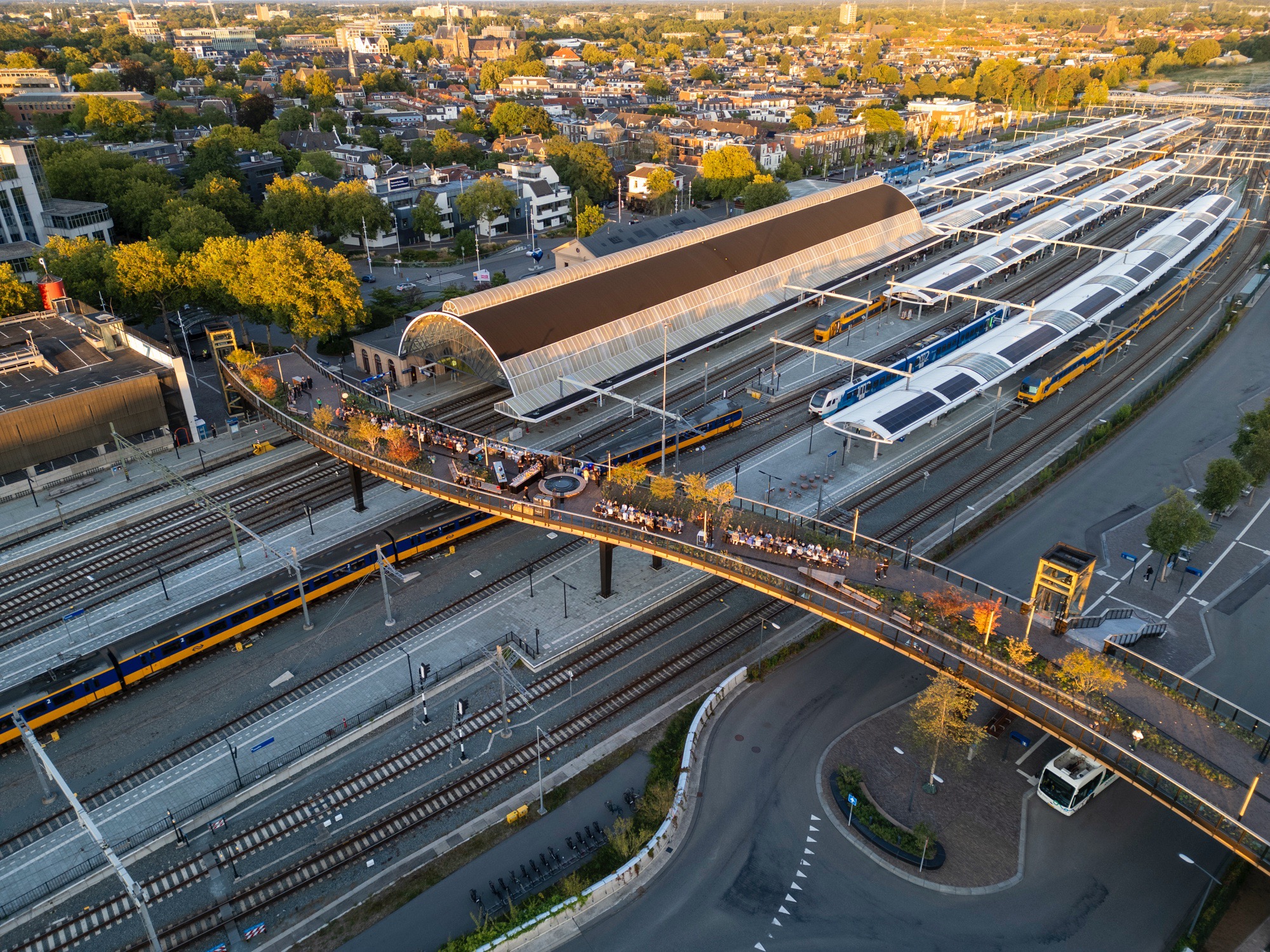
With the opening of the Passerelle in 2025, Zwolle will gain not just a new bridge, but a new urban backbone. Where the railway line once formed a stark dividing line between the historic city centre and the southern neighbourhoods, a natural and pleasant connection is now emerging that brings the city together once more.
The Passerelle is the result of an intensive design process in which Karres en Brands worked with the municipality of Zwolle from 2017 onwards to develop an integrated vision for the railway zone. The focus was not on infrastructure alone, but on the city itself. The aim: to restore urban continuity, strengthen pedestrian and cycle routes, and add new public spaces around the station.
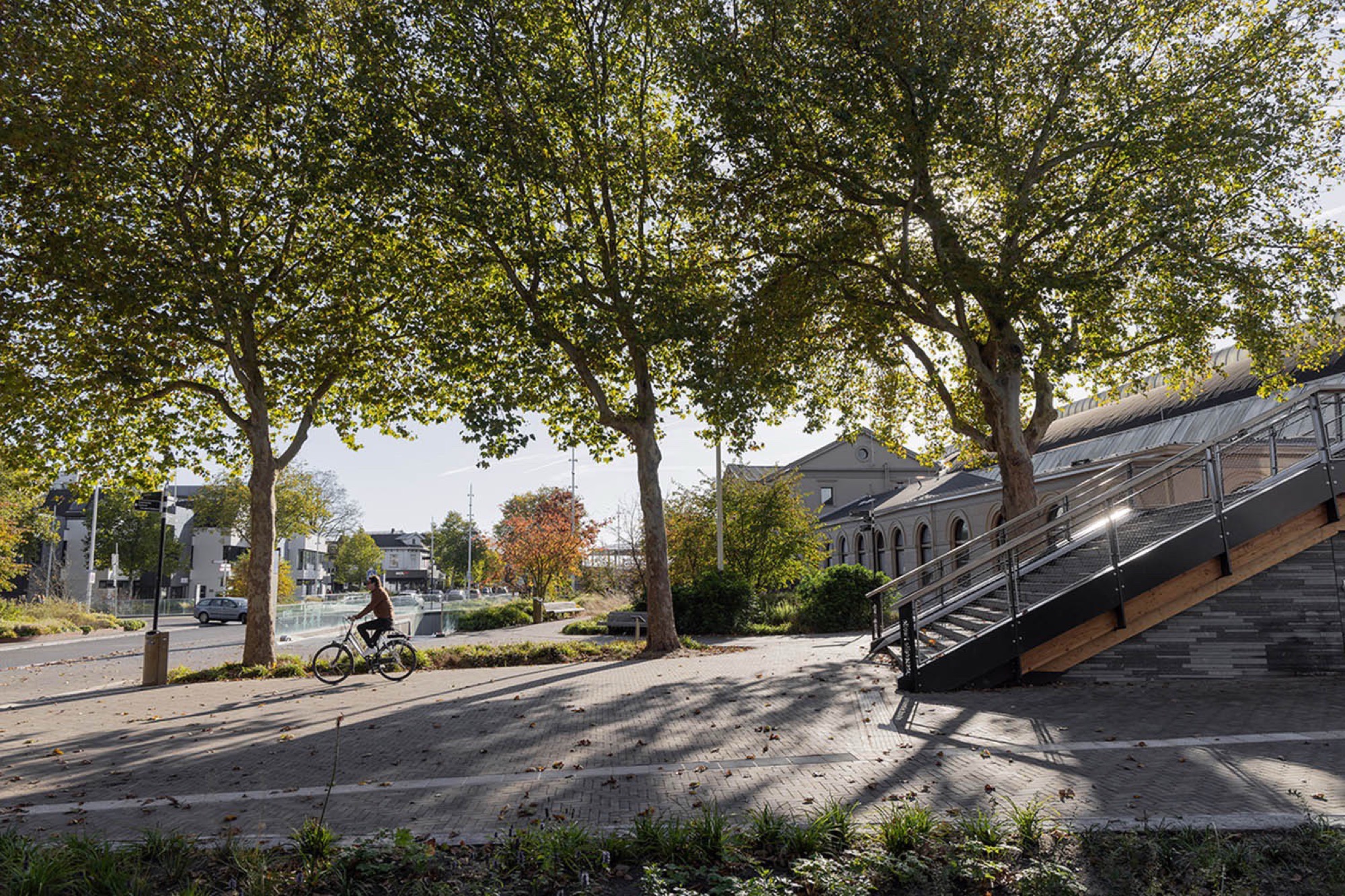
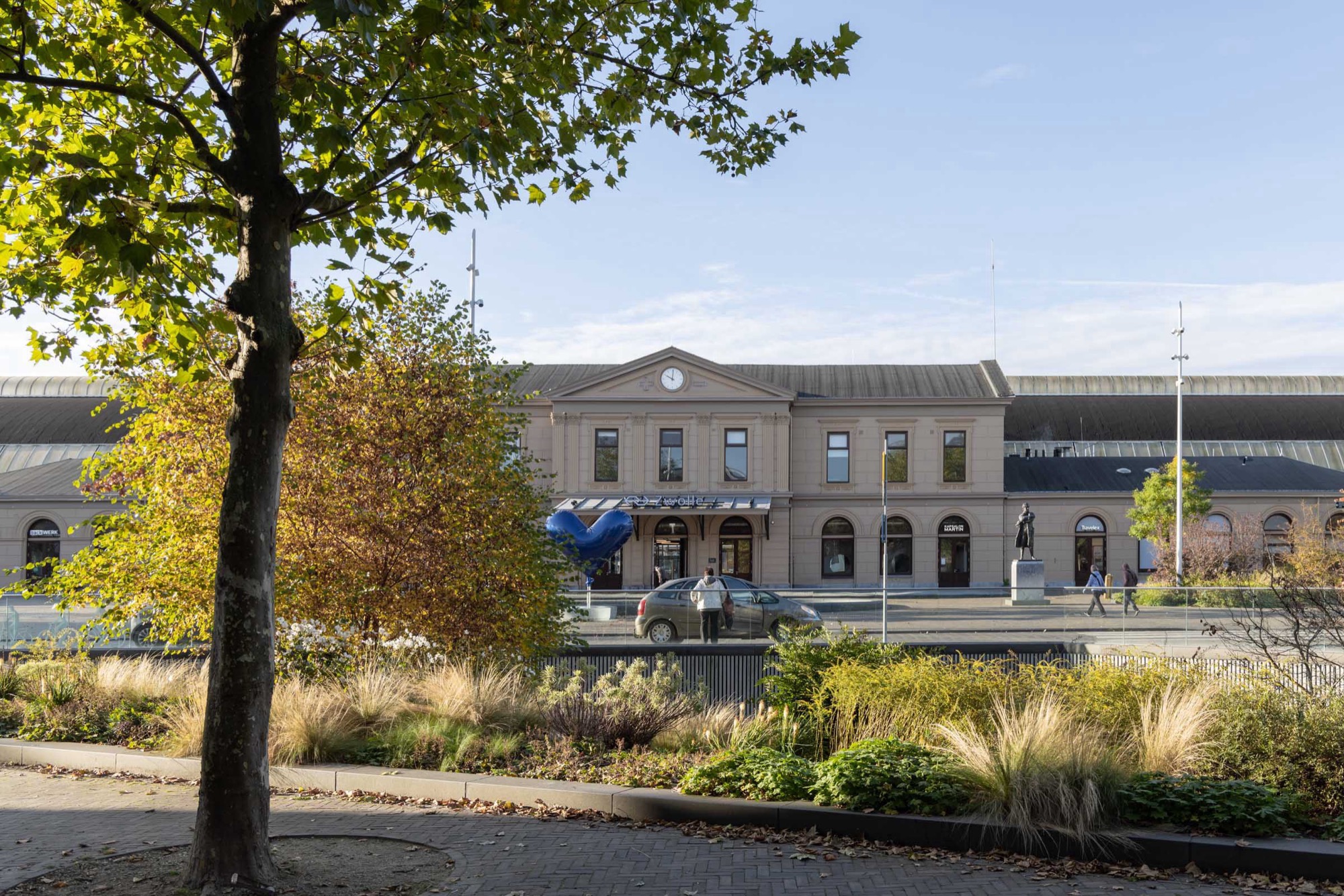
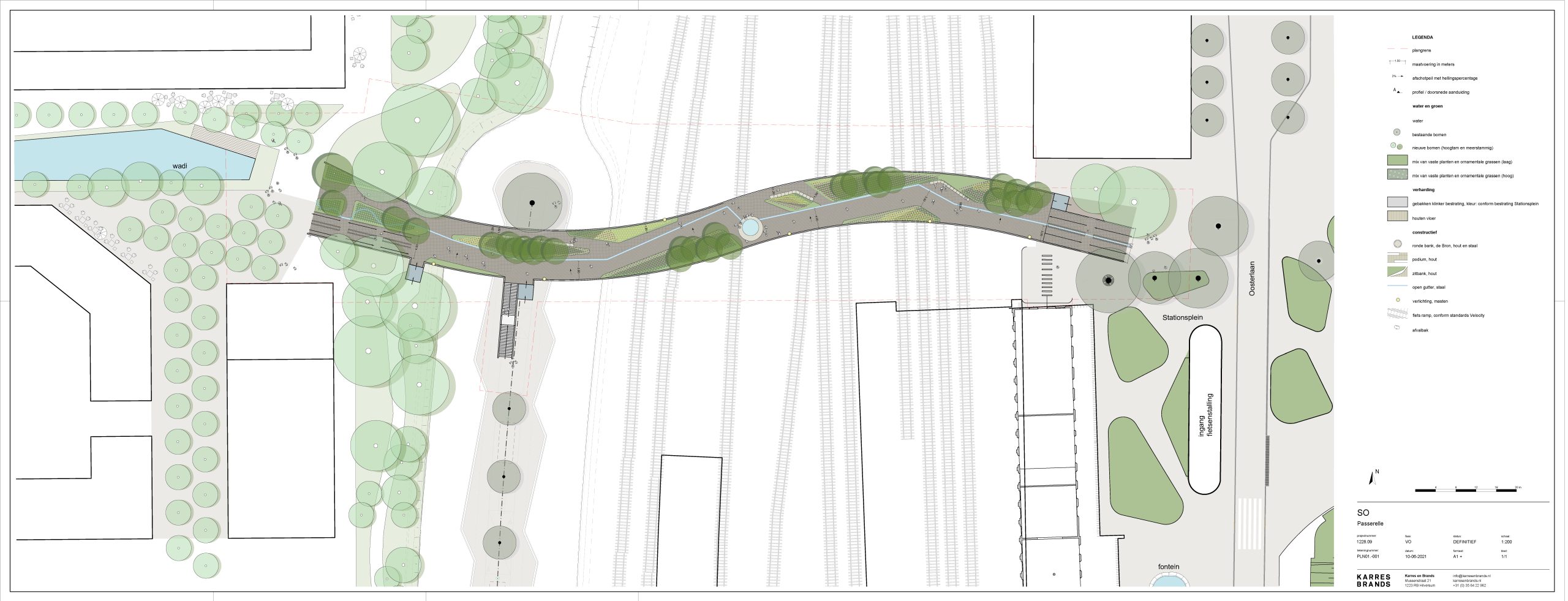
Within the station square introduced by Karres and Brands, a variety of interventions, from a bicycle basement and bus bridge to the redevelopment of Stationsplein, Oosterlaan, Westerlaan and Hanzelaan, are brought together within a single spatial framework. The railway zone is thus transformed from a peripheral area into a new urban centre.
The station as catalyst
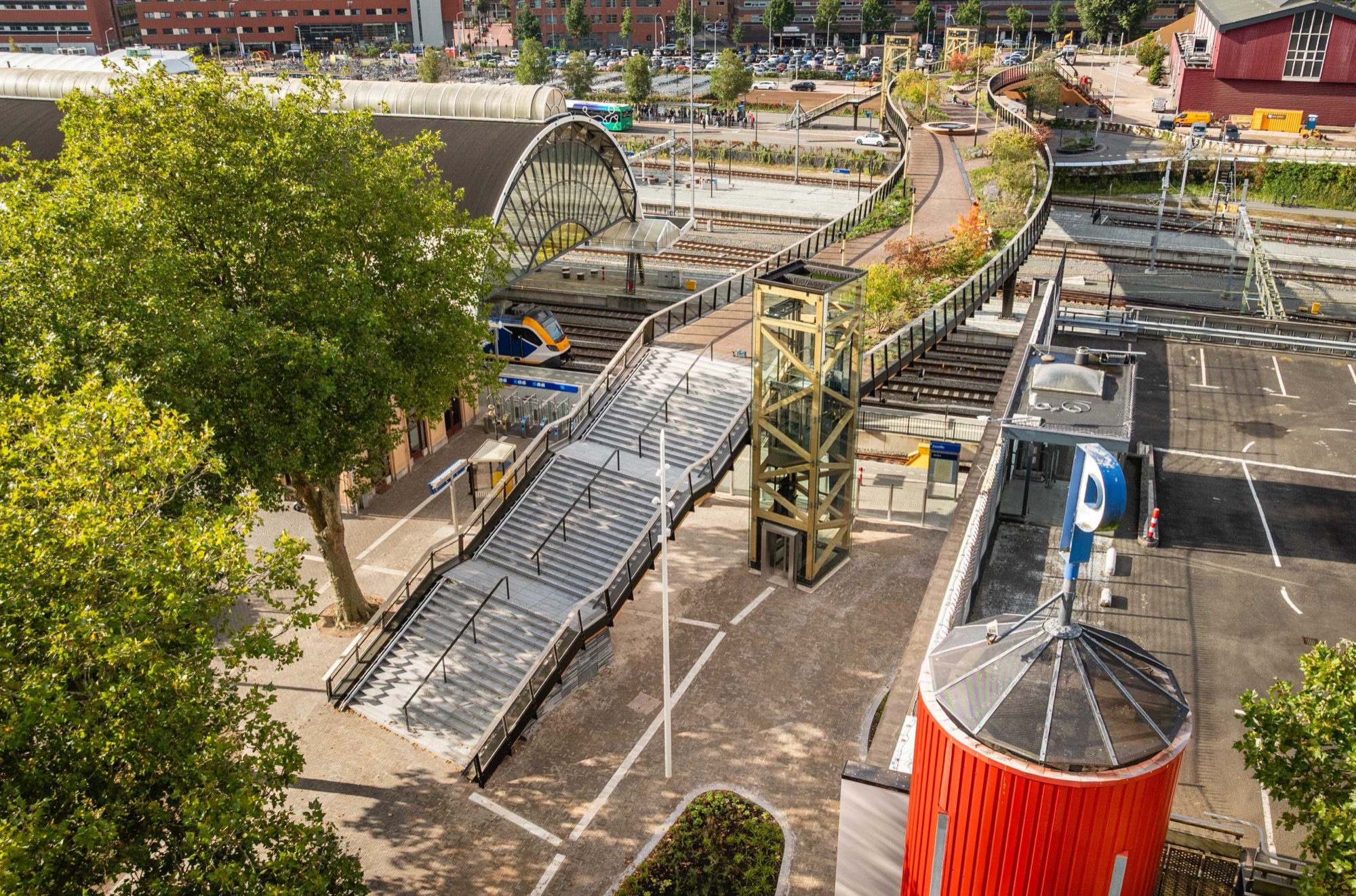
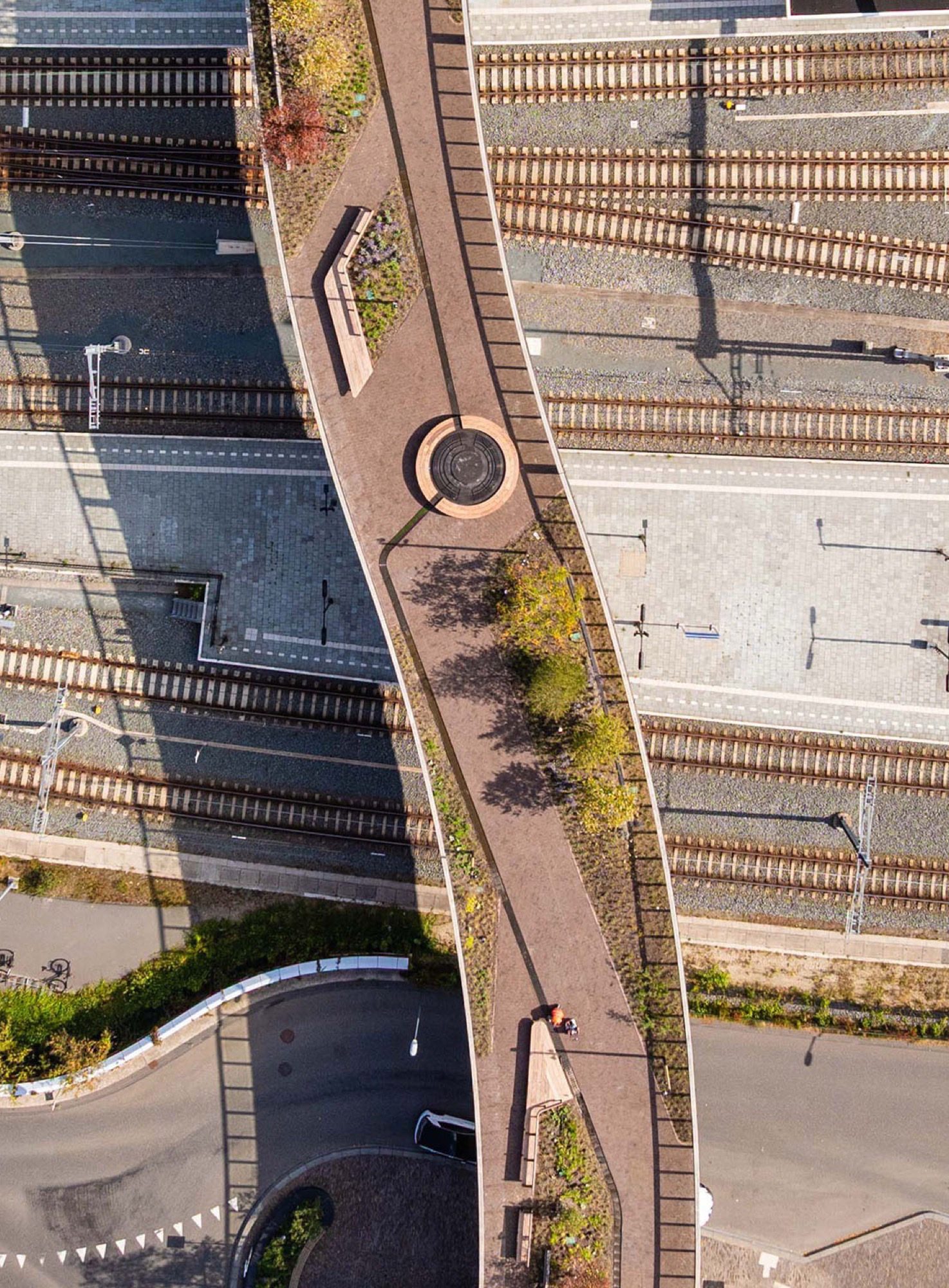
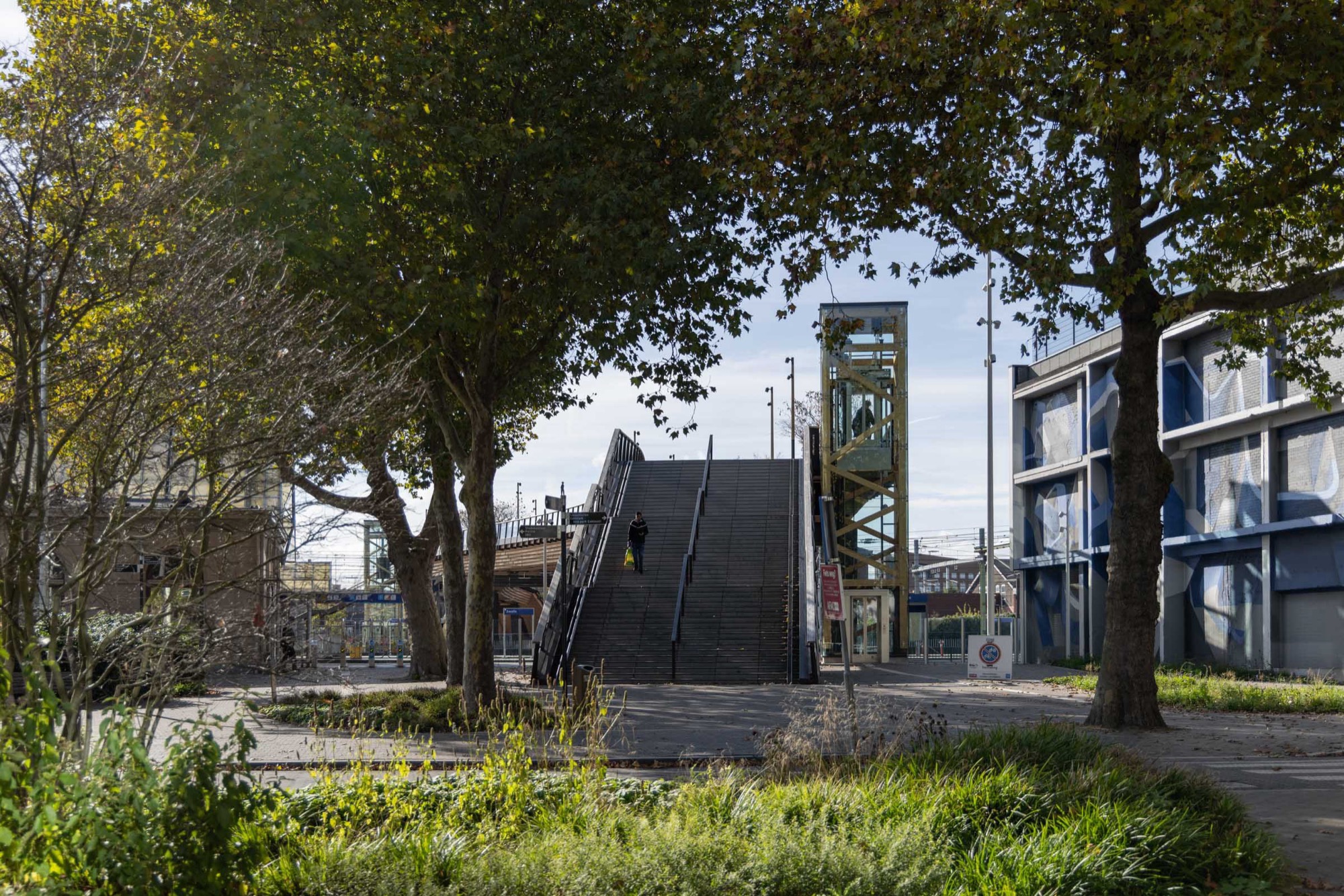
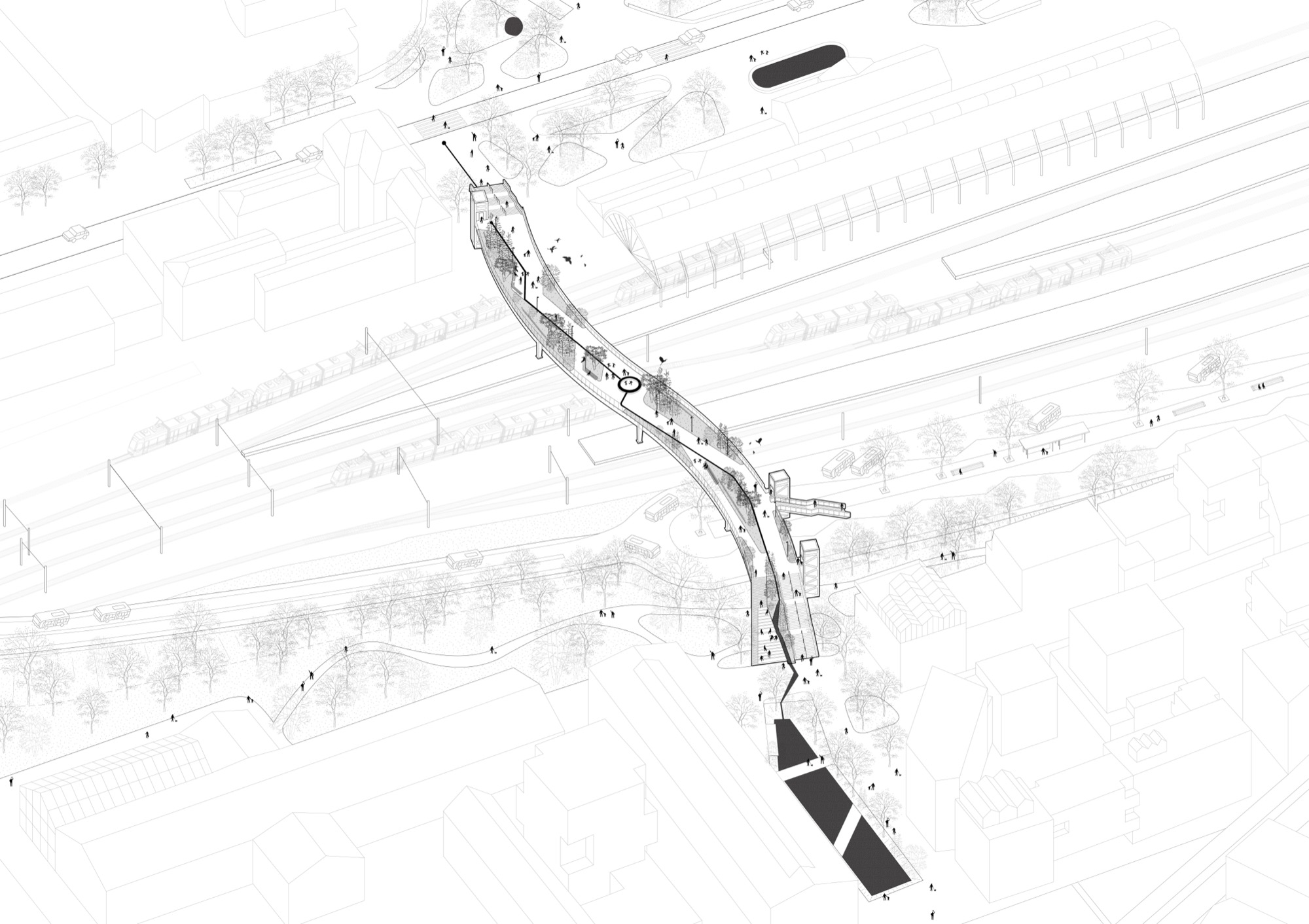
The railway zone functions as an ‘intermediate landscape’ where mobility, urban development and landscape converge. The station area redevelopment acts as a driving force behind broader urban transformation, with ambitions in urbanisation, mobility concepts, climate adaptation and energy transition. The Passerelle plays a key role in this. By extending the station street over the railway tracks, a clear connection is created between old and new Zwolle. This intervention improves accessibility and contributes to social cohesion by connecting the southern neighbourhoods with amenities, employment and urban life.
A ‘raised street’
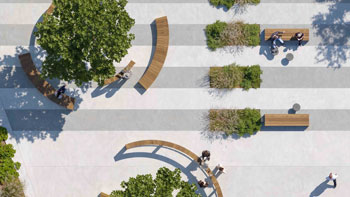
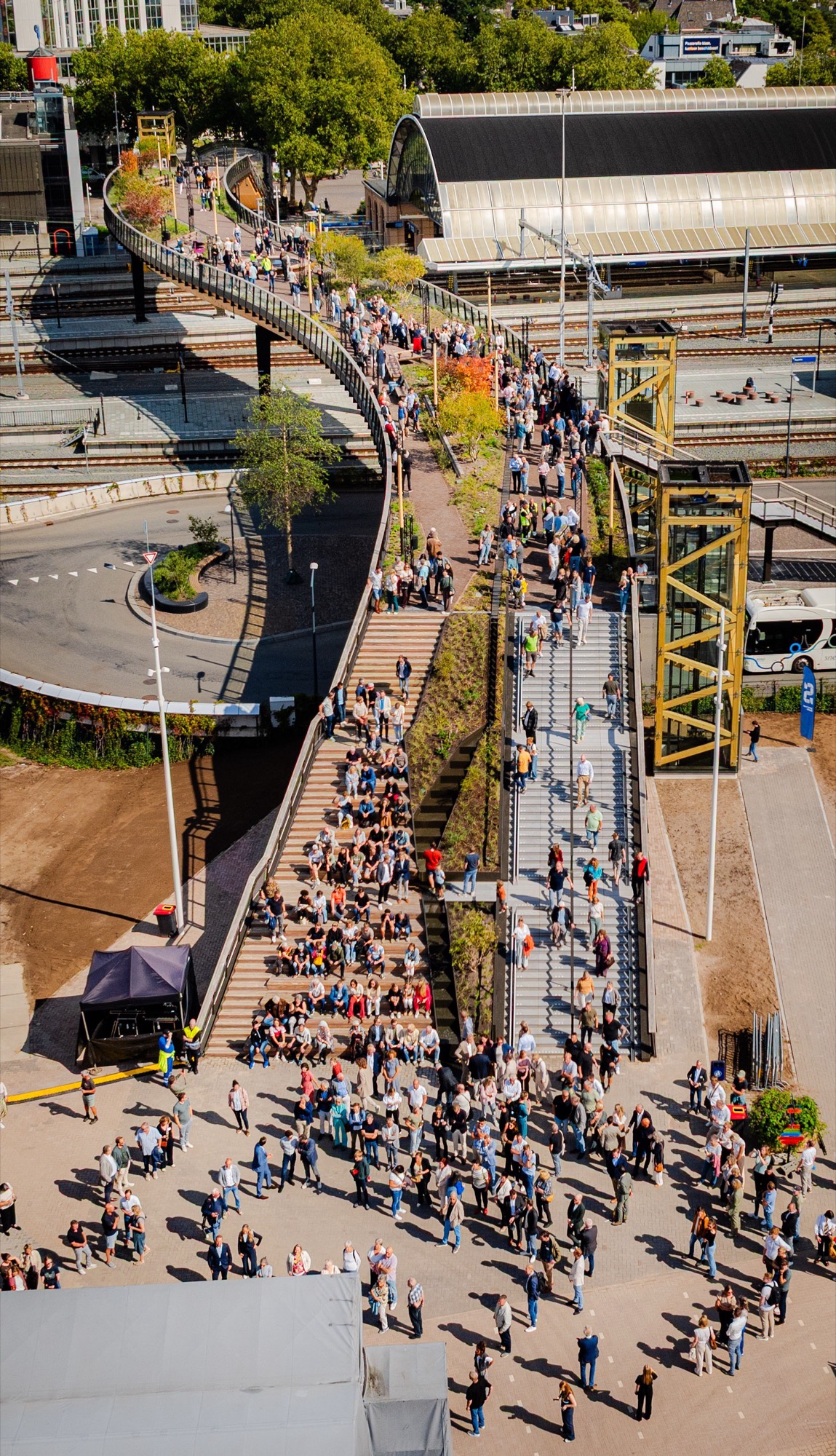
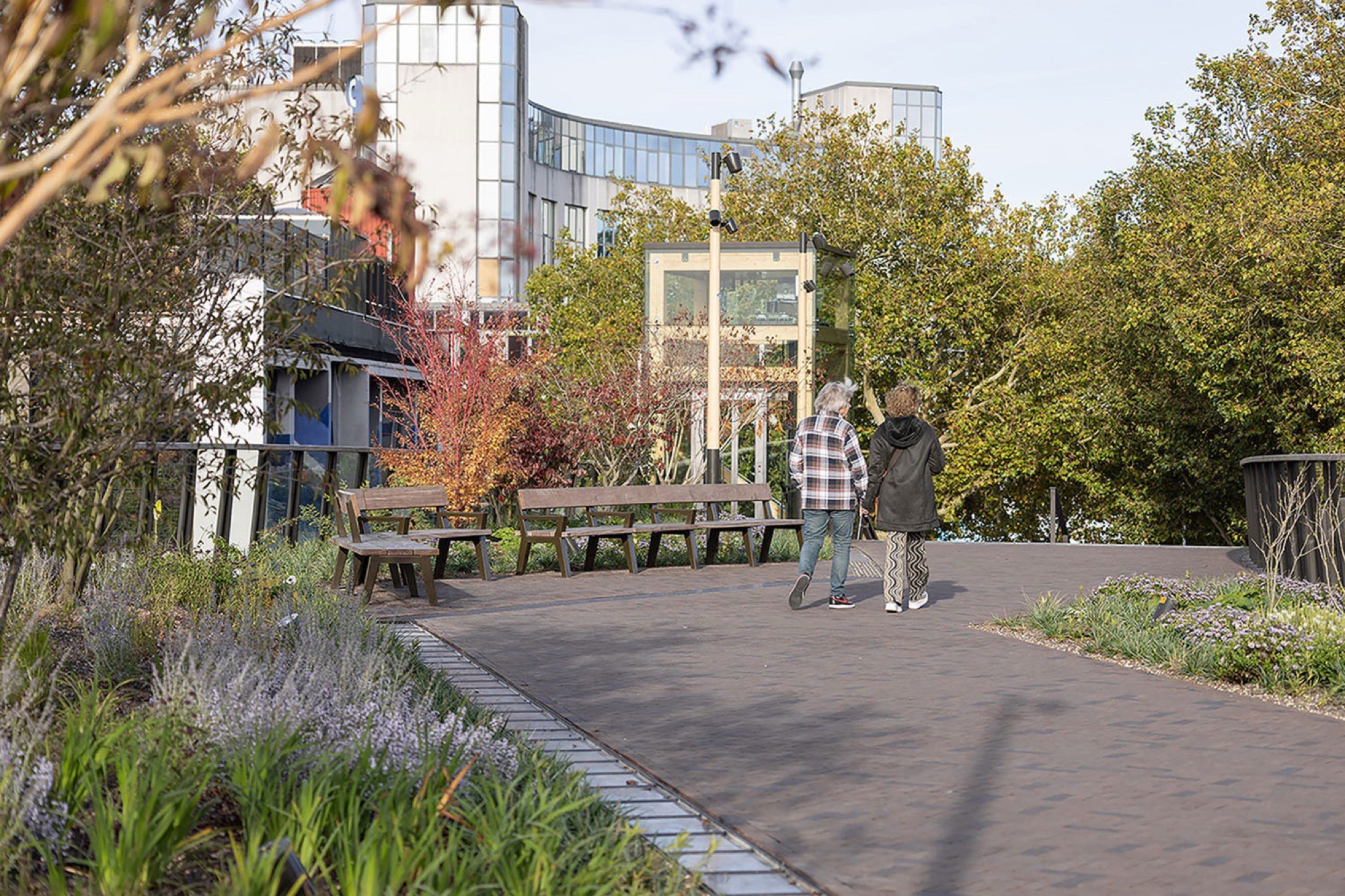
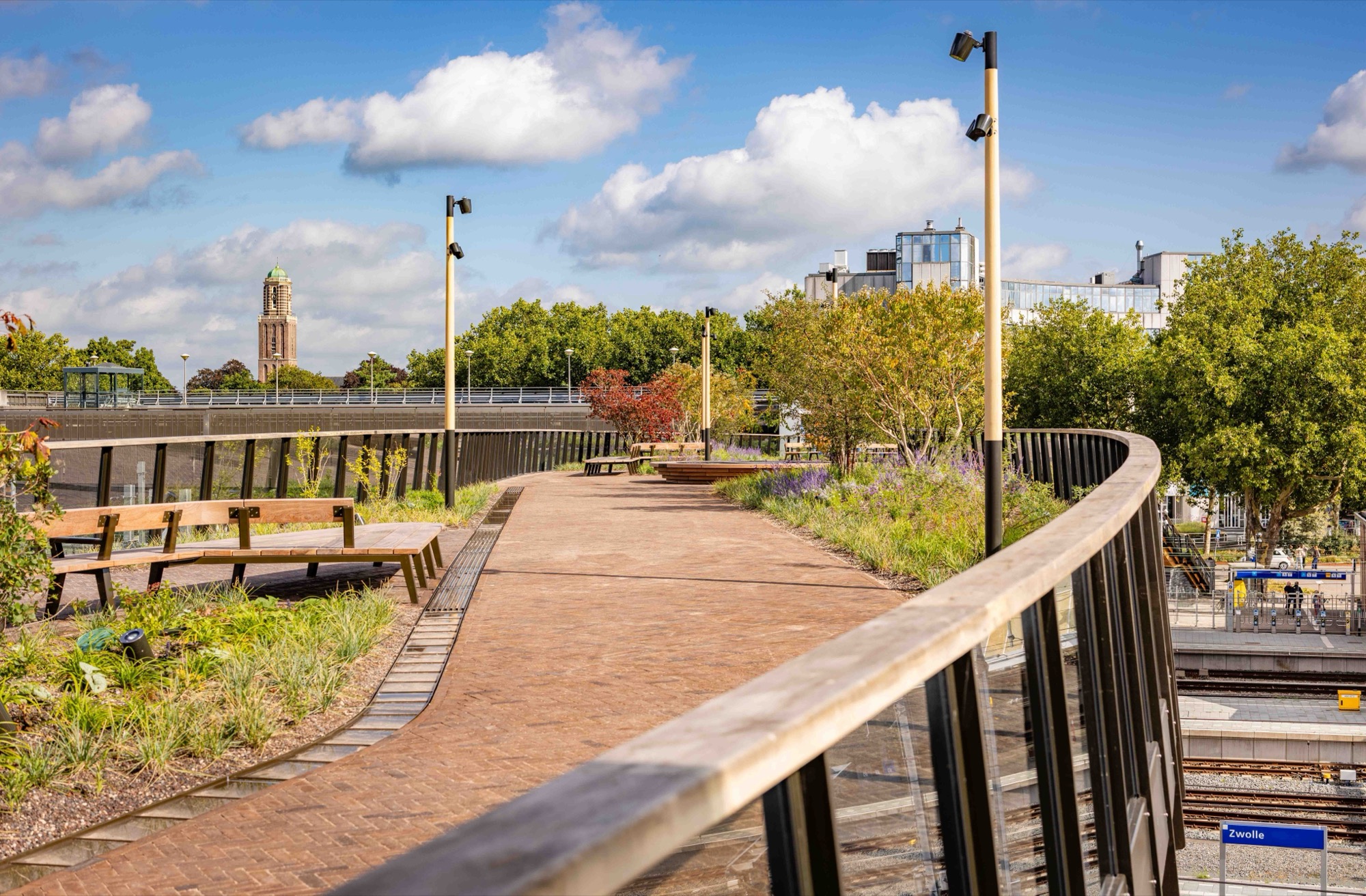
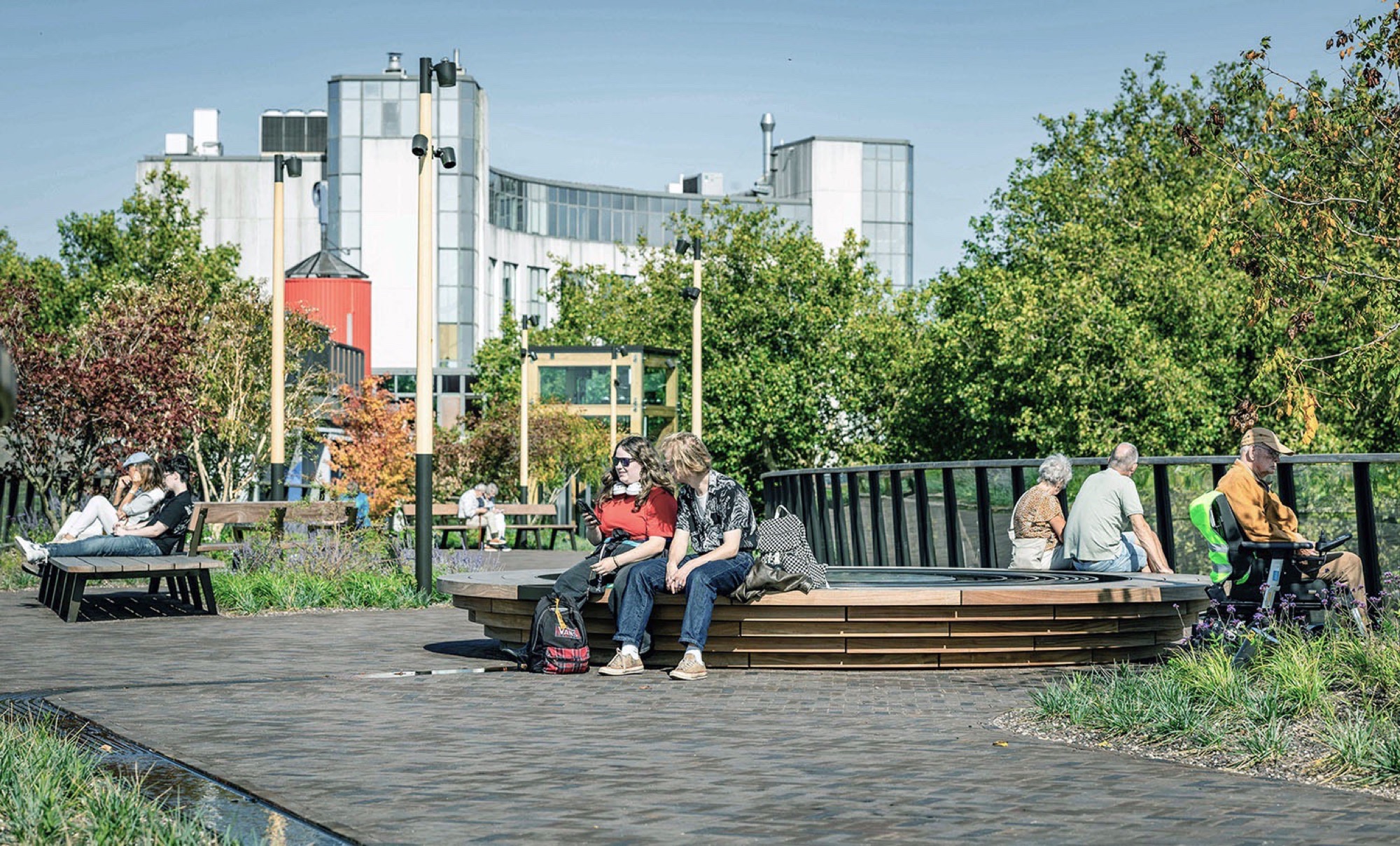
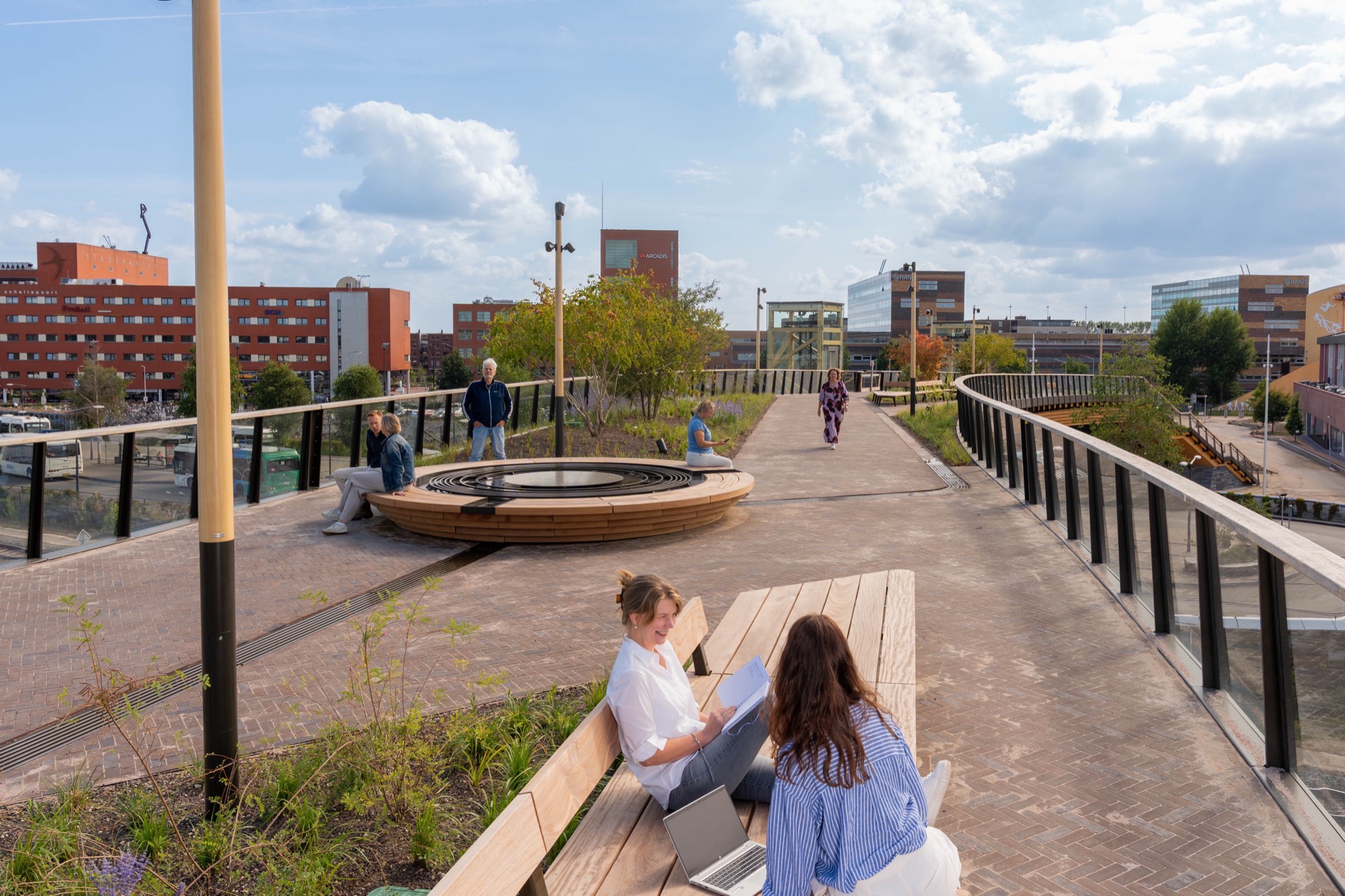
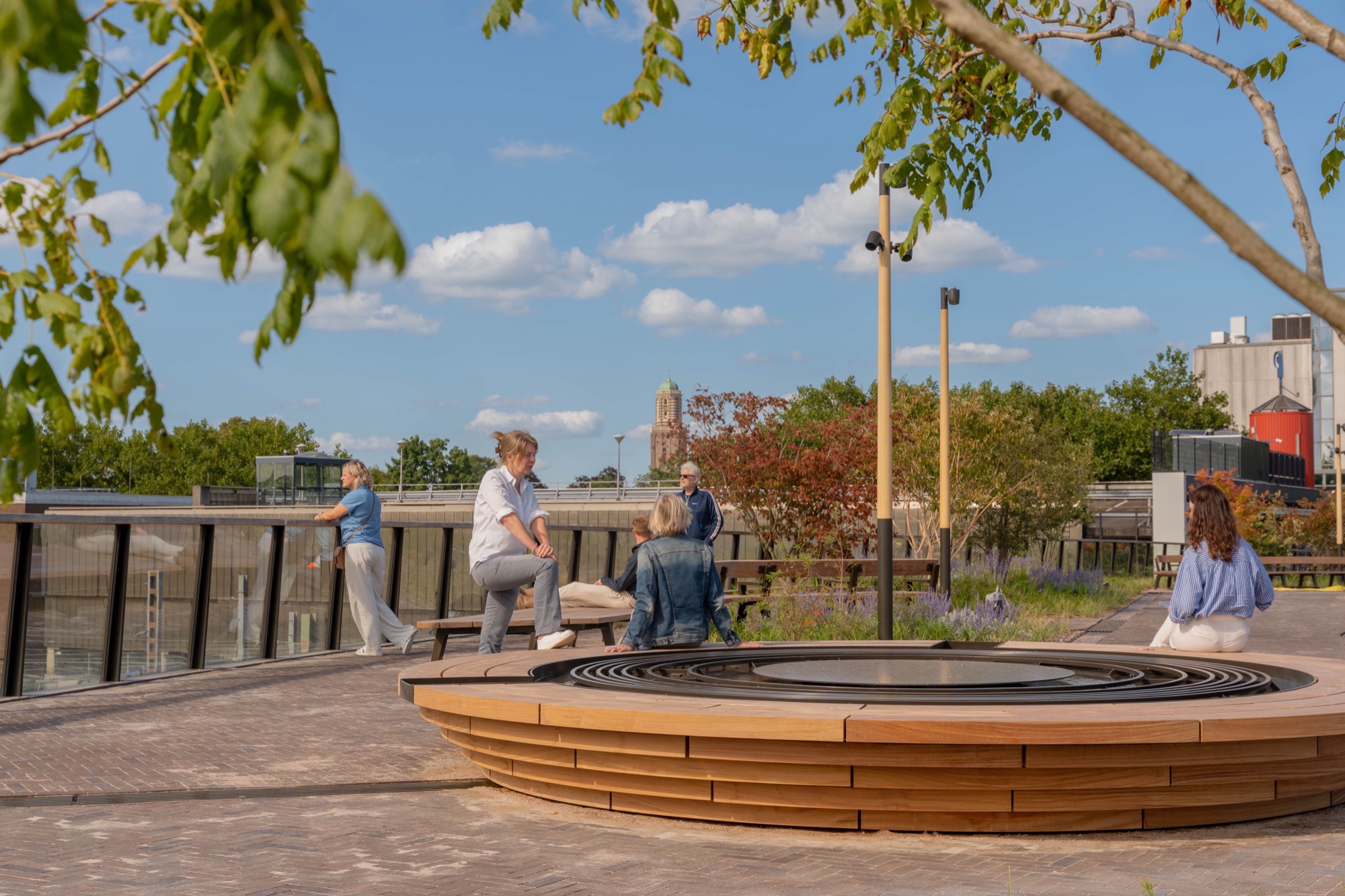
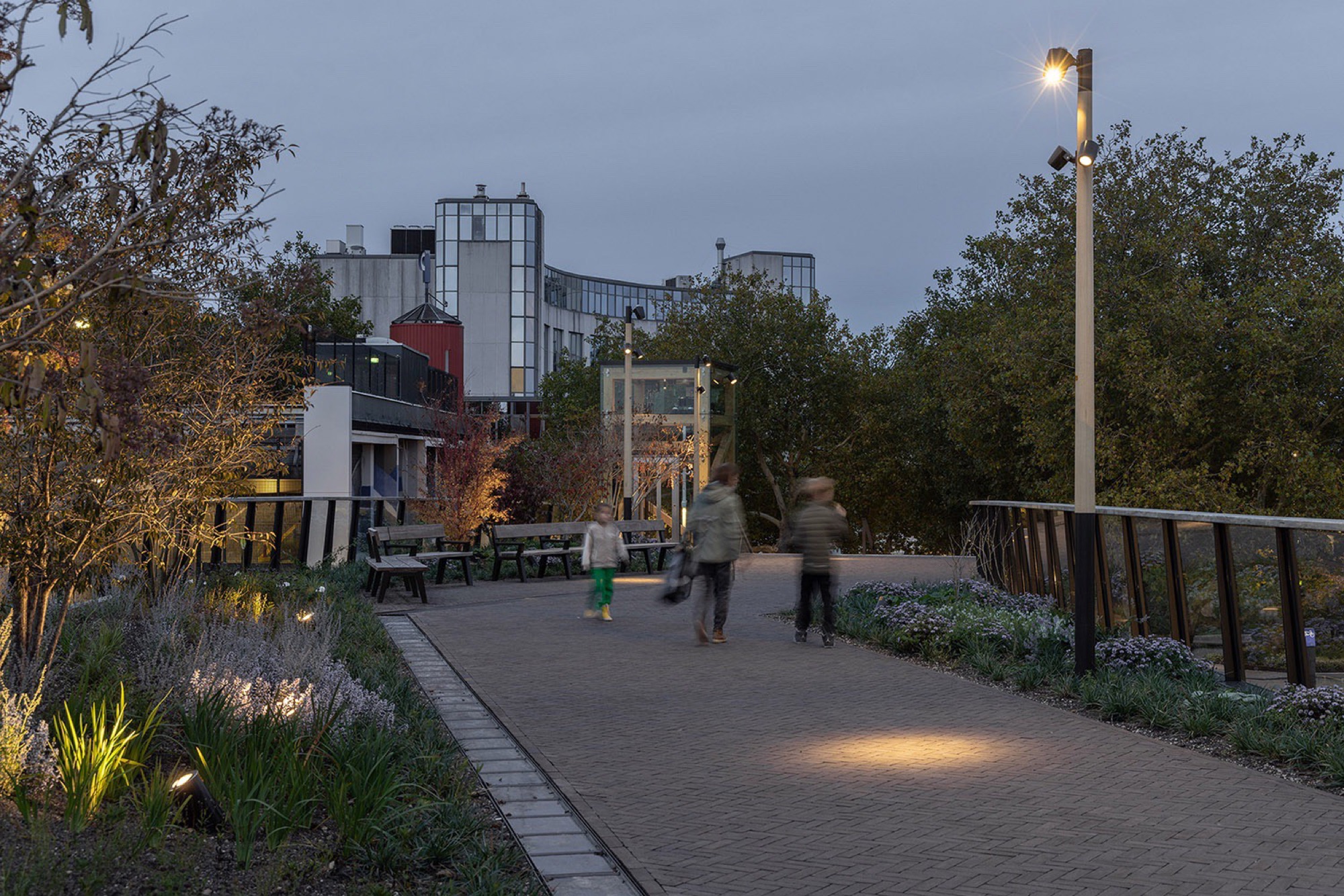
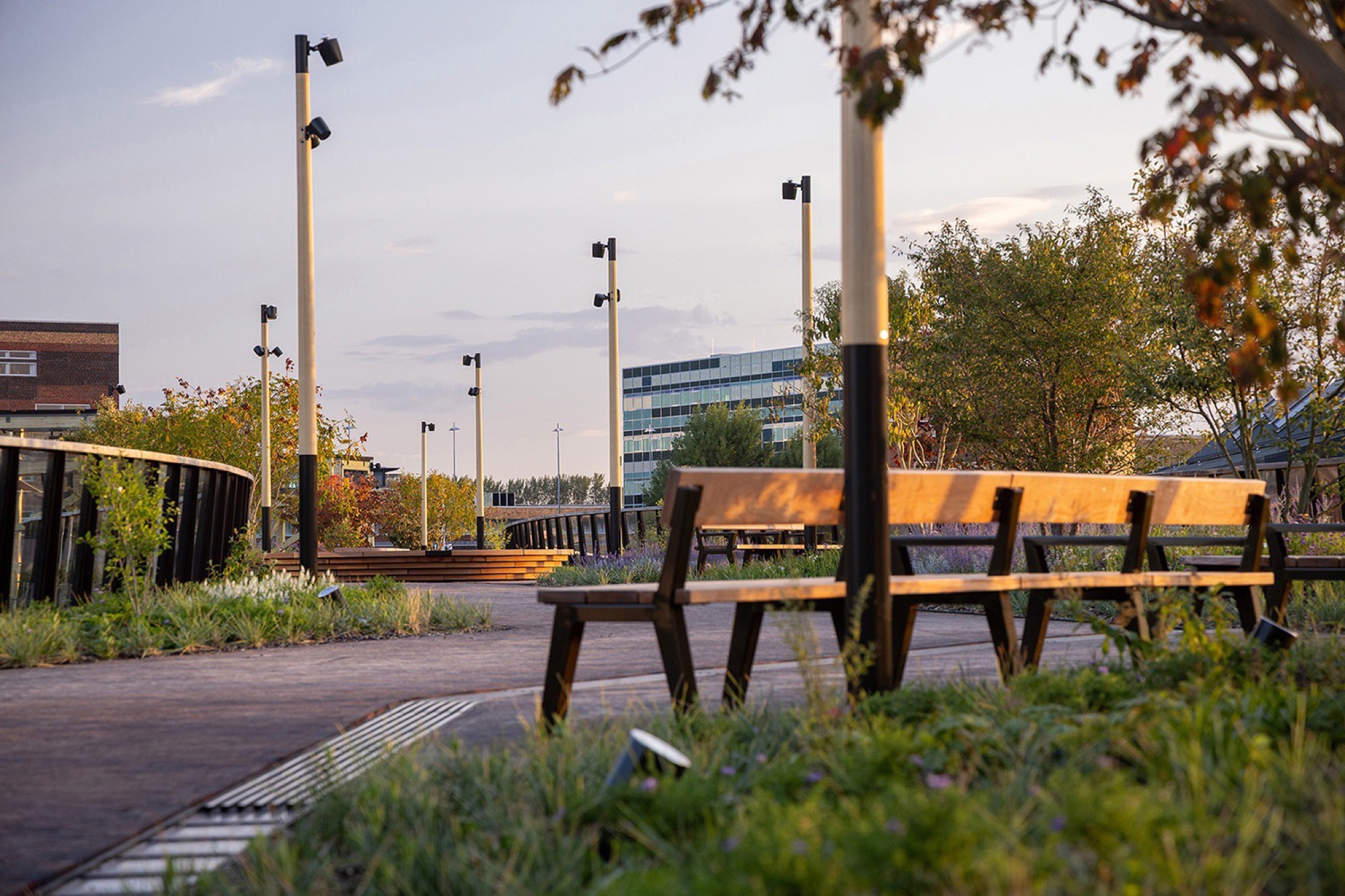
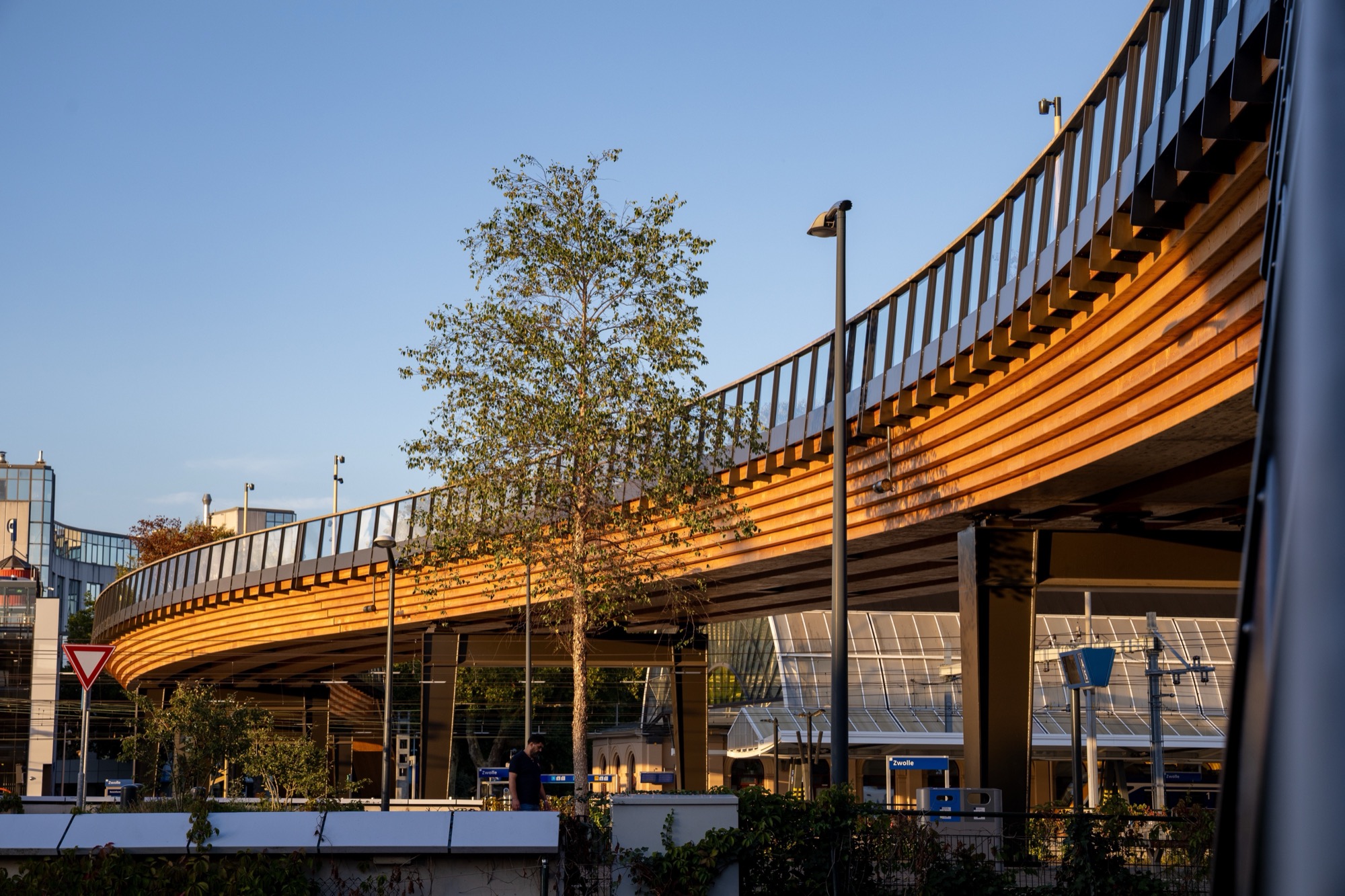
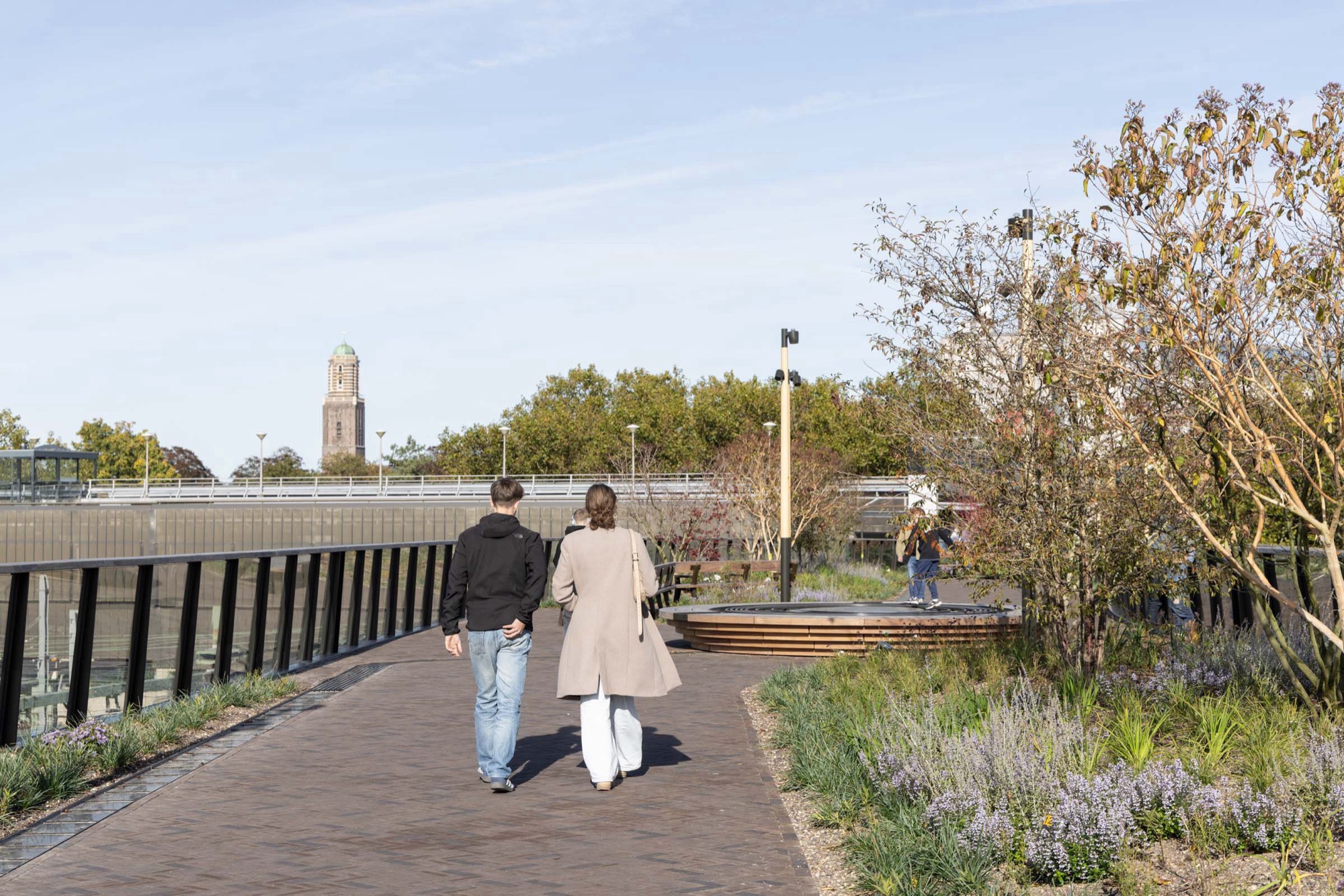
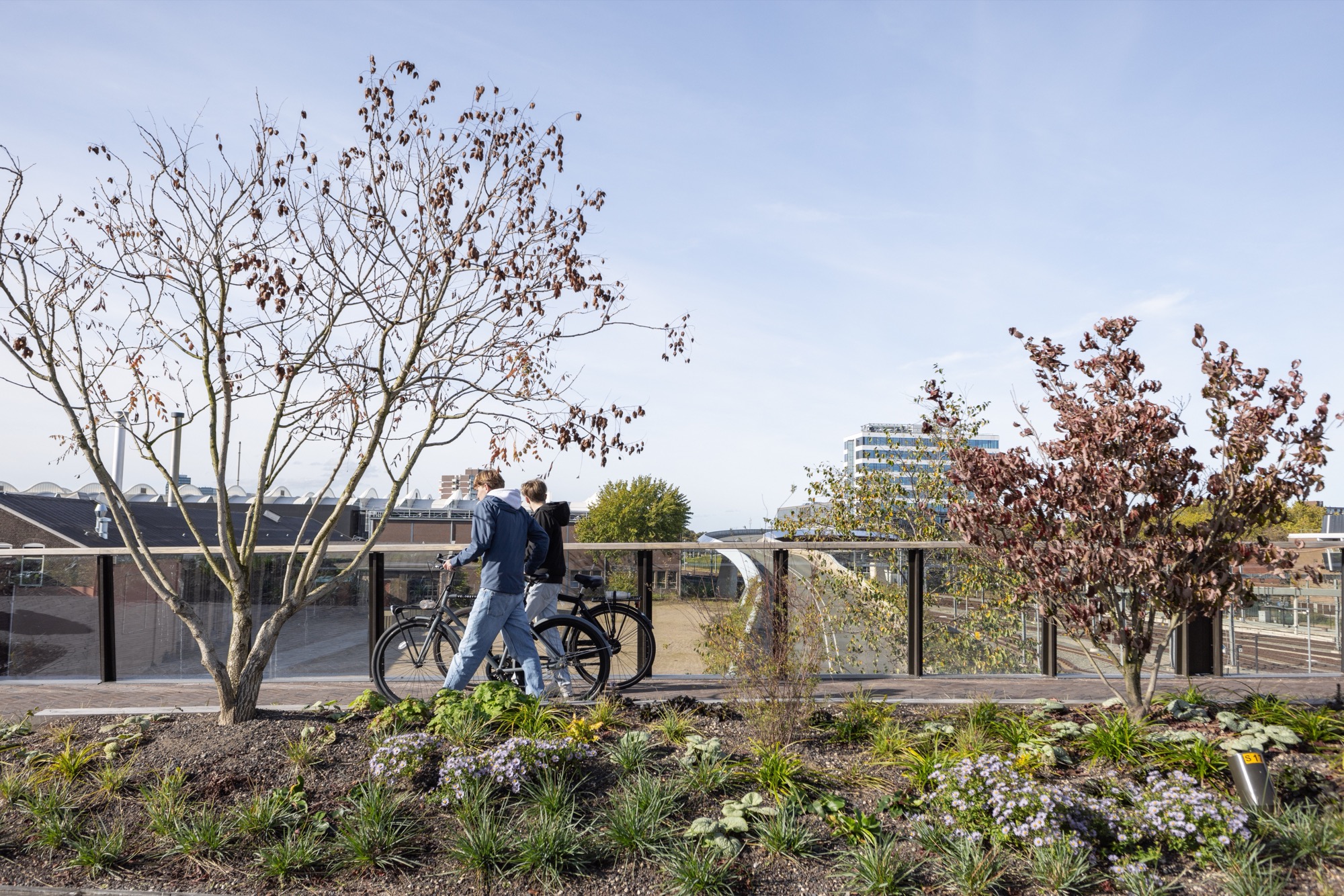
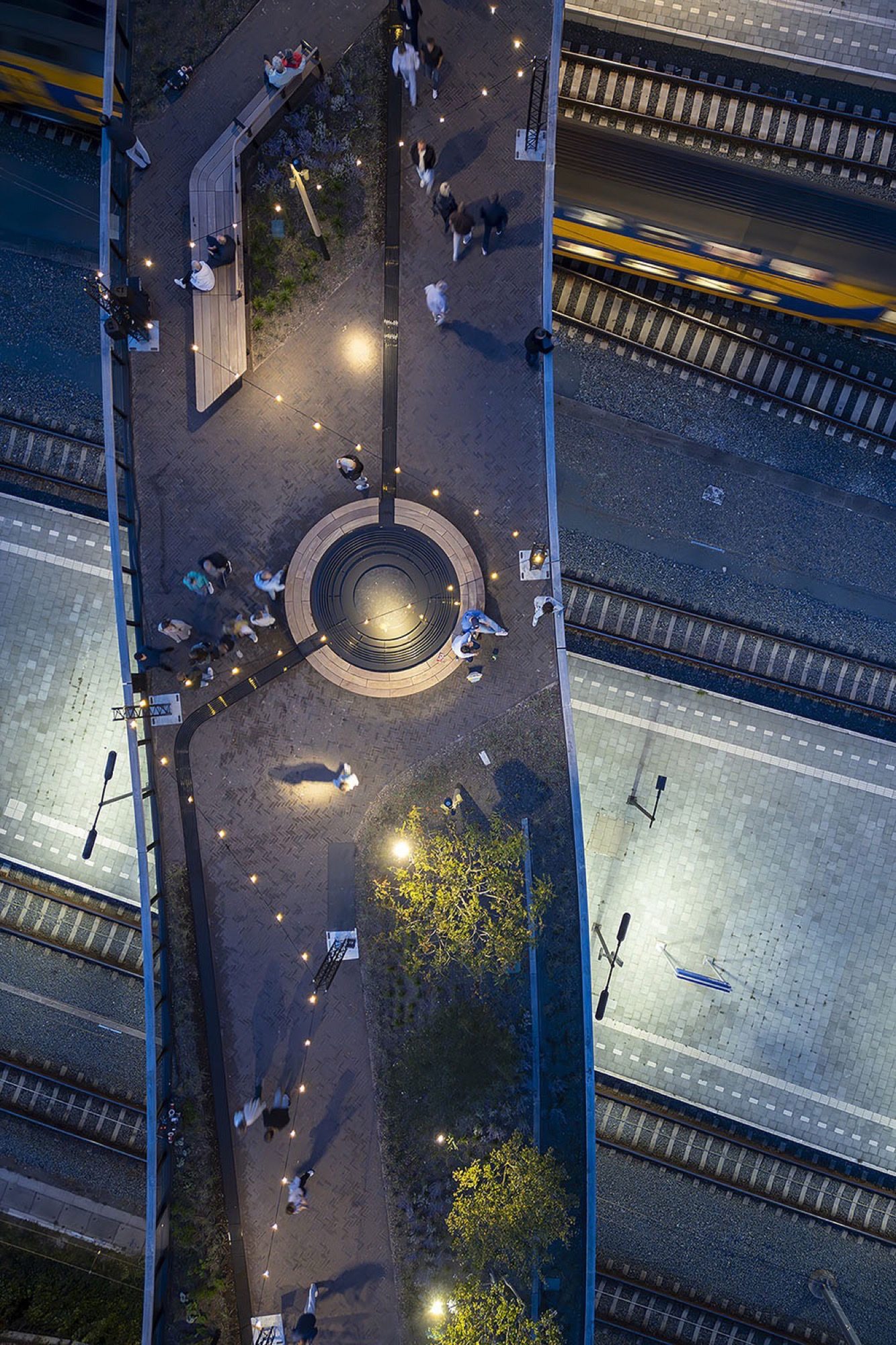
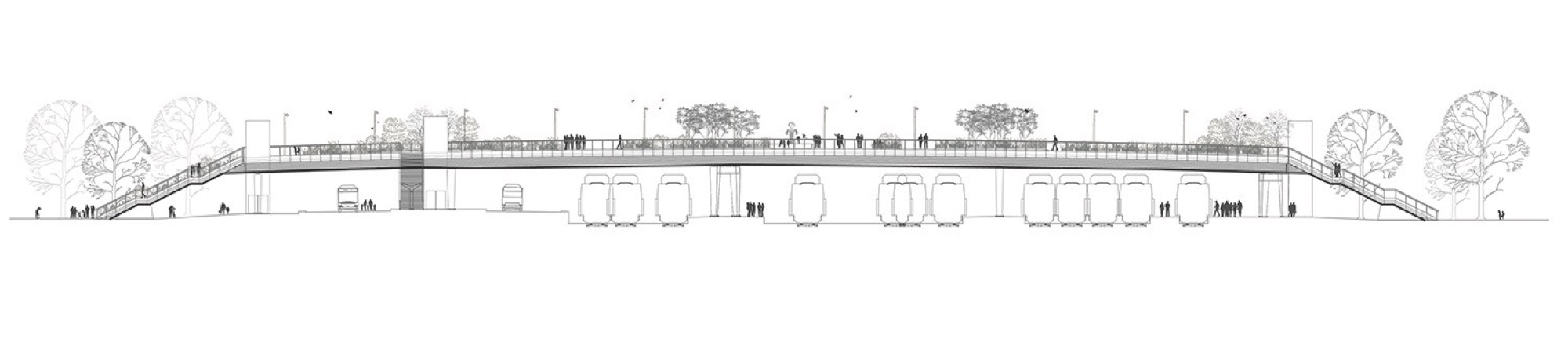
The Passerelle is not a purely technical solution but has been designed as an urban space at height. The concept of the ‘raised street’ forms the core of the design: not a simple linear connection from A to B, but a composed sequence of spaces that invite movement and pause. The S-shape slows the crossing and ensures a gradual unfolding of views over the city and railway. Sightlines shift continuously, allowing users to experience the surroundings in different ways. Halfway across, the bridge widens into a gathering place, to meet others or enjoy the view. On the south side, the bridge transforms into a green viewing platform connected to the station park.
Wood, horizon and connection
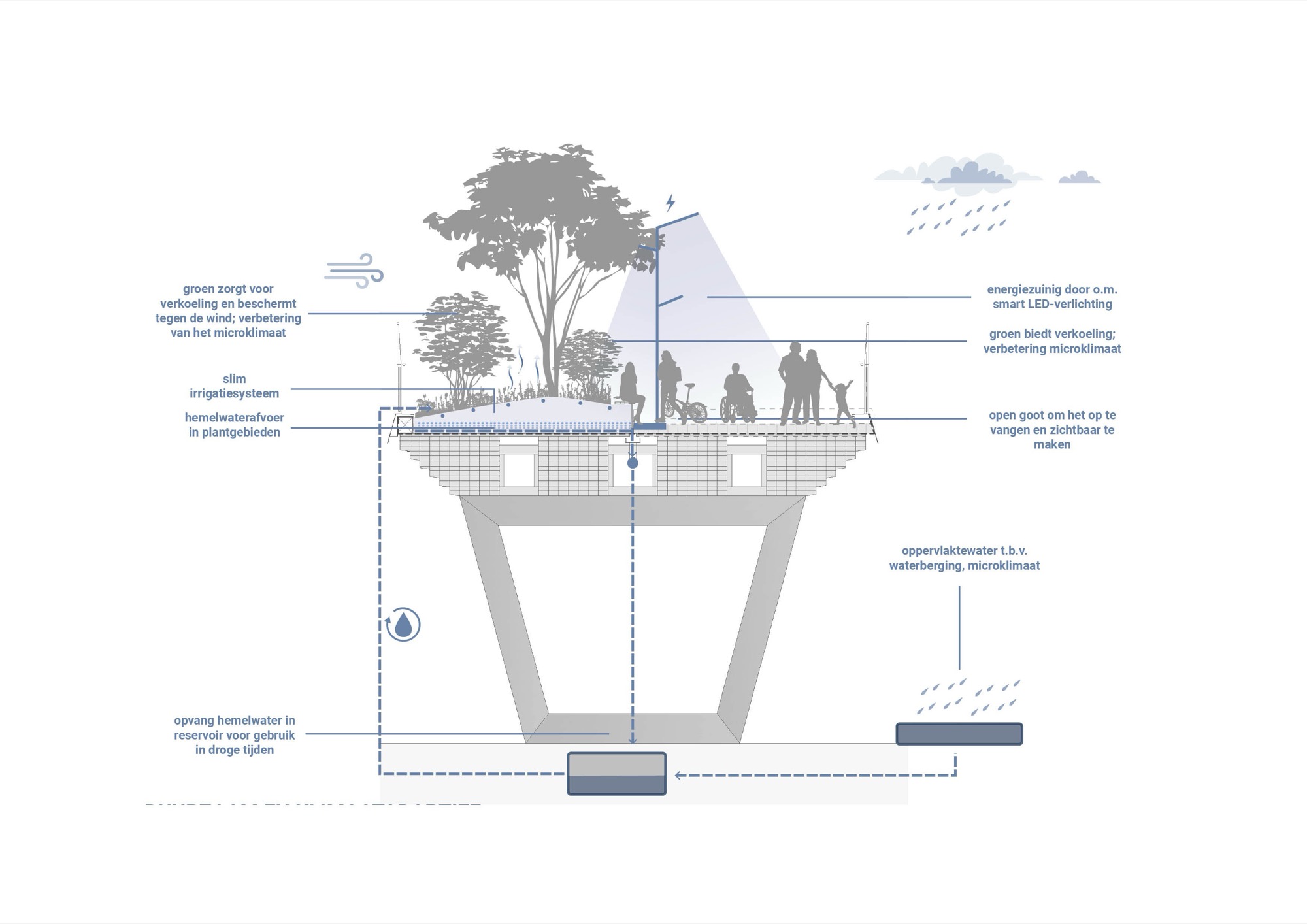
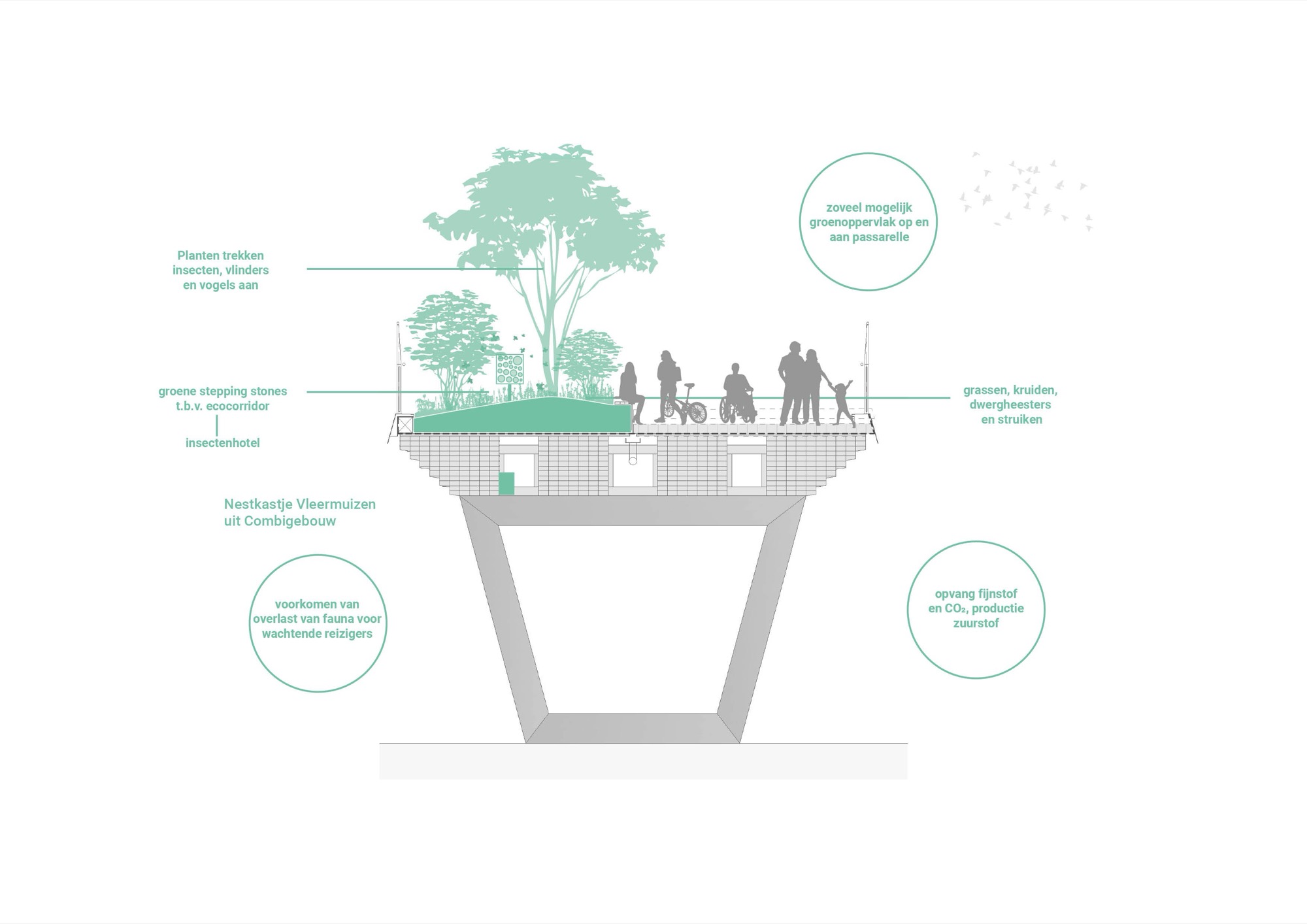
The Passerelle acts as a catalyst within the sustainable development of the Zwolle station area. The design brings together challenges relating to biodiversity, climate adaptation, mobility, inclusivity and circularity into one spatial gesture. This integrated approach is reflected in both design and construction.
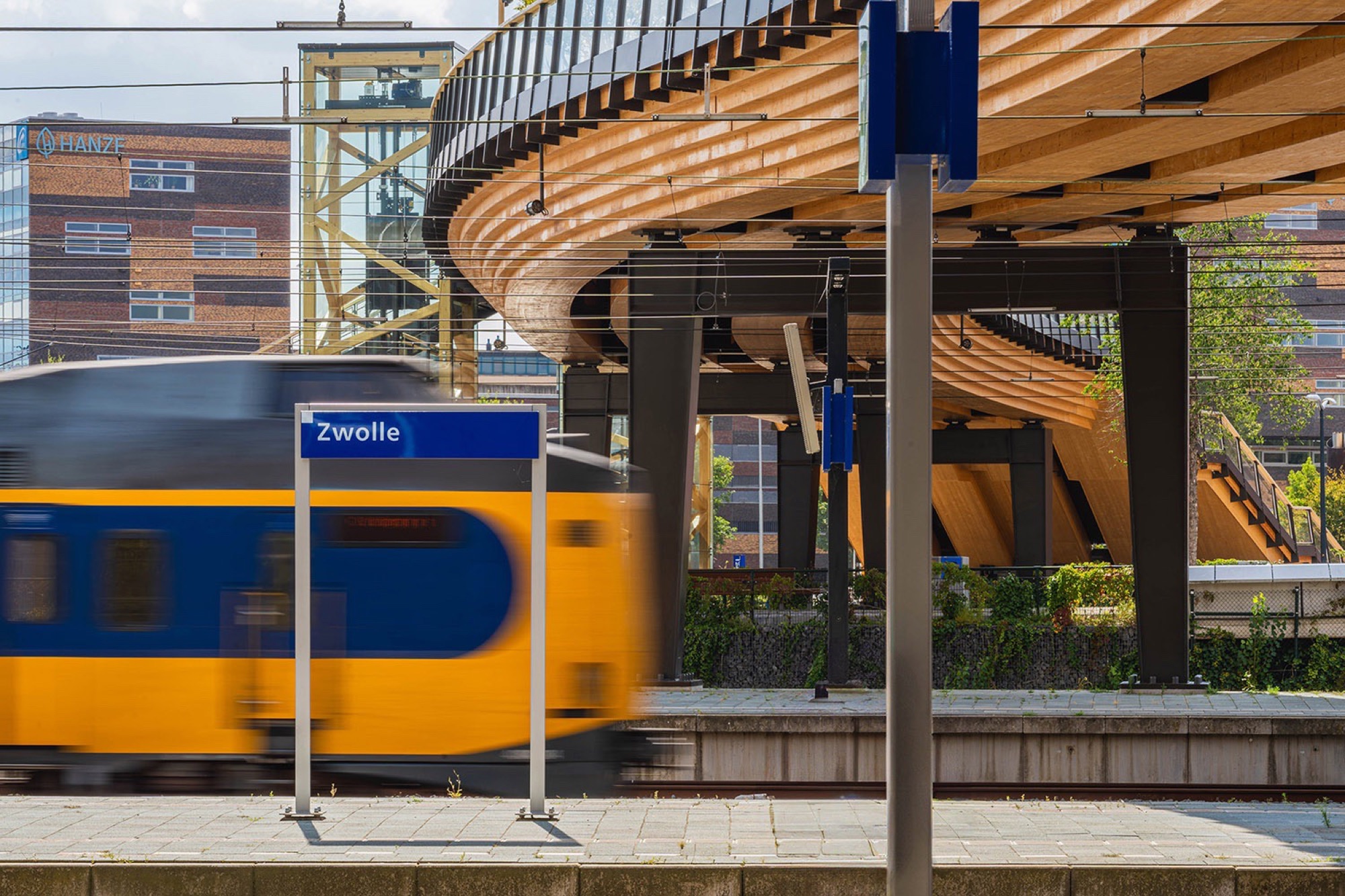
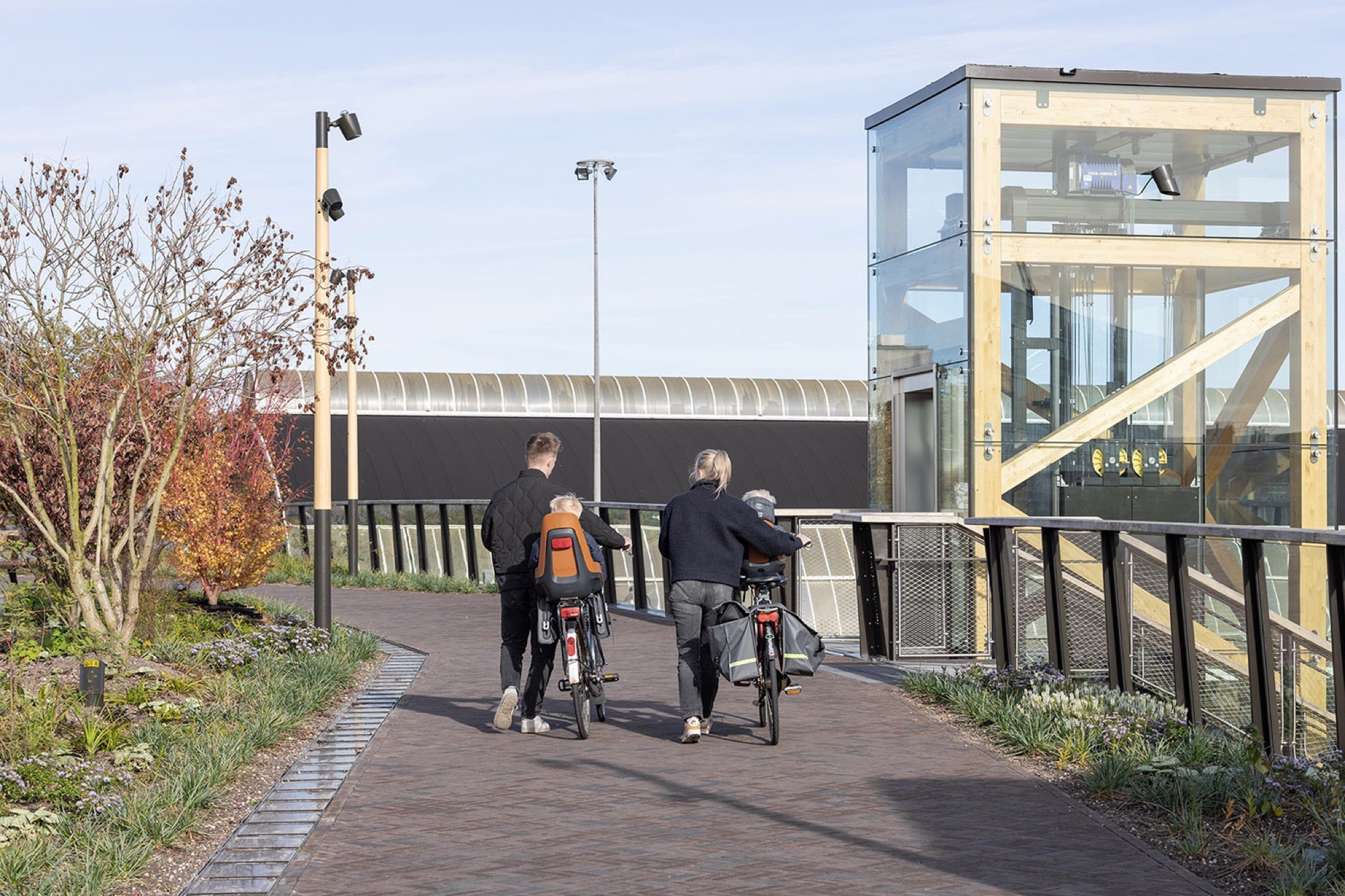
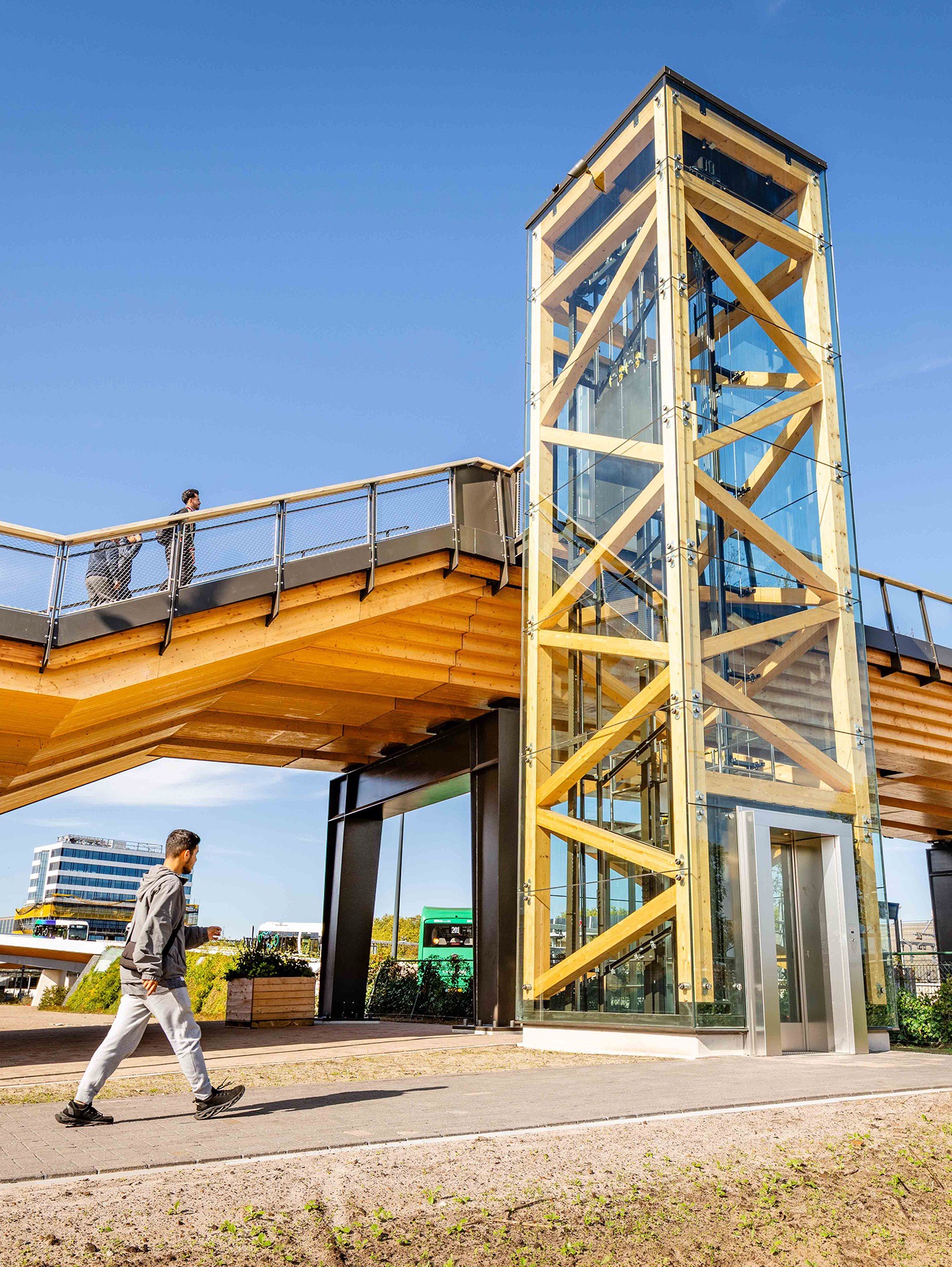
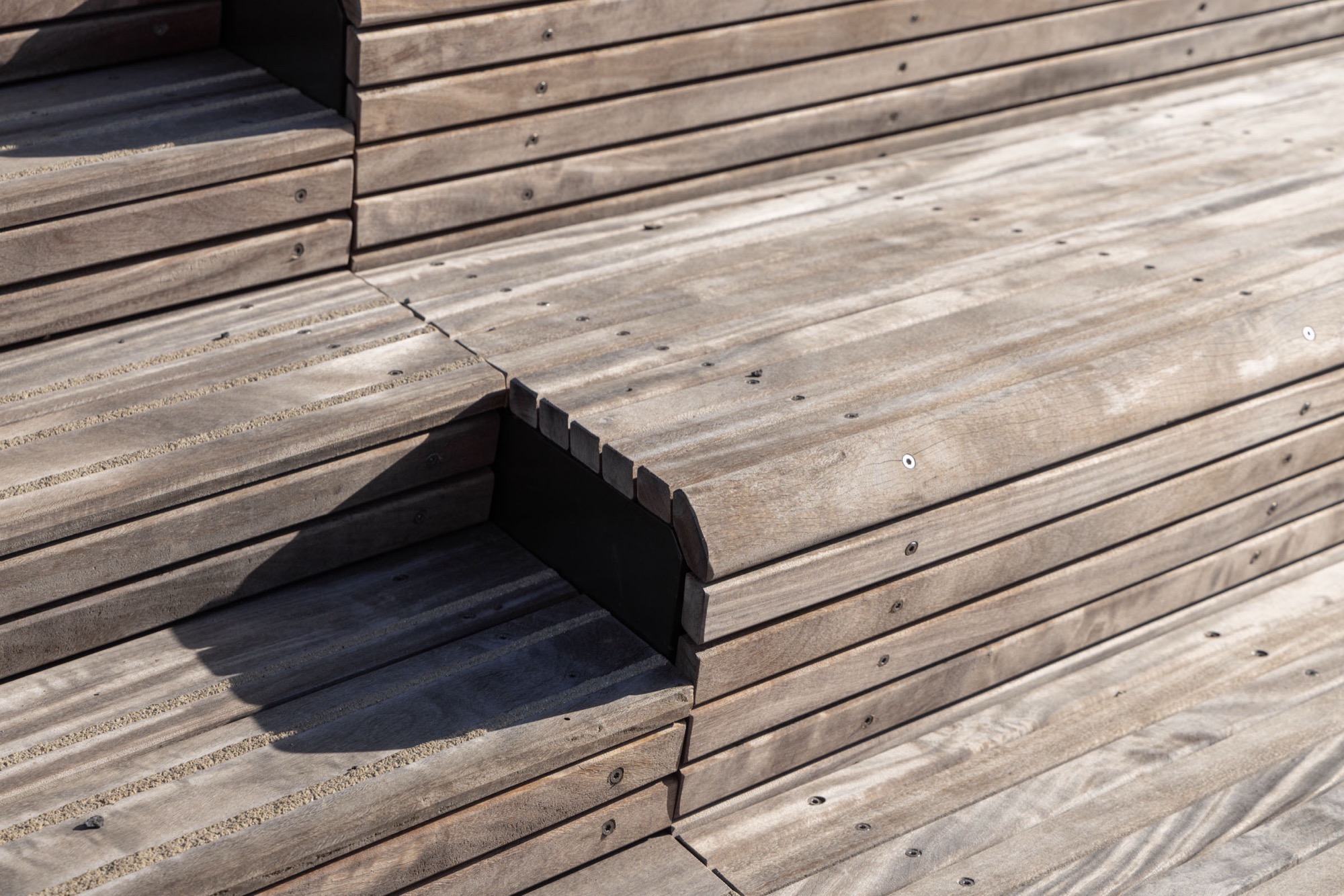
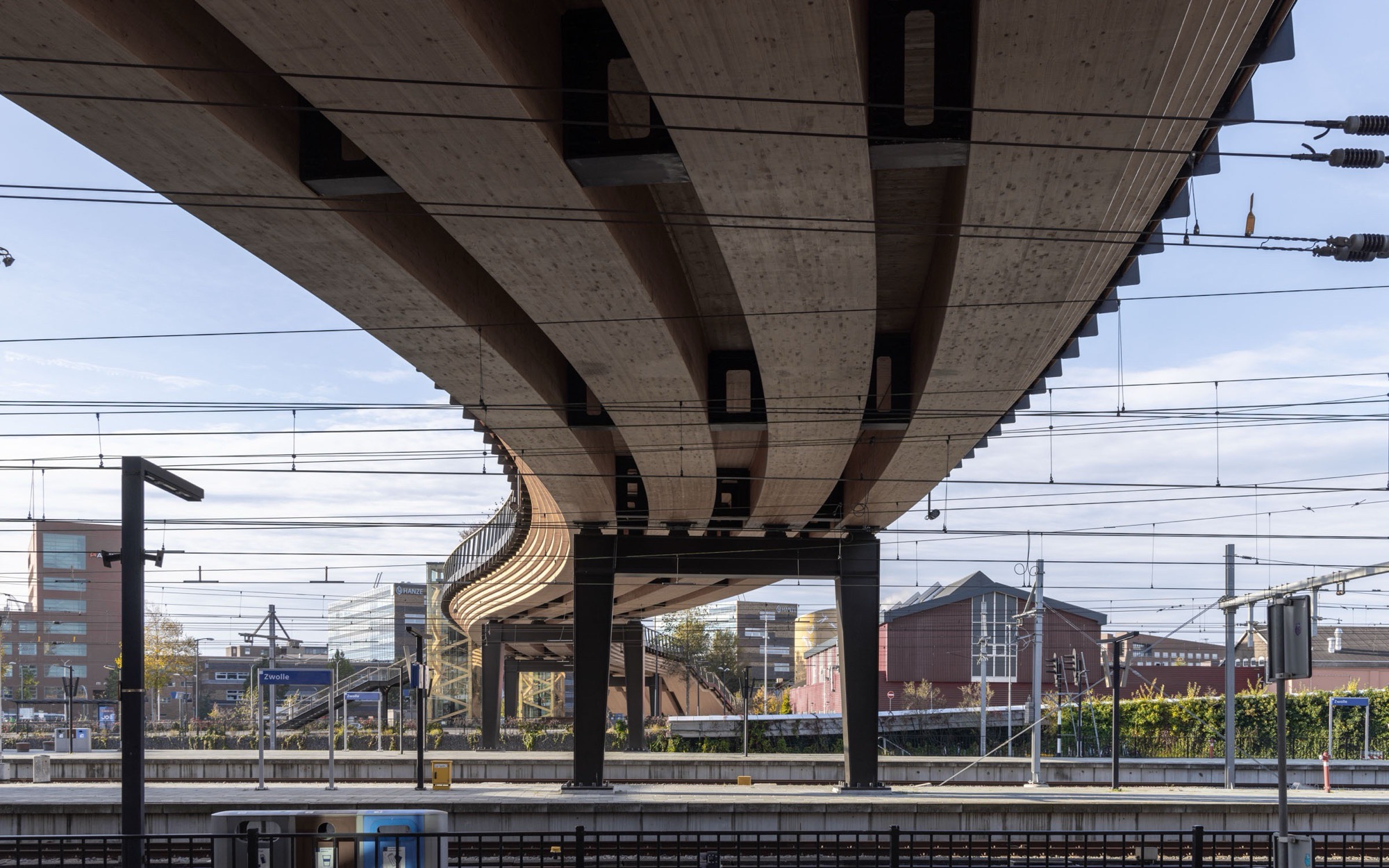
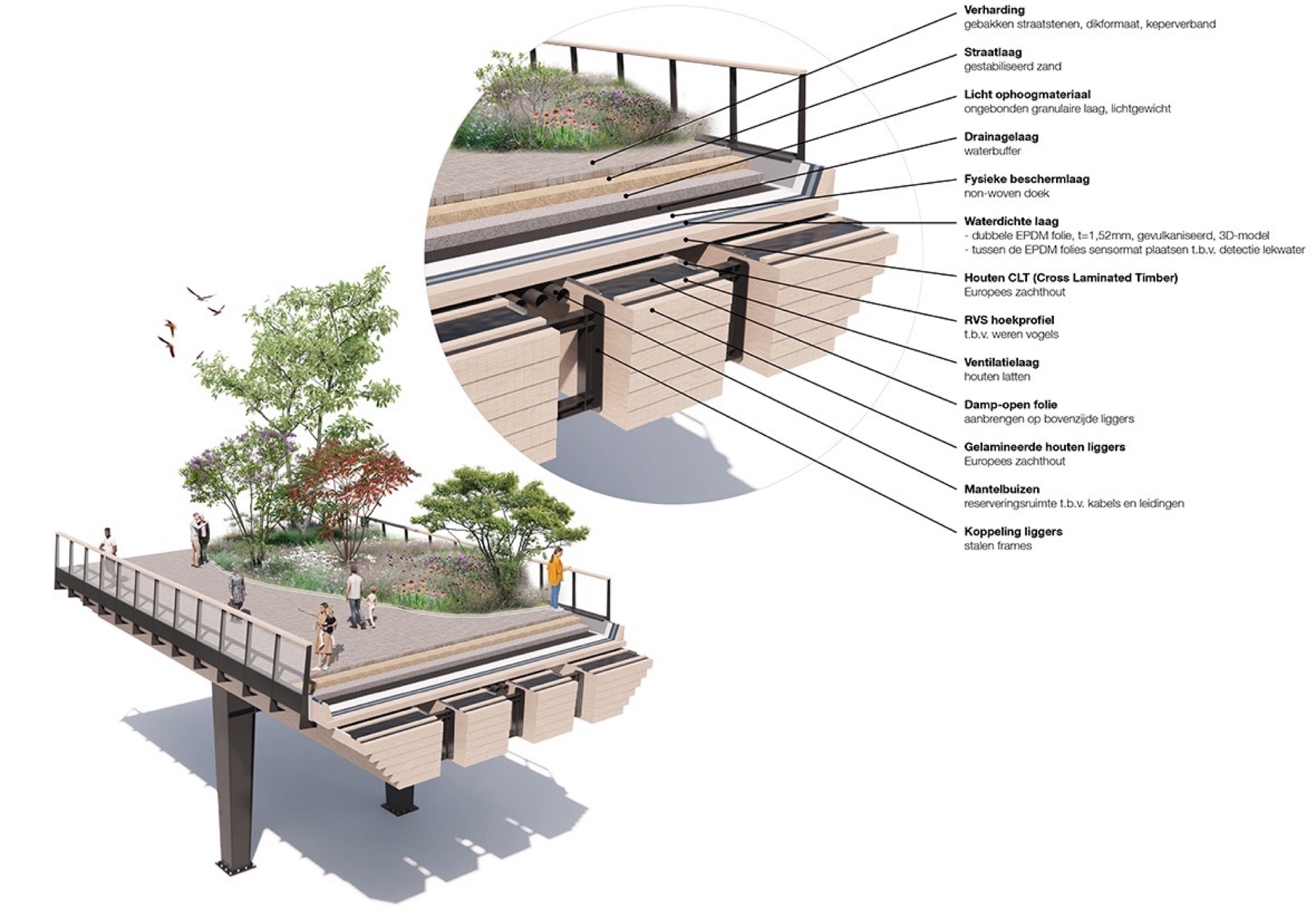
The bridge is constructed from laminated main girders of European softwood, supported by black steel portals. This results in a clear structure in which material and support merge. With a length of 130 metres, the Passerelle is the longest pedestrian bridge made of European softwood in Europe. The bridge stores approximately 1,300 tonnes of CO₂ and reduces emissions by 74% compared to a similar steel variant, showing how bio-based construction can function at infrastructural scale. At the same time, the materials connect to the industrial context of the railway: wood and steel together form a contemporary interpretation of infrastructure, where technology and aesthetics are closely linked.
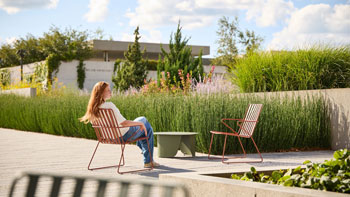
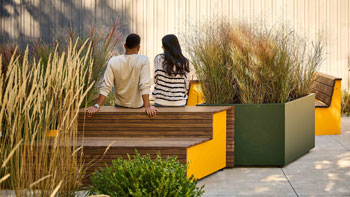
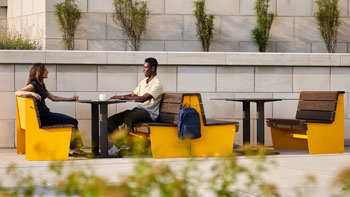
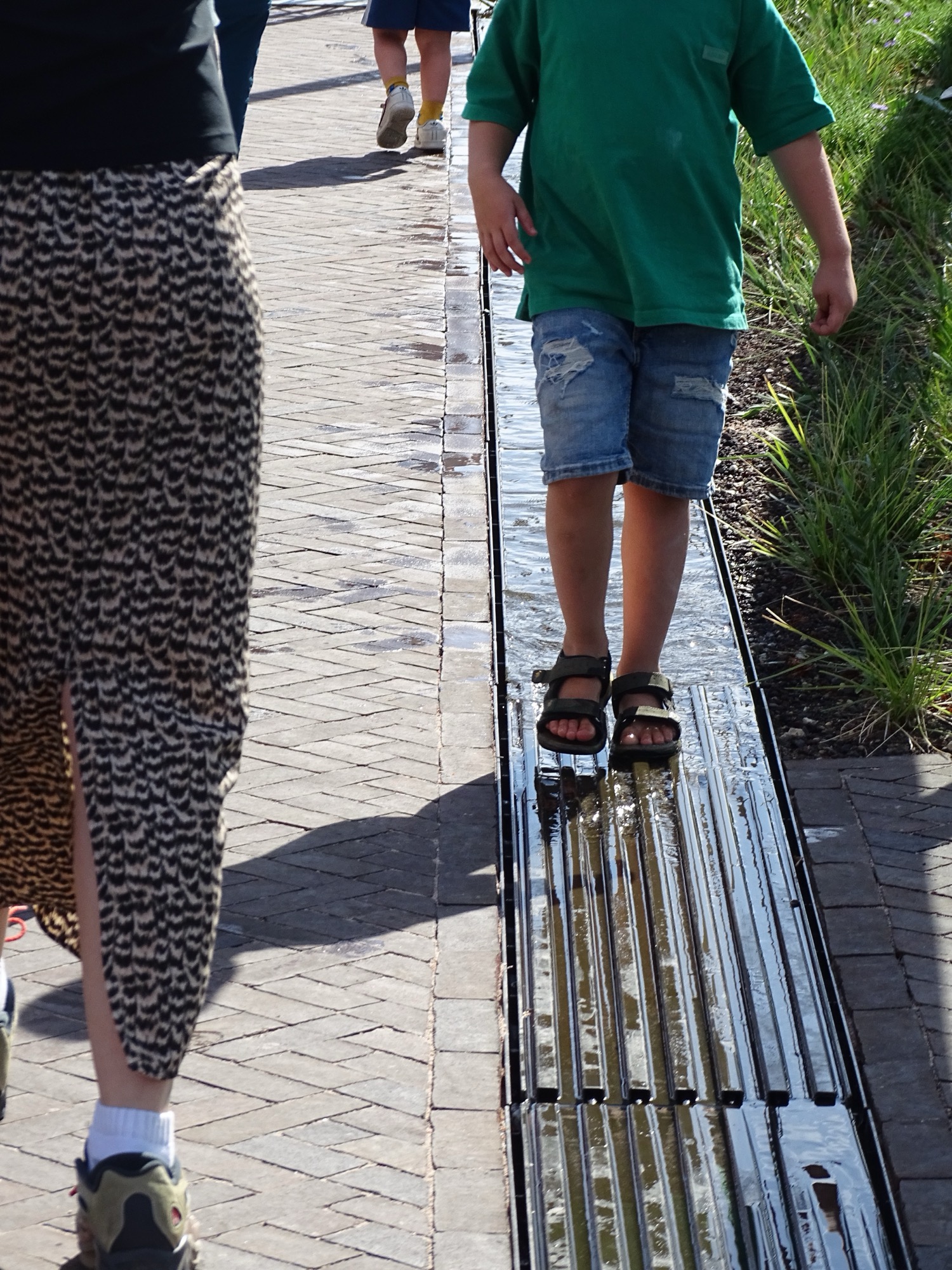
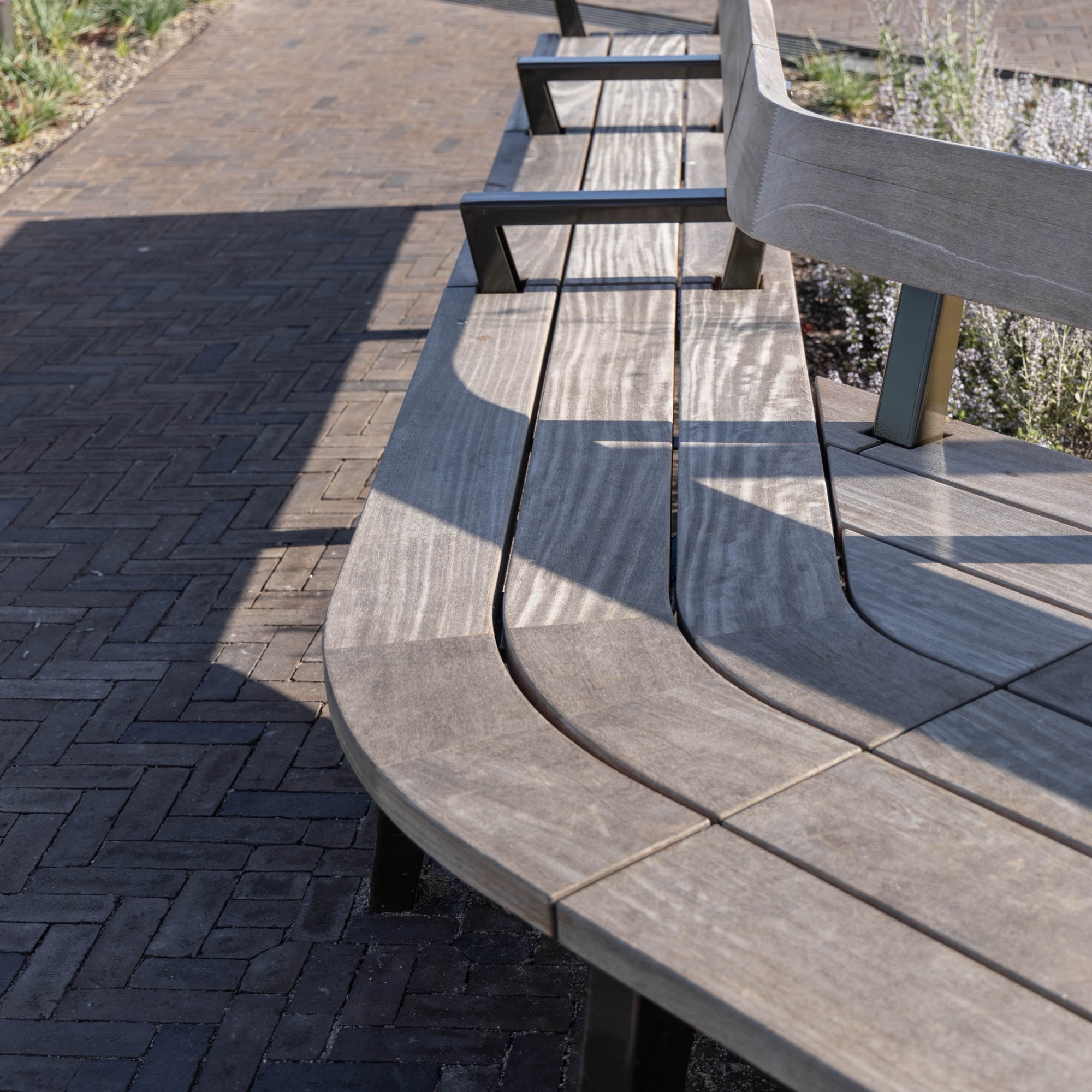
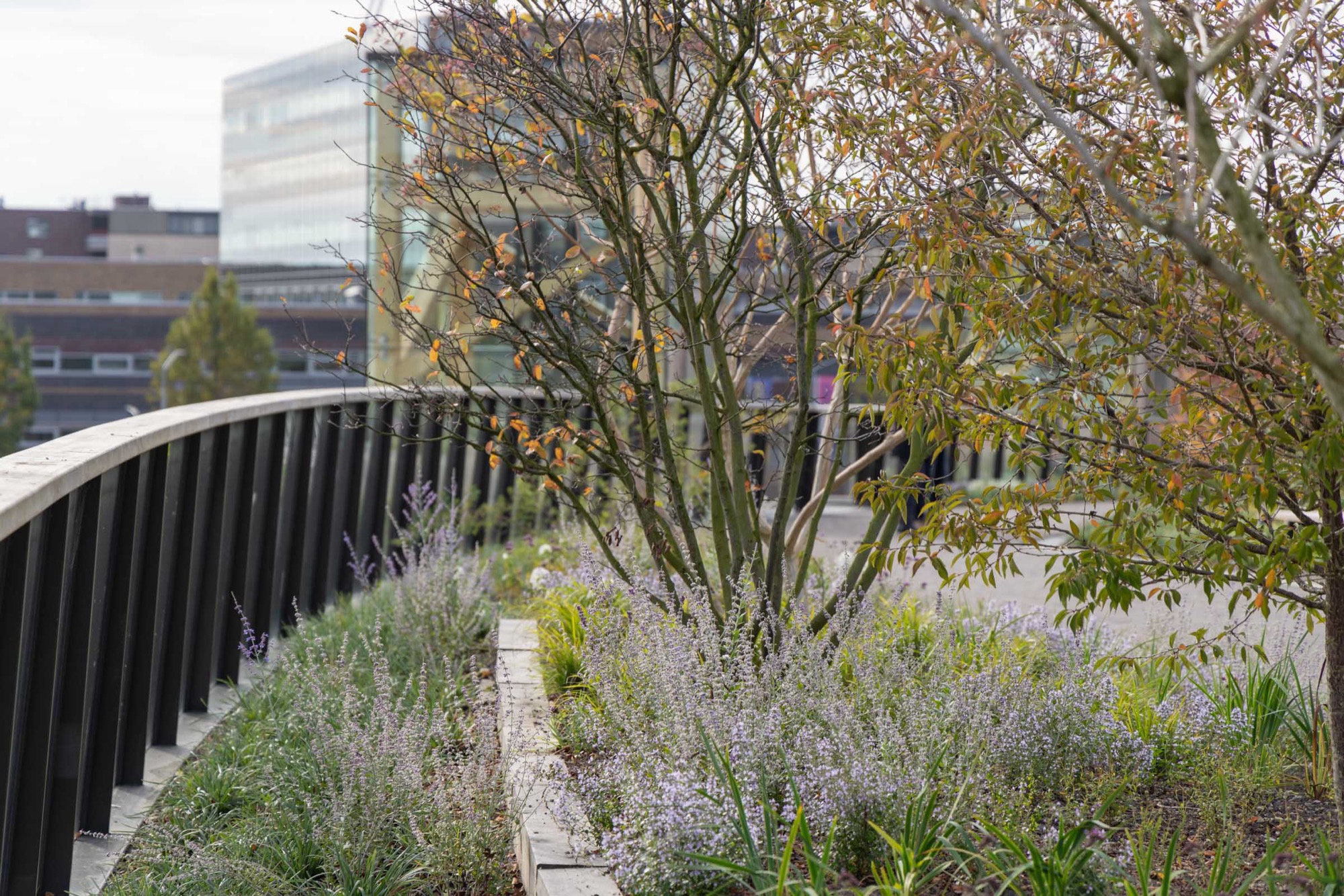
What sets the Passerelle apart is the integration of ecology and use. The bridge functions as an elevated park, where vegetation, water and soil structure are part of the design. The visible water system nourishes plants and contributes to biodiversity, while timber gives the bridge a warm, tactile quality. This creates an environment in which users not only move but also experience seasons and change, connecting neighbourhoods, landscapes and users. Within this context, it has been designed as an inclusive public space. Guidance, integrated seating and clear routing ensure accessibility and social safety for a wide range of users. The combination of spatial clarity, ecological value and quality of stay makes the Passerelle more than infrastructure.
More than a crossing
The Passerelle Zwolle demonstrates how infrastructure can evolve into an urban catalyst. By linking mobility, quality of stay and ecology, a new typology emerges in which infrastructure connects rather than separates. As the first visible result of the wider development of the railway zone, the footbridge marks the beginning of a long-term transformation and to experience the city anew, at eye level.
Municipality of Zwolle [client]
Karres en Brands [coordinating architect, development plan of railway zone, design of layout]
IPV Delft [design]
Miebach ingenieurbüro [engineering]
Pontico [timber and railway expertise]
Municipality of Zwolle [Stationsplein layout and engineering]
Construction Dura Vermeer [construction]
Van Gelder [deck layout]
52.505656, 6.089166
73584


LILA 2026 Sponsor